


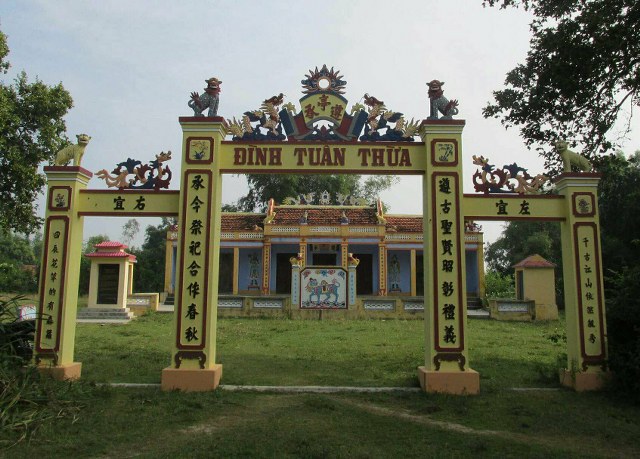
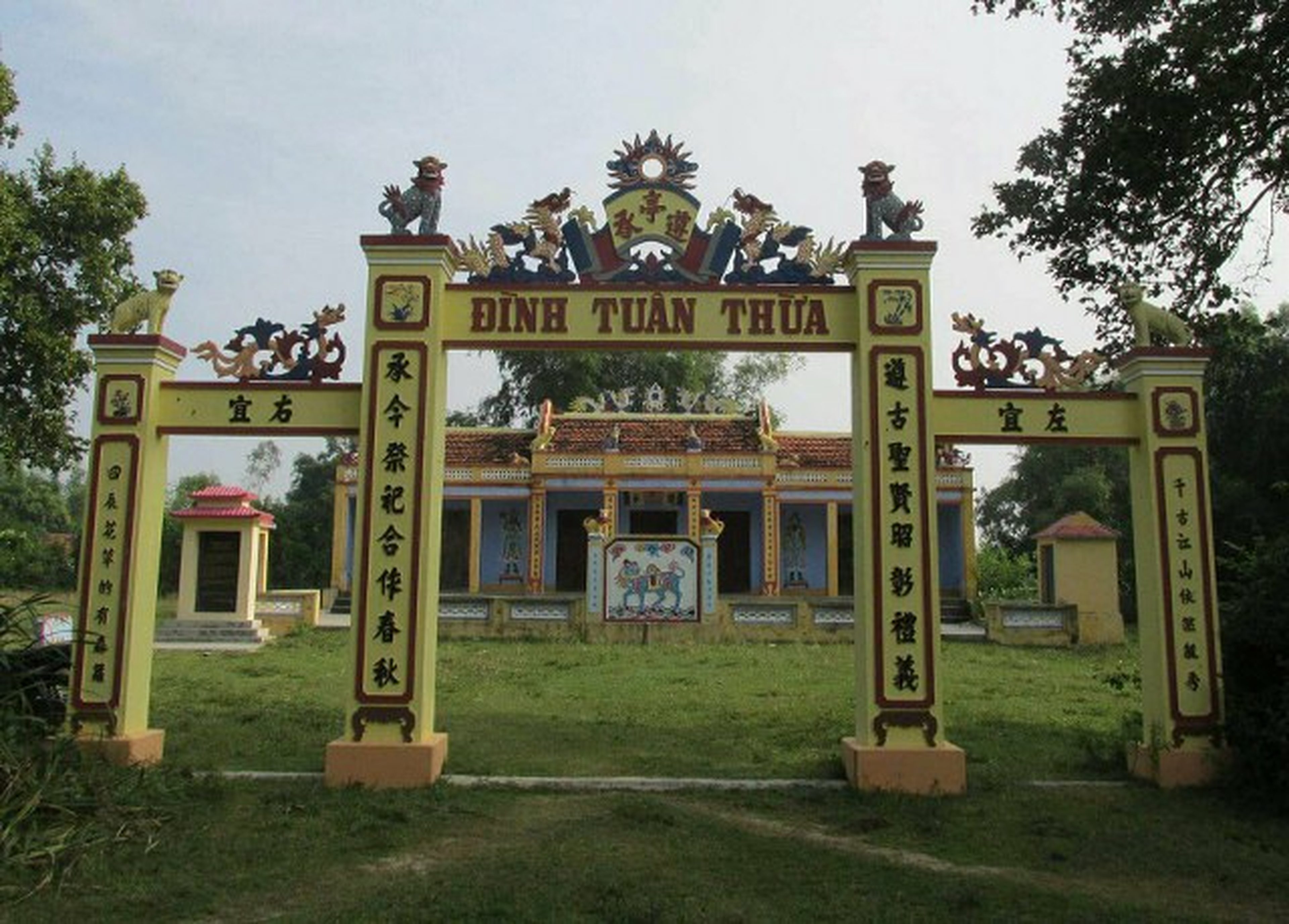
Tuan Thua Communal House is dedicated to the Village Tutelary God and also enshrines the Dai Can Quoc Gia Nam Hai (Great Goddess of the South Sea), the Five Elements Goddess (Ngu hanh Than nu), the Forefathers (Tien hien), the Successors (Hau hien), the Founder of the Craft (Tien su), and the Earth God (Tho cong)…
Since its initial construction, Tuan Thua Communal House has undergone the following renovations and restorations: a major renovation in 1957, roof tile replacement in 1989, and the construction of the ceremonial gate in 2006.
The overall layout of the communal house is as follows: ceremonial gate, screen wall, Muc Dong Shrine, Muc Tuong Shrine, Five Elements Goddess Shrine, main hall (dai dinh), east wing, west wing, Am Hon Shrine (shrine for wandering souls), and kitchen.

Overall site plan of Tuan Thua Communal House
The main hall consists of the front ceremonial hall and the sanctuary. The main door threshold is decorated with scroll patterns bearing Han-Nom characters reading: (亭 承 遵 - Tuan Thua dinh); the columns are inscribed with parallel sentences in Han-Nom, including a pair where the first two characters are derived from the name of the communal house:
Phonetic transcription:
Tuan thu cuu quy mo thon ap khang ninh chuong thinh duc,
Thua nang tang the thuc binh dan hung phat bieu vinh quang.
Translation:
Adhering to the ancient scale, the village remains peaceful and prosperous with glorious virtue,
Following new models, soldiers and civilians rise up to manifest glory.
The sanctuary contains five altars: the central altar is for the Deity, flanked by the Left and Right altars. Against the left side wall of the sanctuary is the altar for the Founder of the Craft and the Earth God, while opposite it on the right side wall is the altar for the Forefathers and Successors. The altar bases are painted with decorative patterns depicting peaceful rural landscapes, phoenixes, and lotus flowers; the columns are decorated with dragon patterns.
Every year, the communal house holds a festival on the 1st and 2nd days of the 3rd lunar month. The festival includes a procession of the imperial edicts from Khanh Long Pagoda to the communal house and a ceremony to return the edicts.
Currently, the communal house still preserves 06 imperial edicts granted by various kings of the Nguyen Dynasty, including:
- Edict from the 2nd year of Thanh Thai (1890) conferring honors upon the Local Tutelary God.
- Edict from the 2nd year of Thanh Thai (1890) conferring honors upon the Four Holy Goddesses of the Great Goddess of the South Sea (Dai Can Quoc Gia Nam Hai tu vi Thanh nuong).
- Edict from the 3rd year of Duy Tan (1909) conferring honors upon the Four Holy Goddesses of the Great Goddess of the South Sea.
- Edict from the 3rd year of Duy Tan (1909) conferring honors upon the Local Tutelary God.
- Edict from the 9th year of Khai Dinh (1924) conferring honors upon the Local Tutelary God.
- Edict from the 9th year of Khai Dinh (1924) conferring honors upon the Four Holy Goddesses of the Great Goddess of the South Sea.
During the resistance wars against French colonialism and American imperialism, Tuan Thua Communal House served as the site for several local revolutionary historical events, including as a military training ground for the local Self-Defense Platoon. In addition, there was a rice granary here to support local revolutionary cadres and soldiers.
In recognition of the historical, cultural, and architectural values of Tuan Thua Communal House, the People's Committee of Khanh Hoa Province issued Decision No. 2994/QD-UBND on November 20, 2009, ranking it as a Provincial-level Historical and Cultural Relic.