


Not all the most worthwhile spiritual experiences in Nha Trang city are found in large-scale pagodas or historical relics located on bustling central streets. Sometimes, the most original and vivid cultural values are quietly preserved under humble communal house roofs and fishing village mausoleums hidden behind small seaside alleys that few passing tourists know by name. The Truong Tay Communal House and Mausoleum relic, located in Vinh Nguyen Ward, is exactly the kind of destination that offers an authentic and profound glimpse into the faith life of the coastal residents of the 'Land of Agarwood'.
Every year, the management board and the elders at the Truong Tay Communal House and Mausoleum organize the Cau Ngu (Fish Worshipping) festival and the communal house ceremony following a rigorous set of procedures passed down through generations. This series of events includes many important, sequential spiritual rituals: from the ceremony to honor the predecessors who pioneered and founded the village, to the ritual of welcoming Ong (the Whale God) from the open sea, the procession of the Goddess to the mausoleum, the Ho Ba Trao singing and dancing, the official worship ceremony of Ong Nam Hai, and the Tong Na ceremony (to cast away misfortune). Such documentary information proves one thing for certain: the Truong Tay Communal House and Mausoleum is not a static architectural structure left to sit idly for sightseers. This is a vibrant community space, a spiritual sanctuary where the coastal villagers practice their faith and preserve the memories of their ancestors regularly throughout every festival season.
Nghinh Ong — The ritual of welcoming the guardian from the ocean
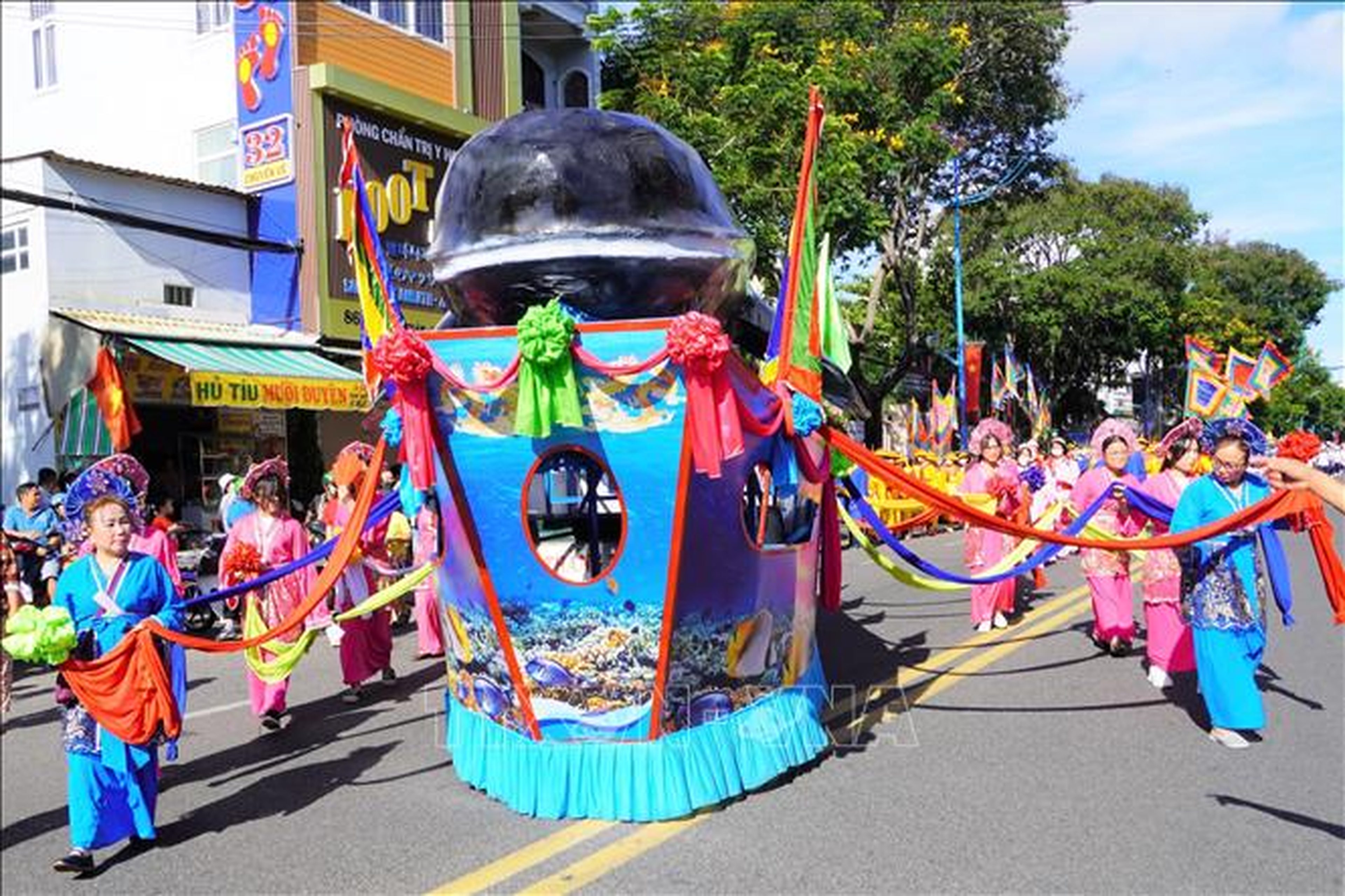
Throughout the entire festival series at Truong Tay, the Nghinh Ong procession is always the part that brings the most intense emotions and visual impact to observers. To the fishing village residents, Ong Nam Hai is not merely a character in abstract religious legends; He is a sacred presence, a real guardian deity amidst the vast open sea, who has protected their ships from the brink of life and death during great storms many times. Therefore, the Nghinh Ong festival carries a sacred significance: it is a welcoming, a deep expression of gratitude, and a sincere prayer for the safety of the entire fishing village.
As the procession begins to move from the sea toward the land, the surrounding space seems to be enveloped in a solemn atmosphere. Every step of the ceremonial team, every beat of the ritual drum, and every flag fluttering in the sea breeze carries a strangely grave rhythm. If you have the opportunity to stand and observe, you must always remind yourself of one core principle: the coastal people are not 'performing' or trying to look good to attract the cameras of tourists. They are fulfilling a sacred spiritual duty to their ancestors and deities with all their heartfelt devotion. This mindset will help you know how to restrain your own behavior: do not crowd, do not run around to find photo angles, and do not turn the solemn ritual space into a stage for your own personal photos.
The harmonious combination of the Communal House and Mausoleum structures in coastal village culture
A unique point in terms of cultural anthropology at the Truong Tay relic is the parallel existence of both the Communal House and Mausoleum structures within the same spiritual space. The communal house is a place to worship the village guardian deities and the predecessors—historical figures who had the merit of clearing the land and establishing the village, representing the Vietnamese moral principle of 'when drinking water, remember its source.' Meanwhile, the Mausoleum is a place to worship the Whale (Ong) and sea deities, tied to the specific livelihoods and characteristic beliefs of the coastal inhabitants. When these two elements are placed side by side and blended together during a festival season, the viewer can see the most complete and holistic picture of how the spiritual life of a fishing village is organized: there is gratitude for the origins of the land-based ancestors, awe and prayers for peace before the open sea, and a tight-knit bond among the members of the community.
What makes the Truong Tay Communal House and Mausoleum even more interesting and worthy of writing about is its geographical location. This space lies right in the heart of a modern, urbanized Nha Trang, surrounded by bustling streets, high-rise buildings, and a fast-paced tourist lifestyle. Yet, beneath that sleek urban veneer, the source of the coastal village's belief system has never been severed or disappeared. It continues to move silently in parallel with the city, adapting skillfully to the new pace of life while firmly retaining the core values and the most important festival days of their forefathers.
Practical tips for visitors who want to delve deeper
If your goal is to attend and fully observe the atmosphere of the Cau Ngu festival at Truong Tay, the first thing you need to do is proactively track the lunar calendar and information from the relic's management board, as the opening date of the festival is usually not fixed to the solar calendar from year to year. When you go, you should plan to arrive early in the morning and choose vantage points along the edge of the processional route or by the communal house courtyard, avoiding standing in the middle of the ceremonial team's main path. Regarding attire, polite, modest clothing in subtle colors is always the optimal choice.
Suggested itinerary for combining the exploration of coastal culture in Southern Nha Trang:
-
5:30 - 7:00: Observe the early fish market rhythm at Cua Be - Vinh Truong.
-
7:30 - 9:00: Move to visit the Truong Tay Communal House - Mausoleum (Vinh Nguyen).
-
9:30 - 11:30: Visit the Nha Trang Oceanography Museum to learn about marine science and marine species.
When taking photos in the communal house - mausoleum space, always remember that the beauty of spiritual photography lies in distance and propriety. Use wide-angle shots to capture the solemn context of the ancient roof, the rhythmic movement of the Ho Ba Trao troupe, or the vibrant colors of the ceremonial flags under the golden sunlight. Absolutely avoid placing the camera close to the faces of those who are devoutly offering incense and praying. This article about the Truong Tay Communal House and Mausoleum in the Spirituality section will serve as a valuable guide, helping readers realize another beauty of Nha Trang: the beauty of a city that knows how to cherish its fishing village memories and how to preserve prayers for peace for ships heading out to the open sea amidst the noise of modern life.