


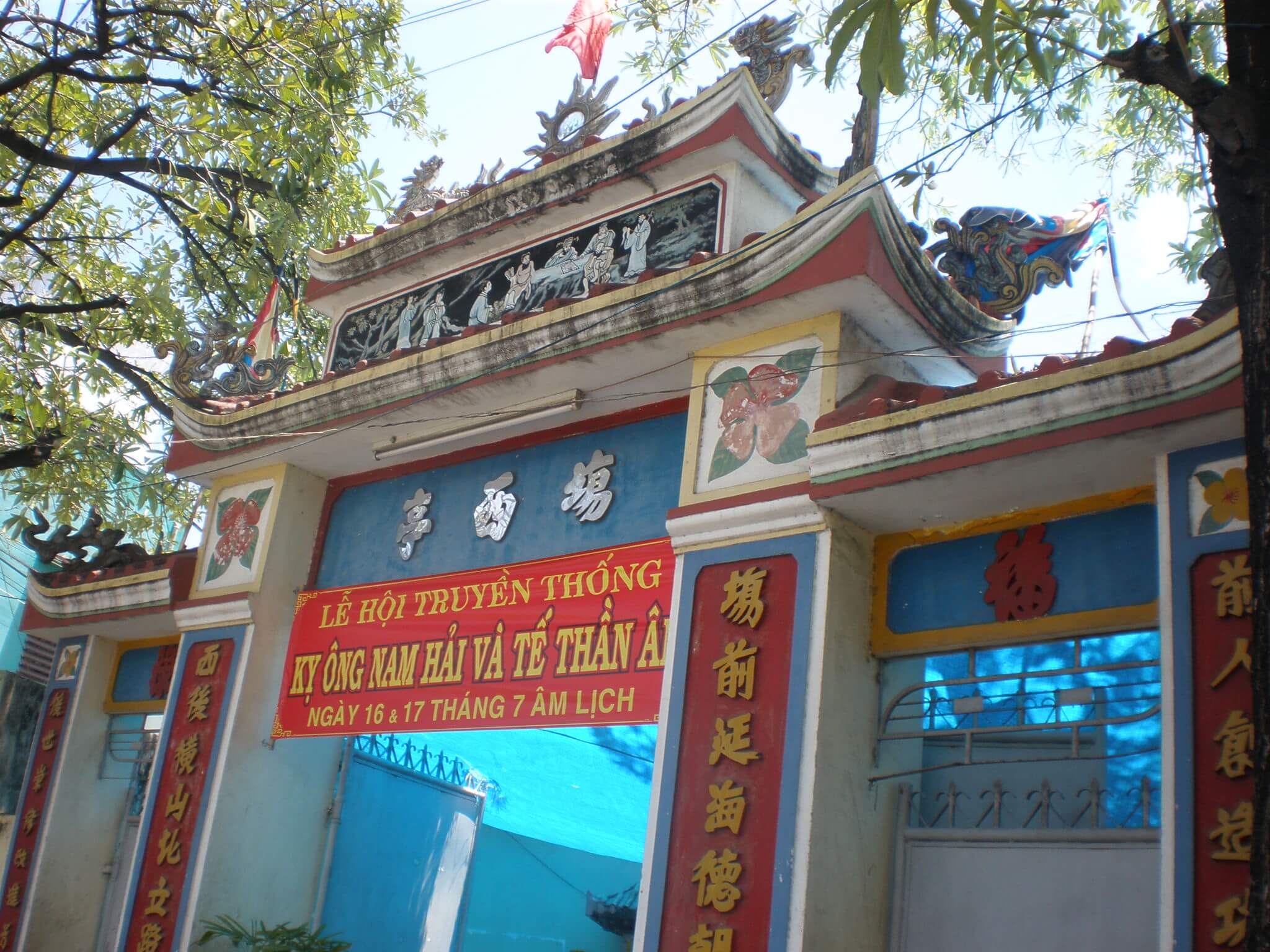
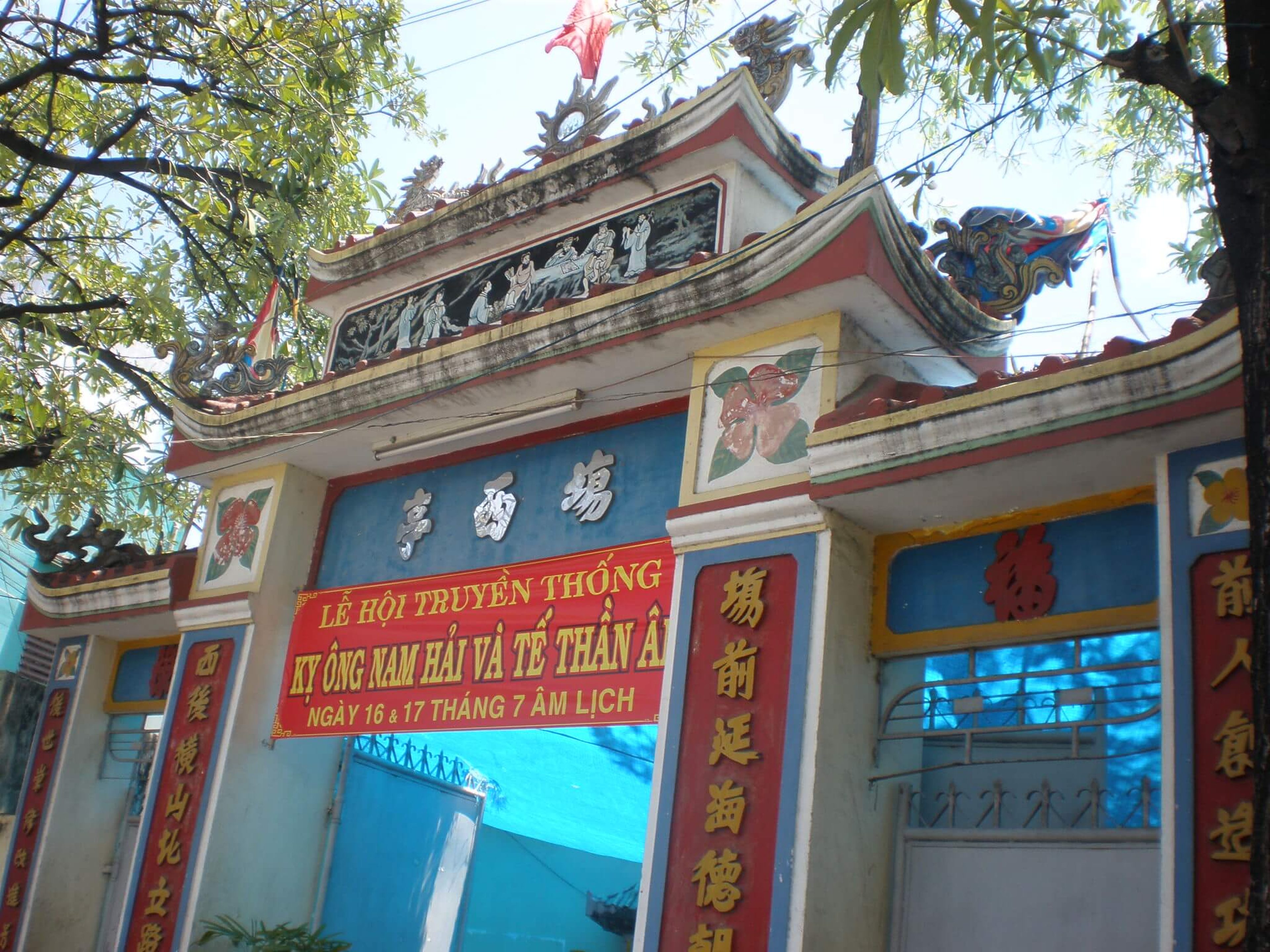
Truong Tay Communal House – Mausoleum is located at No. 73, Tran Phu Street, in Tay Hai residential group, Vinh Nguyen ward, Nha Trang city, Khanh Hoa province. From the beginning of Tran Phu Street heading towards the end of the road, reach Cau Da (Chut), near the Cau Da Villa slope; looking to the left, you will see Truong Tay Communal House – Mausoleum. The heritage site can be reached by both road and sea transport.
 Ba Trao singing
Truong Tay village communal house is not like other agricultural communal houses in Nha Trang. Since the villagers mainly make their living by fishing, besides worshipping the Tutelary God (Thanh Hoang), they also worship Ong Nam Hai (Whale deity). The current location of the communal house - mausoleum was originally the Mausoleum of Ong, while the Truong Tay communal house back then was situated next to the Chut mountain ridge, at the corner of the road leading to Cua Be[1]. In 1943, during the construction of the Nha Trang airport, the Japanese army set off mines to extract stone at Hon Chut (also known as Canh Long mountain). The tremors from the rocks and soil caused the already dilapidated Truong Tay communal house to be at risk of collapse. Faced with this situation, the village elders discussed two options: one was to relocate the communal house to Bau Ong Han[2], and the other was to move it to the Mausoleum of Ong. They decided to relocate the communal house to the Mausoleum of Ong to facilitate worship. In 1958, Truong Tay Communal House – Mausoleum was rebuilt, contained within a single compound and worship space.
Truong Tay Communal House – Mausoleum has a unique feature unlike many other heritage sites: it has two gates, reflecting the specific nature of the site: the western gate is the entrance to the communal house, and the eastern gate is the entrance to the mausoleum. However, the front hall (tien te) and the main hall (chinh dien) face East, the main orientation of the Mausoleum of Ong. The communal house – mausoleum was built on a plot of 602.10 m2, covered with western-style roof tiles, with a raised roof structure, combined with embossed dragon and phoenix patterns, creating ancient lines for the site.
Since 1958, the communal house has undergone several restorations and renovations:
- In 1997, due to the widening of Tran Phu Street, the communal house – mausoleum lost a portion of its land, requiring the western gate to be moved back, a new entrance gate to be built, and the house of the Pioneers (Tien hien) to be moved to its current location.
- In 2003, the theatrical stage (vo ca) was rebuilt.
- In 2006, the Am Hon shrine was built, altars for the Left and Right cohorts (Ta ban and Huu ban) were established in the house of the Pioneers, and the roof tiles of the great hall were re-tiled.
Looking into the site from the East, there are the following structures: the entrance gate and surrounding walls, the spirit screen (an phong), the theatrical stage, the great hall (mausoleum), the house of the Pioneers, the Am Hon shrine, the east house, and the west house.
Truong Tay Communal House – Mausoleum worships the Tutelary God, Ong Nam Hai, the Pioneers, the Successors (Hau hien), and the Am Hon shrine.
Today, Truong Tay Communal House – Mausoleum still preserves horizontal lacquered boards, parallel sentences, incense burners, artifacts, antiques, and nine royal decrees bestowed upon the communal house and mausoleum by the Nguyen Dynasty emperors.
During the two wars of resistance against the French colonialists and American imperialists, Truong Tay Communal House – Mausoleum, like many other village communal houses in Nha Trang, served as a place to harbor revolutionary cadres, a point of contact, and a gathering place for the people to participate in the struggle to protect the Fatherland. The area surrounding the communal house – mausoleum was sparsely populated at that time, and the site itself was nearly desolate, with few passersby. Moreover, it was a convenient location for travel between the mainland and islands, so the site became a secret communication spot for revolutionary fighters and a place to hide weapons and documents.
 Entrance gate of Truong Tay communal house – mausoleum
According to the traditions of the people living along the coast who engage in fishing, whenever a whale (Ong) dies and drifts ashore, they bury it with special, solemn rituals. After two years, they exhume the remains and build a mausoleum to worship the Whale. Truong Tay has had many instances of the Whale drifting ashore, but they only organize two main memorial services. On the altar, there is a very large skeleton of a whale, but it only contains the mid-section. According to the elders, the Whale drifted ashore in three places: the head section in Phan Rang, the mid-section at the Truong Tay mausoleum, and the tail section at the Cu Lao mausoleum (Cu Lao Communal House – Mausoleum, Vinh Tho ward, Nha Trang city).
Every year, Truong Tay Communal House – Mausoleum organizes two ceremonies in the Spring and Autumn, commonly referred to as the “Spring-Autumn biannual ceremonies.” The memorial day for Ong Nam Hai falls on the 25th of the first lunar month each year, so the management board combines this with the Spring ceremony to pray for “national peace and people’s prosperity,” and for fishermen to have smooth voyages and bountiful seasons. Truong Tay Communal House – Mausoleum hosts its largest festival in the Autumn, on the 16th and 17th of the seventh lunar month annually. This is the memorial day for Ong Nam Hai and the Divine Grace ceremony.
Recognizing the typical historical and cultural values of Truong Tay Communal House – Mausoleum, the People's Committee of Khanh Hoa province issued Decision No. 1519/QD-UBND on August 22, 2007, recognizing Truong Tay Communal House – Mausoleum as a provincial-level historical – cultural heritage site.
[1] now the H180 petroleum unit area – Ministry of National Defense.
[2] now the branch location of Khanh Hoa Petroleum Company.
Source: https://disanvanhoa.khanhhoa.vn/