


Trinh Phong Shrine is located in the middle of Phu An Nam 4 village, Dien Khanh commune, Khanh Hoa province. From Tay Nha Trang ward, follow the 23/10 road up to the Thanh Dien Khanh intersection to reach the historical site, located on the left, next to a large Dầu Đôi tree standing imposingly by the 23/10 road.
* The life and career of Binh Tay (Pacify the West) General Trinh Phong
Trinh Phong was born in Phu Vinh village, Xuong Ha canton, Vinh Xuong district[1]. In his youth, he was intelligent and a good student. In 1864, he passed the military examination and was appointed as a Regional Commander (De doc) by the Nguyen Dynasty, serving in Quang Nam.
In 1858, the French colonialists opened fire to invade our country in Da Nang. Subsequently, they occupied the Six Provinces of Cochinchina and had ambitions to capture the territory under the management of the Nguyen Dynasty. Faced with the French colonialists' plot to invade, and with the Nguyen court divided into two factions—the pro-war faction and the pro-peace faction—he resigned from office and returned to his homeland, nurturing his will and waiting for the opportunity to drive out the invaders.
After the Patenôtre Treaty in 1884, Khanh Hoa became a province under the management of the Nguyen Dynasty (belonging to Central Vietnam). In 1885, King Ham Nghi ascended the throne; he was a young, patriotic king supported by Ton That Thuyet, a high-ranking official of the pro-war faction at court. In 1885, the counter-attack at the Hue Citadel commanded by Ton That Thuyet opened fire on the French troops. Although unsuccessful, the Nguyen King and his officials did not abandon their will; Ton That Thuyet brought King Ham Nghi to Quang Tri, preparing for a long-term resistance and issuing the Can Vuong Edict calling on the people of the whole country to rise up to help the King save the nation.
The Can Vuong Edict acted as a unified signal for the patriotic movement in various localities. Across the country, people rose up in resistance in many places, and the movement grew increasingly strong, receiving the response of scholars nationwide.
In Khanh Hoa, Trinh Phong, along with Le Nghi, Tran Duong, Nguyen Khanh, Pham Chanh, Nguyen Di, Nguyen Luong, Nguyen Sum, Pham Long, and Bachelor (Tu tai) Nguyen Trung Muu, were among the gentry and scholars who rose up to establish the “Binh Tay Quoc Cuu Doan” (Pacify the West and Save the Nation Force) with the slogan: “Eliminate small bandits, remove the corrupt, and stabilize national turmoil; Raise the army for a righteous cause to restore the land.” They called on the people to join the insurgent army, contribute food, train soldiers, and forge weapons in preparation for battle against the invading French colonialists.
Thanks to his superior virtue and intellect, Trinh Phong was honored by the insurgent army and the people as Binh Tay (Pacify the West) General, commanding the insurgent forces. In the process of building his forces, militarily, Trinh Phong divided Khanh Hoa into two sectors: the Northern sector commanded by Tran Duong, and the Southern sector directly commanded by himself and Le Nghi. Relying on the rugged terrain characterized by the sea and intersecting mountains, Trinh Phong established a defense system along the coast in Nha Trang, Ro Tuong, Hon Khoi, and Tu Bong, ready to repel French troop landings from the sea. Faced with the spirit of the insurgent army, especially the prestige of Trinh Phong and the other leaders, the forces grew increasingly powerful. The provincial officials then stationed in the Dien Khanh Citadel voluntarily handed over the Citadel and military authority to the insurgent army, and Dien Khanh Citadel became the General Headquarters of the insurgent army. The Can Vuong movement in Khanh Hoa was actively supported by all walks of life, especially in terms of food, supplies, and the mobilization of youth to join the insurgent ranks.
In August 1885, French troops landed at the mouth of the Cu Huan River (Nha Trang). Trinh Phong entrusted the defense of Dien Khanh Citadel to Le Nghi, while he personally commanded the insurgent army to intercept and attack the French at the Cu Huan River mouth, Hon Thom, Hon Da Lo, etc. Thanks to thorough preparations, familiarity with the terrain, and the wholehearted assistance and protection of the people, the insurgent army cleverly lured the enemy deep inland, then utilized guerrilla tactics, dividing and scattering the enemy formations, causing them significant damage.
With intelligence and bravery, the insurgent army defeated the enemy's scheme of a quick war and quick victory. During the initial period, the insurgent army preserved its forces, winning consecutive victories in various places: Ba Ha (Hon Khoi – Ninh Hoa), successfully lifting the siege of Dien Khanh Citadel after 21 days and nights of holding the Citadel, and forcing the withdrawal of the only French military post at Hon Khoi. In December 1885, the Can Vuong insurgent army of Khanh Hoa coordinated with insurgent forces from South-Central provinces to retake the Dien Khanh Citadel and gain control of most of Khanh Hoa province. According to a report by the French Resident Aymonier sent to the Governor of Cochinchina: “...in Khanh Hoa, rebel officials have gained control of the entire province and are organizing the people into military units to protect villages, maintain order...”
After many failed attempts to attack and occupy, suffering heavy losses, the French army adjusted its strategy. In mid-1886, the enemy increased reinforcements from Gia Dinh, concentrated forces to advance and retake Khanh Hoa province, and simultaneously intensified the terrorization of the families of the insurgents, especially the families of the movement's leaders. They utilized espionage and counter-espionage activities, striving to bribe and sow division within the insurgent army, and used traitorous Vietnamese to lead the way and suppress the people, isolating the insurgent army from the populace. After understanding the terrain and with a significant advantage in weapons and tactics, the French army launched many major attacks, frantically massacring the insurgent army, drowning the movement in blood, and seizing several important positions, including the Dien Khanh Citadel.
Faced with the enemy's strength, Trinh Phong withdrew his troops to the North of Khanh Hoa, joined forces with Tran Duong, Pham Chanh, Nguyen Sum, and Pham Long to establish a defensive line at the Hon Khoi sea gate, and built bases at Thung Nha Bui and Hon Heo. When the French army attacked and occupied Hon Khoi, the insurgent army retreated to the base to organize a defense.
Although the insurgent army still fought fiercely, causing some losses to the enemy, due to the enemy's military strength, the movement's resistance gradually weakened. Movement leaders such as Trinh Phong, Tran Duong, Nguyen Khanh, Pham Chanh, Pham Long, and Nguyen Sum were murdered by the enemy, and hundreds of generals and insurgents were imprisoned by the enemy.
The Can Vuong movement in Khanh Hoa was extinguished, but its heroic, steadfast, and indomitable spirit left a deeply profound sentiment in the hearts of the people of Khanh Hoa. The people honored the three leaders of the Can Vuong movement in Khanh Hoa—Trinh Phong, Tran Duong, and Nguyen Khanh—with the title “Khanh Hoa Three Heroes” (Khanh Hoa tam kiet).
The death of Binh Tay General Trinh Phong still carries many different opinions today. However, we can recognize that there are many similarities between the narrative of the enemy's actions and folk tales. At the time Trinh Phong was murdered by the enemy and for a long period afterwards, the French colonial government implemented a very harsh ruling policy; therefore, it is understandable that no one dared to openly bury and build a shrine or temple to worship those who had fallen for the great cause of the nation, especially the leaders of the movements. Regarding Binh Tay General Trinh Phong specifically, the fact that the people used legends to hide his identity from the colonial authorities and legitimize the shrine to worship Trinh Phong, a person who had rendered service to his homeland and country, is a creative and clever way to show grief and gratitude to those who served the nation—a beautiful traditional cultural feature of the Vietnamese people.
* History of the site's formation:
The shrine was established in 1886, associated with a story passed down through folklore as follows: It is said that when Binh Tay General Trinh Phong was defeated and murdered by the enemy, who decapitated him in Ninh Hoa and then brought his head to the Khanh Hoa Provincial Governor at Dien Khanh Citadel to be displayed by the Song Can bridge (now Tran Quy Cap bridge) to intimidate and warn the public. At that time, a woman named Trinh Thi Xuyen[2], secretly brought his head back to her home in Phu Vinh village for burial. On the way, Ms. Xuyen was followed, and fearing the enemy would discover her, she hurriedly hung the cloth bag containing Trinh Phong's head on a fig tree next to the Dầu Đôi tree. The next day, Ms. Tran Thi Dai of Phat Tinh hamlet, Phu An village, passed by the Dầu Đôi tree and suddenly screamed in panic when she discovered a cloth bag containing a human head hanging on the fig tree. The people in the hamlet did not know who the unfortunate person was, but moved by compassion and thinking “death is the final obligation,” they buried it properly, and Ms. Tran Thi Dai asked the village to build a small shrine to worship him.
A long time passed, and almost no one remembered the story above. Suddenly, one fine morning, a man plowing the fields went into a trance (mediumship)(1), ran straight to the foot of the Dầu Đôi tree, and identified himself as Trinh Phong, who had been murdered by the enemy, decapitated, buried by the villagers, and honored with a shrine, and now wished to express his gratitude. After speaking, the man fainted for a long time; when he awoke, he did not know why he was lying right at the foot of the Dầu Đôi tree, and he was unaware of what he had said.
Through the above legend, the local people believed that the head in the cloth bag hanging on the fig tree all those years ago was indeed the head of Trinh Phong. From then on, the small shrine by the Dầu Đôi tree was discreetly called Trinh Phong Shrine by the people. Adjacent to the site is a Dầu Đôi tree that is several hundred years old and associated with many local historical events, so the people often used the tree's name to name the site: Dau Doi Tree Shrine, which is the folk name of Trinh Phong Shrine.
 Royal decrees preserved at Trinh Phong Shrine
The shrine was granted a royal decree by King Thanh Thai in his 13th year (1901) for “Dai Duc Khoi Tinh,” and later in the 9th year of King Khai Dinh's reign (1924), it was further granted a decree with the honorific title: Duc Bao Trung Hung Linh Pho Thuan Chinh. This allows us to infer that Trinh Phong was a leader of the Can Vuong movement, which was strongly suppressed by the French colonialists, with its leaders executed to intimidate the fighting spirit of the people; at this time, the feudal Nguyen court was dependent on France and had its power manipulated by the French. Therefore, on one hand, the court was under the control of the French colonialists, but on the other hand, it still held a positive view of the Can Vuong movement. Thus, the succeeding kings after King Ham Nghi granted royal decrees to places worshipping those who had served the country and fallen for it, but they did not dare and could not write the actual names, using only the honorific title “Dai Duc Khoi Tinh” to implicitly refer to the hero who sacrificed himself for the nation. That is understandable and sympathetic towards the reigning kings during a period of many fluctuations in our country's history.
 Trinh Phong Shrine today
Over time, the shrine has been restored and renovated many times. Initially, it was just a small shrine made of thatch and bamboo. The largest renovation took place in 2003, on the occasion of the 350th anniversary of the founding of Khanh Hoa province. Trinh Phong Shrine received funding for the restoration of several items: building a wall surrounding the site, the ceremonial gate (nghi mon), the front hall (bai duong), the main sanctuary (chanh dien), and the Eastern house. In 2013, the roof was restored, and some wooden pillars in the front hall were replaced.
* Features of the site:
The Trinh Phong Shrine site has a total area of 639.1m2. The shrine is built with an architectural style of one main bay and two lean-tos; the three entrance doors are designed in the traditional upper-lattice, lower-panel style, and the wooden frame structure reflects the traditional features of Khanh Hoa sites. The front hall is paved with Bat Trang tiles, raised about 30cm above the courtyard, with no surrounding walls, and features 4 rows of columns consisting of 4 main pillars and 14 support pillars. The four main pillars form two sets of roof truss structures; the auxiliary rafters and purlins are mortised from the main pillars and extend to the ends of the support pillars. The roof system is covered with yin-yang tiles, and the roof ridge is decorated with a “Two Dragons Chasing the Moon” motif. In the center of the front hall stands a simple wooden altar that exhibits an ancient and solemn appearance.
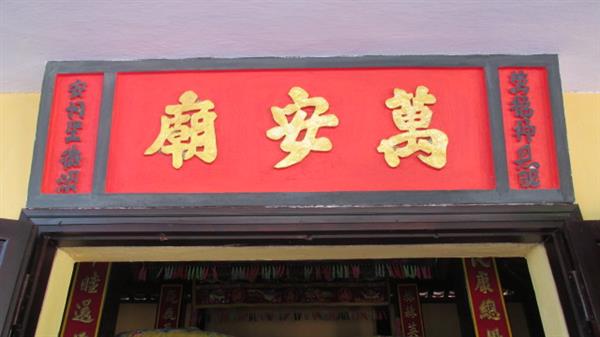
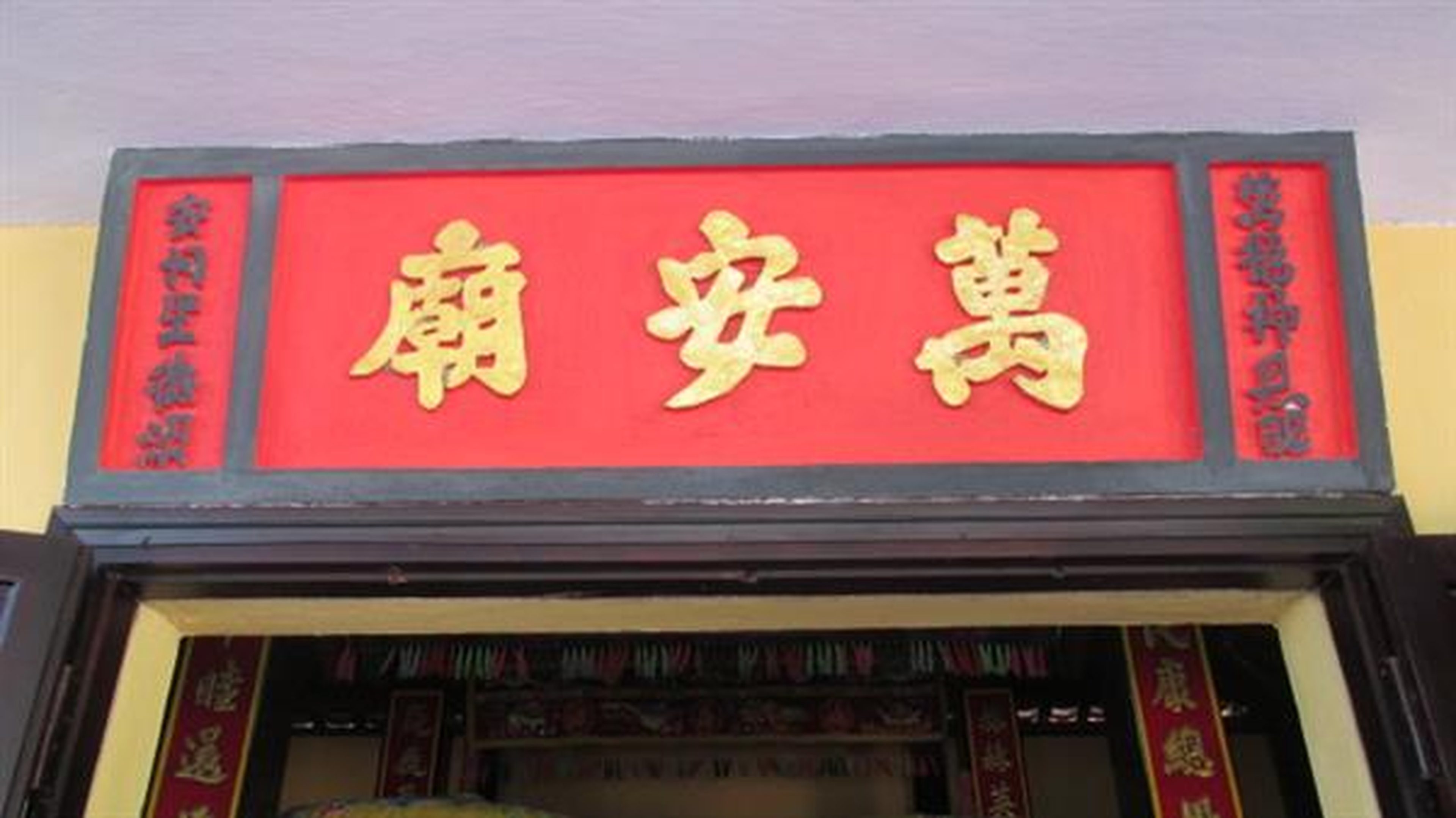
 Horizontal lacquered board (hoanh phi) inscribed with Chinese characters "Van An mieu" at Trinh Phong Shrine
The main sanctuary hangs a wooden horizontal lacquered board (hoanh phi) inscribed with Sino-Nom characters “Vạn An miếu”. The door system is designed in the upper-lattice, lower-panel style. In the center of the main sanctuary stands a communal altar, flanked by a pair of cloth ceremonial umbrellas, and above the altar hangs a cloth hanging banner (chan). Adjoining the rear gable wall is a wooden altar cabinet (kham tho) meticulously carved and inscribed with the Sino-Nom character “God” (神). Four square wooden pillars support the roof of the main sanctuary; the pillars are carved with two pairs of couplets in Sino-Nom characters and are painted in red and gold, with floral patterns carved above. The ends of the rafters are also stylized to create a soft aesthetic at the site. Inside the main sanctuary hang two pairs of couplets praising the virtues of Trinh Phong:
Transliteration:
Hách trạc thần công linh hữu trợ,
Hinh hương tự điển giác đồng vinh.
Translation:
The people are helped by the brilliant, sacred work of the god,
Achieving such glory through fragrant ritual codes.
Transliteration:
Võ kiếm cung thao lược võ bình tây thăng đại tướng,
Văn kinh sử trí tri văn Khánh tỉnh xuất trung thần.
Translation:
With martial sword and strategic skills, pacifying the West, promoted to General,
With literary classics and wisdom, Khanh Hoa province produces a loyal subject.
 Altar at Trinh Phong Shrine
Every year, the site organizes a Spring worship ceremony on the 16th day of the 3rd lunar month. A grand ceremony is held every three years.
Currently, Trinh Phong's grave is located in Phu Vinh village, Vinh Thanh commune, Nha Trang city, Khanh Hoa province. In the grave area, besides his grave, there are 2 graves belonging to his parents. The grave area was renovated in 2005 and 2012.
Recognizing the historical and cultural values of the site, in 1991, the Ministry of Culture and Information issued Decision No. 1548 – QD on August 30, 1991, designating Trinh Phong Shrine as a National Historical-Cultural Site.
[1] now is Phu Vinh village, Vinh Thanh commune, Nha Trang city.
[2] a nephew of Trinh Phong, who served him throughout the time he led the insurgent army to fight the French.
Source: https://disanvanhoa.khanhhoa.vn/