


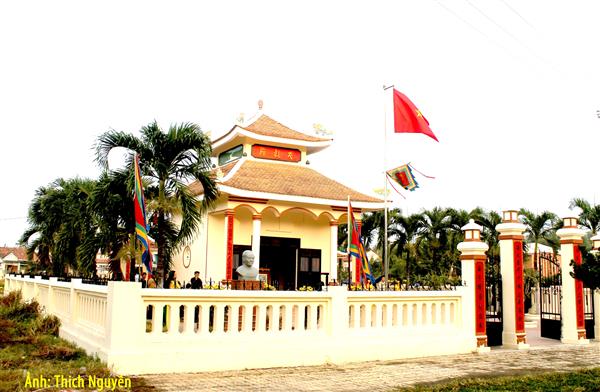
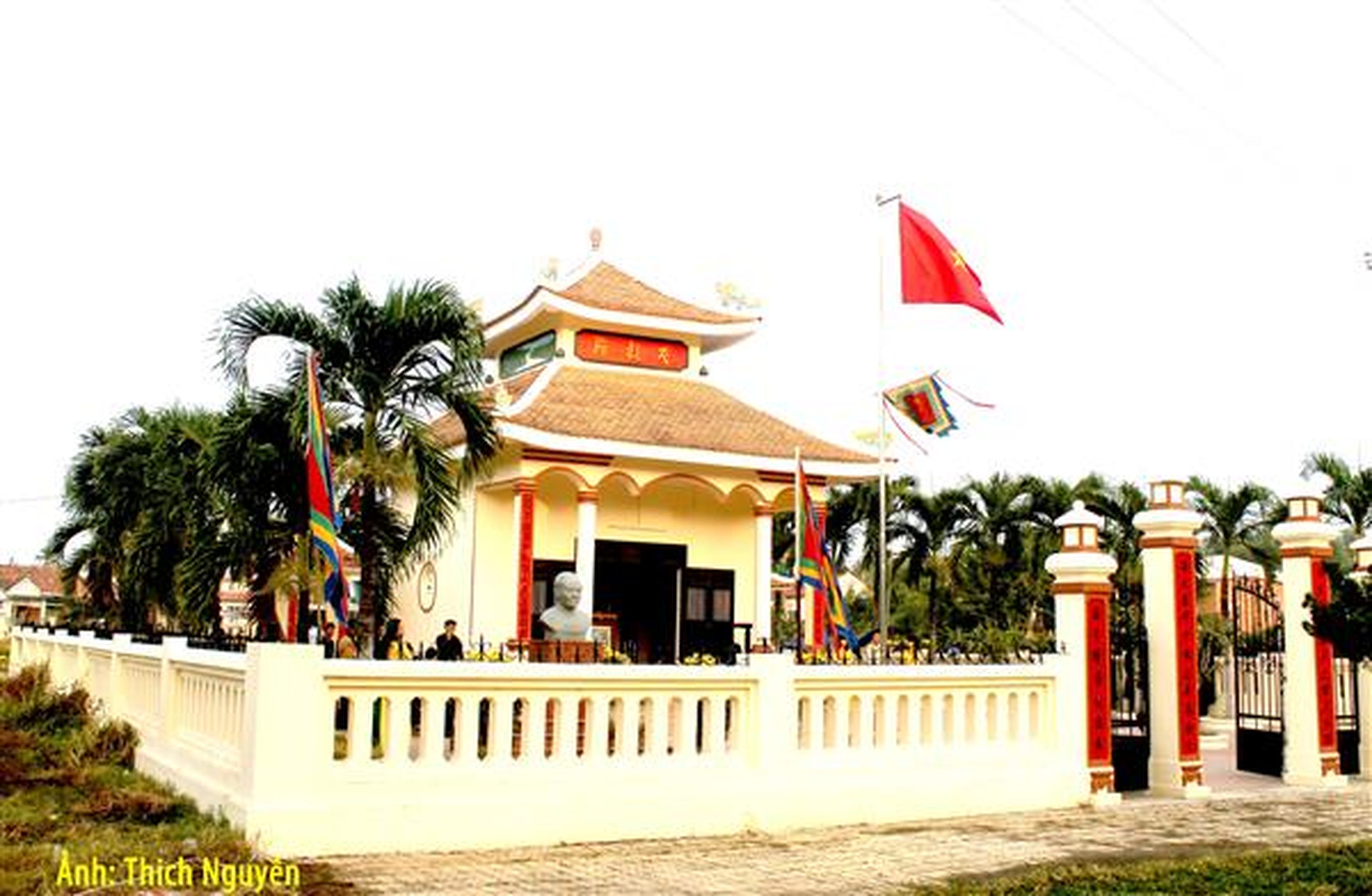
Tran Quy Cap Temple is located in Dien Khanh Commune, Khanh Hoa Province. The temple was built in the Go Chet Chem area, approximately 50 meters south of the Song Can Bridge (now Tran Quy Cap Bridge) and 1 kilometer northwest of the Dien Khanh Citadel relic.
Tran Quy Cap, whose courtesy name was Thich Phu and pseudonym was Thai Xuyen, was born in 1870 in Thai La Hamlet, Bat Nhi Village, Dien Ban District, Quang Nam Province. From a young age, Tran Quy Cap showed himself to be intelligent, a diligent student, eager to learn, and possessed of great spirit. Born and raised in a period of great upheaval in Vietnamese society, he witnessed the funeral of Governor-General Hoang Dieu at the age of 13 when the Thang Long Citadel fell (1882); three years later, he witnessed the scholars and literati in his hometown responding to King Ham Nghi's patriotic Can Vuong movement.
In 1904, he took the doctoral examination and passed alongside Huynh Thuc Khang[1]. At this time, Confucianism was in decline in our country, while the New Learning movement was beginning to emerge. Tran Quy Cap frequently associated with Phan Chau Trinh and Phan Boi Chau, studying new books and publications, exploring progressive ideas, and promoting New Learning through educational reform to raise public awareness, civil rights, and national self-reliance. In Quang Nam, Phan Chau Trinh and his comrades, including Tran Quy Cap, founded the Duy Tan (Renovation) Society. The Duy Tan Society selected many outstanding youths to send to Japan for studies, intending for them to serve as the core of the nation's revolutionary movement in the future. Together with other intellectuals in the region, Tran Quy Cap established the "Tan Hoi Hoc" (New Association for Learning), which received widespread support from the people.
In 1906, he and several others established agricultural associations, trade associations, and schools. He also wrote poems and songs encouraging trade, agriculture, and land reclamation to engage in agricultural production using new, progressive methods. The "Song of Soul-Calling for the Nation," also known as the "Encouragement of Learning" (learning to become self-reliant), called on everyone to learn the Vietnamese alphabet (Chu Quoc Ngu) to raise the intellectual level of the people.
He opened New Learning classes and brought in teachers to teach the Vietnamese alphabet and French right at the Prefecture school. He made many contributions to the Duy Tan movement, constantly promoting New Learning, rejecting the old examination system, and eliminating obsolete customs. For this reason, feudal officials used the excuse of transferring him to Tan Dinh (in present-day Ninh Hoa town, Khanh Hoa) to serve as an Education Instructor. Here, he continued to maintain contact with friends in his hometown and pursue his aspirations. Local officials were extremely resentful and sought every means to harm him; they often sent secret agents to track him and closely monitor his letters and papers. Once, upon receiving a letter from home informing him of the people's struggle, he wrote seven characters on it: "ngo dan thu cu, khoai khoai khoai" (my people are rising, joyful, joyful, joyful). Seeing this as a major opportunity to eliminate the man they had been tracking for so long, they arrested him while he was teaching and imprisoned him at the Dien Khanh Citadel jail—which was the capital of Khanh Hoa at that time. Tran Quy Cap's sentence was quickly approved: Conspiracy to betray the country, to be punished by "decapitation and exposure of the head."
At exactly 9:00 AM on June 15, 1908 (the 17th day of the 5th lunar month), in the Go Chet Chem area, about 50 meters from the current temple, Tran Quy Cap was taken to be executed. Tran Quy Cap demonstrated a brave and upright attitude in the face of death without the slightest fear. When led by the enemy to the execution ground, Tran Quy Cap remained calm; he tore off his blindfold, requested an incense altar to be placed facing North, bowed to thank his hometown, then bowed to thank his compatriots, greeted those who came to bid him farewell, and heroically offered his head for the blade, his face expressionless and serene, just as it was when he taught books or discussed literature with his students.
Faced with the death of Tran Quy Cap, not only were the people deeply saddened and indignant, but even the officials and public servants of the time felt pained and admired the will of the patriotic martyr.
Although Tran Quy Cap was not born and raised in Khanh Hoa, his life, career, and passing are linked to the land of the Land of Agarwood. Clearly, the life and career of a renowned figure do not belong to any single person; he belongs to the Fatherland, to the heroic people of Vietnam!
For that reason, the people of Khanh Hoa grieve for him, and the people of Vietnam weep for his soul. His whole life was dedicated to the people and the nation, wholeheartedly committed to a great ambition: to modernize the country so that our people could progress and develop in every aspect.
The Fatherland is grateful to him, and the people remember him with affection. Today, his name is given to streets and schools across the country. In 1970, the people of Khanh Hoa built a temple to worship Tran Quy Cap, along with the two leaders of the Can Vuong movement in Khanh Hoa, "Binh Tay" General Trinh Phong and Military Advisor Nguyen Khanh, by the Song Can bridge, called the "Trung Liet Dien" (Temple of Loyal Heroes). The temple is located in an area popularly known as "Go Chet Chem" – the place where the enemy had once murdered so many patriots and Can Vuong soldiers. At that time, our country was still at war against the American imperialist invaders, so the construction of the Trung Liet Dien temple carried the significant meaning of encouraging the patriotic movement against foreign invaders and upholding the examples of those who bravely sacrificed themselves for the Fatherland.

Overall layout of Tran Quy Cap Temple
In 2003, on the occasion of the 350th anniversary of the founding of Khanh Hoa province and to facilitate the rebuilding of the Song Can bridge (now Tran Quy Cap bridge), the temple was relocated further inward, about 50 meters from the old temple site. The temple was restored on a larger scale. The temple covers an area of 54m2; in the courtyard stands a flagpole over 3 meters high. It was built relatively simply but still follows traditional architectural structures, such as having a bell tower, decorative dragon patterns on the roof corners, and roofs tiled with dragon-scale tiles. The temple faces East, and several ornamental trees are planted around it to create an elegant, simple, and intimate landscape. Beside the temple stands an ancient "long muc" tree, which marks the crimes of the colonial-feudal regime that executed many soldiers in our country's revolutionary movements; above the front of the temple, the three characters "TRUNG LIET DIEN" are embossed.

The altar and door system are designed entirely of wood, giving them an ancient and warm appearance. On the altar are placed three spirit tablets worshiping the martyr Tran Quy Cap, "Binh Tay" General Trinh Phong, and Military Advisor Nguyen Khanh. Above the main hall, four Chinese characters "Trung Nghi Cam Nhan" are inscribed, meaning: "The heart of loyalty and righteousness has inspired everyone." On both sides of the altar are embossed couplets praising the spirit of the patriots:
Transliteration:
Vi than ho, vi gia ho, vi thien ha ho, thien chi anh hung do vi bach
Thu thien gia, thu dia gia, thu giang son gia, oan ham tuyen nguong (..) nang minh
Translation:
For the self, for the family, or for the world, the heroic aspiration is yet to be revealed
This heaven, this earth, this nation, the injustice held in the underworld shall eventually be made clear.
The two side walls feature images of the tomb in Tran Quy Cap's hometown and poems by his peers mourning Mr. Tran upon hearing the news of his execution in Khanh Hoa.
Every year on the 16th day of the 5th lunar month, a memorial ceremony is held at Tran Quy Cap Temple to honor Mr. Tran Quy Cap and pay tribute to past generations; at the same time, it is an occasion to review the "When drinking water, remember its source" tradition of the Vietnamese people.
In recognition of Tran Quy Cap's contributions and sacrifice for the nation, in 1991, Tran Quy Cap Temple was ranked as a National Historical-Cultural Relic by the Ministry of Culture and Information (now the Ministry of Culture, Sports and Tourism) under Decision No. 1548–QD dated August 30, 1991.
[1] currently, the stele recording the names of the doctors still exists in the ancient capital of Hue.
Source: https://disanvanhoa.khanhhoa.vn/