


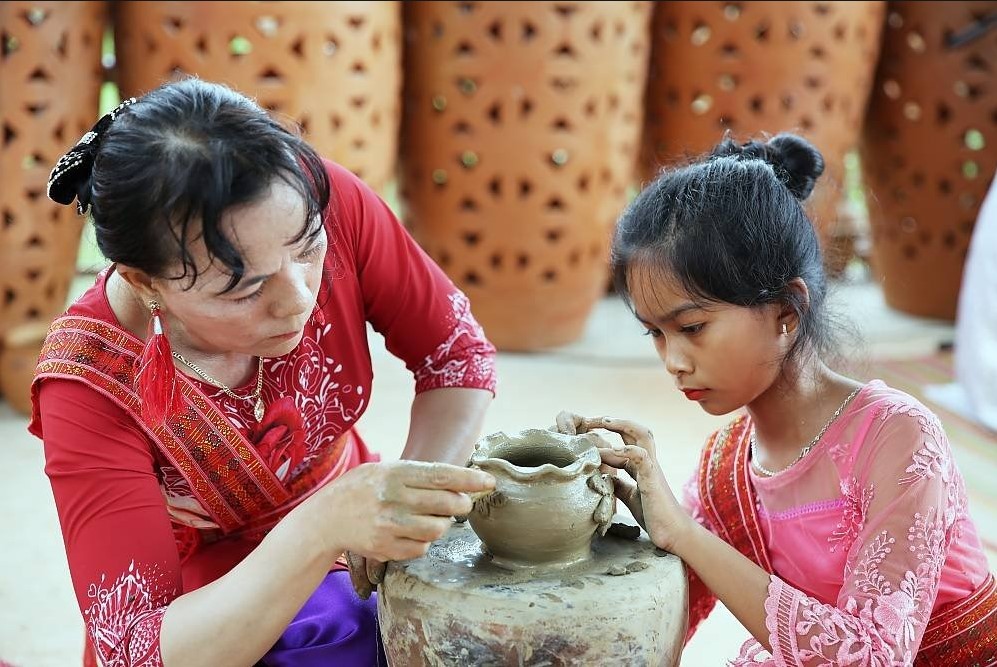
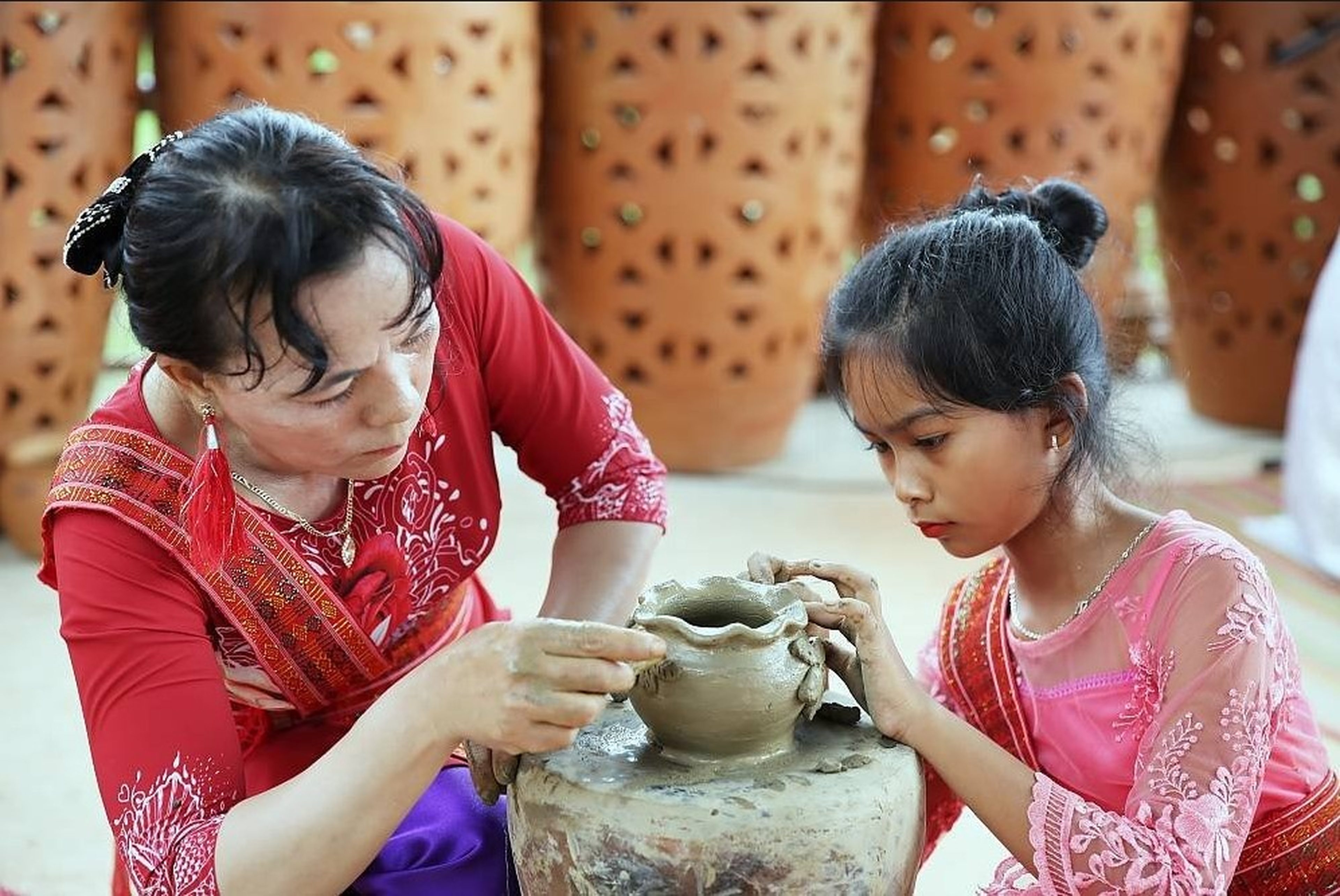
Cham pottery consists mainly of household items, ritual objects, and artistic pieces including jars (jek), pots (gok), trays (cambak), and vases (bilaok)… The craft of pottery is seen as an expression of personal creativity produced by Cham women based on knowledge passed down within the community. Instead of using a potter's wheel, Cham women move backwards around the raw material to shape the product. The pottery is unglazed and sun-dried, then fired outdoors with wood and straw for 7 to 8 hours at a temperature of approximately 800°C. Materials (clay, sand, water, wood, and straw) are sourced locally. The clay is regenerated in a cycle of every few years after being extracted from the Hamu Tanu Halan field, on the banks of the Quao River in Bau Truc village (Ninh Thuan province) and the clay mine of Xuan Quang village (located 3km northwest of Binh Duc village, Binh Thuan province). Pottery tools are simple, with artisans utilizing materials on-site such as scraping rings (made of bamboo) to thin the pottery body, and shells and water-soaked cloth to smooth the surface. Knowledge and skills in pottery making are passed down to generations within the family through practice. Practicing the craft provides opportunities for Cham women to socialize and interact during production and daily life, as well as in educating their children, further elevating their role in society. Pottery making also helps increase family income and preserves traditional customs and the cultural identity of the Cham people in Vietnam. However, despite many safeguarding efforts, the Cham pottery craft is still at risk of disappearing due to the impact of urbanization on access to raw materials, slow adaptation to the market economy, and the younger generation's lack of interest in the craft.

Photo: Documentation from the Department of Cultural Heritage
According to the Intergovernmental Committee for the Safeguarding of the Intangible Cultural Heritage, the nomination file for the intangible cultural heritage 'Art of Cham pottery' meets the following criteria for inscription on the List of Intangible Cultural Heritage in Need of Urgent Safeguarding:
1. This heritage relates to the traditional hand-crafted Cham pottery trade using simple tools. The cultural subjects and practitioners are mainly Cham women. Knowledge and skills of the craft are passed down within families, lineages, and the community. Transmission is carried out through storytelling and daily practice. The heritage attracts exchange and interaction among practitioners, social activities, and enhances the role of Cham women in modern society. The heritage is linked to folk performing arts, customs, beliefs, and festivals, including rituals related to the ancestors of the Cham pottery craft. The Cham pottery craft contributes to preserving the Cham cultural identity in Southeast Asia.

Photo: Documentation from the Department of Cultural Heritage
2. The file indicates that currently, the number of artisans, practitioners, and apprentices in pottery villages is low. Despite many safeguarding efforts, the heritage is still at risk of disappearing due to various threats such as urbanization affecting the space of traditional craft villages and the availability of raw materials, rising costs of materials, the advanced age of skilled artisans, the lack of interest among the younger generation, the lack of product diversity, and the impact of the COVID-19 pandemic.
3. The file presents a detailed plan for safeguarding the heritage, which will be implemented over four years (2023–2026). The objectives for each year, specific activities, and expected results are clearly presented in the file. The proposed safeguarding activities aim to address the challenges mentioned in criterion U.2 and include training, documentation, addressing issues related to raw materials, and creating sustainable livelihoods for practitioners. The file includes a timetable and a detailed budget.
4. The community, groups, and individuals involved participated in the nomination process by providing information and contributing to the inventory process. Many community members were involved in filming and photographing the pottery-making process and rituals for the craft ancestors. Furthermore, 354 artisans agreed to the nomination of this heritage to the List of Intangible Cultural Heritage in Need of Urgent Safeguarding. The file states that visitors wishing to participate in the ritual for the craft ancestors must comply with certain customary rules.
5. The heritage is included in the National List of Intangible Cultural Heritage and the National Inventory Report on Intangible Cultural Heritage on the Information Management System for Intangible Cultural Heritage of the Department of Cultural Heritage. Departments and research institutes carry out inventory at provincial, city, and national levels. The file notes that the inventory of the heritage attracted the participation of the community in Bau Truc and Binh Duc villages, in coordination with the Departments of Culture, Sports and Tourism of Ninh Thuan and Binh Thuan provinces, and the Center for Cham Culture Research and Display (Ninh Thuan province) in surveying, inventorying, filming, and photographing. The inventory results are updated annually, before October 31.
The Art of Cham pottery is Vietnam's 15th intangible cultural heritage to be inscribed on UNESCO's lists. On behalf of the State Party with the inscribed heritage, Assoc. Prof. Dr. Le Thi Thu Hien, Director of the Department of Cultural Heritage, representing the Ministry of Culture, Sports and Tourism, delivered a response speech, committing to implementing measures to protect the values of the Cham pottery craft, and thanked the Evaluation Body, the members of the Intergovernmental Committee, and the Secretariat for their dedicated work in inscribing this heritage of Vietnam.


Photo: Thu Trang