


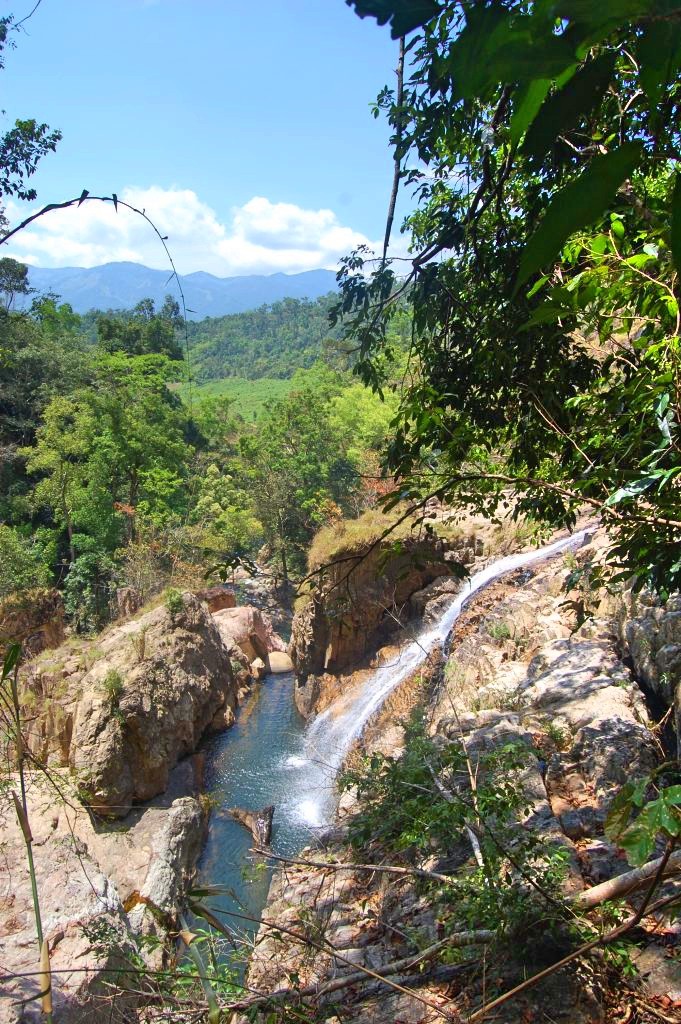
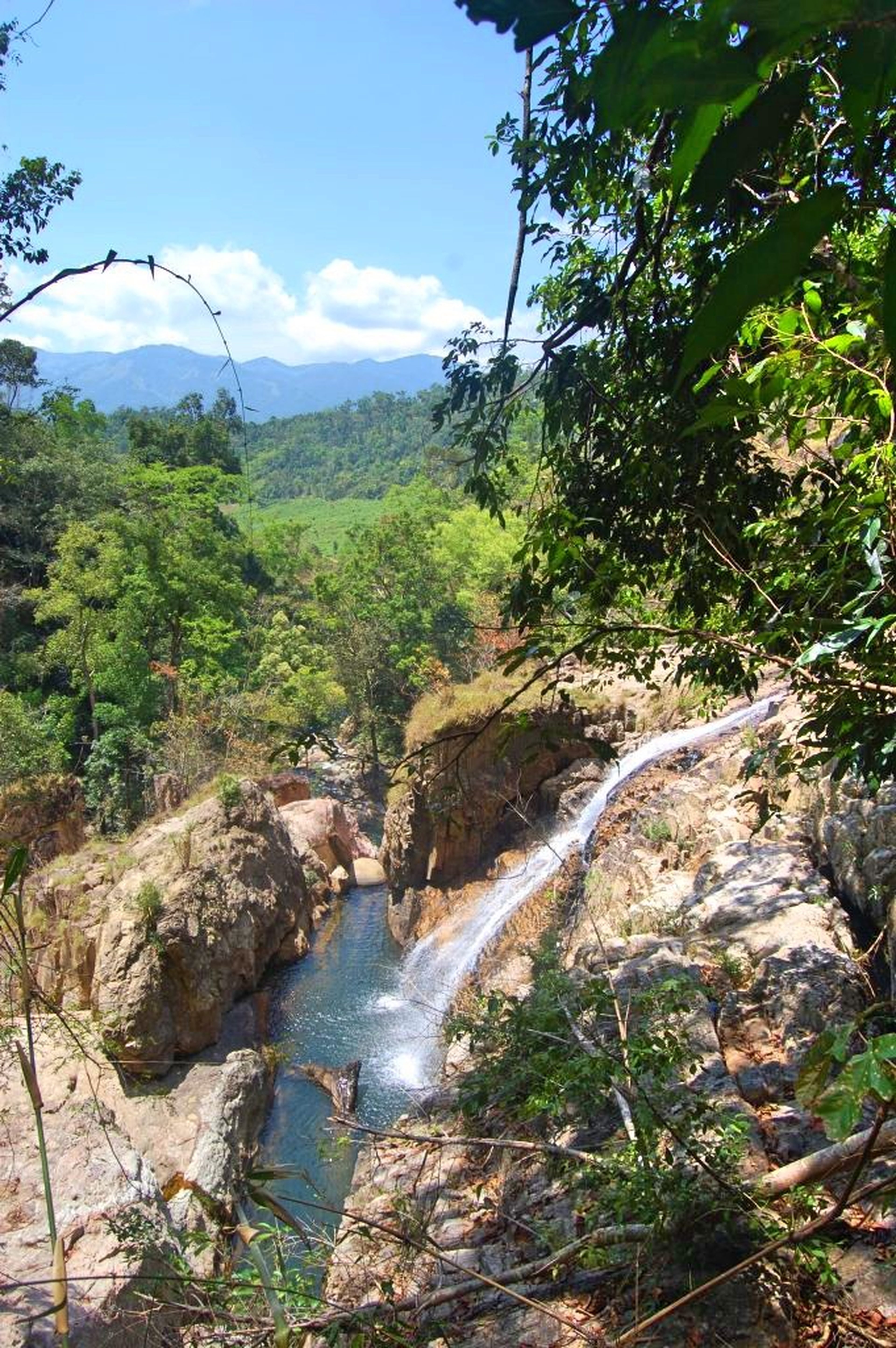
Ta Gu Waterfall is located in Ta Gu Village, Son Hiep Commune, Khanh Son District, a mountainous district in the west of Khanh Hoa Province. The scenic spot of Ta Gu Waterfall also goes by other names: Ta Gu Waterfall, Ru Gou Waterfall, and Ru Gu Waterfall. In the Raglai language, the word "Ta" means stone, and "Gu" means standing; together they mean "standing stone." However, it is phonetically transcribed and commonly known as Ta Gu, a name that has become popular today.
Khanh Son is situated in the western, southwestern, and southern mountainous regions of Khanh Hoa, located between latitudes 11°48’30” to 12°10’40” North and longitudes 108°41’ to 109°17’ East. It is a vast mountainous area with an average altitude of 400m above sea level, featuring many high peaks, resulting in fog and cool, chilly weather almost year-round.
According to local residents, the headwaters of Ta Gu Waterfall originate from Hon Ba mountain, and Ta Gu Waterfall flows into the To Hap River. The To Hap River is one of the main rivers of Khanh Hoa; its upper reaches are 23km long and flow within the territory of Khanh Hoa Province, while its lower reaches flow into the territory of Ninh Thuan Province. This is the only river in Khanh Hoa Province that flows from East to West. Hon Ba is one of the high mountain peaks in Khanh Hoa Province. Because it receives a lot of rain, the water at Ta Gu Waterfall never runs dry; it flows year-round with a large volume and strong current. Hon Ba is home to many oaks, To Hap trees, orchids, wild strawberries, birds, monkeys, and more.
Ta Gu Waterfall is located in the protective forest area of the Khanh Son mountain pass crest of the To Hap River. From the Son Hiep Commune People's Committee, one must cross seven water fords, known as the Ta Gu fords, to reach the scenic spot. Vehicles can usually only cross these fords during the dry season, from about January to August. During the rainy season, floodwater from waterfalls on the mountain slopes pours down through the fords, sometimes washing them away, making it impossible for vehicles and people to pass and causing localized flooding. Currently, Son Hiep Commune has built bridges over these fords so that residents can cross during the rainy season.
The Ta Gu Waterfall area generally consists of two levels: the first level at the bottom of the waterfall and the second level at the top. There is a path leading up, but access is difficult as one must climb along rocky banks and steep slopes.
Although they are considered two levels, this is a rocky waterfall area, so it is not truly flat; rather, the path rises gradually and is uneven. This is a pristine headwater forest area that has not yet been developed for tourism, so the path to the waterfall must follow rugged, slippery rocky banks.
Below the waterfall: consists of three pools, a small waterfall, and the main waterfall, in order from the outside in: the first pool, the "bottomless" pool, the small waterfall, the "underground water" pool, and the main waterfall (Ta Gu Waterfall).
The first pool: walking in from the outside for about 50m, we encounter the first pool; however, to go into the waterfall, we follow the rock slabs on the right.
The "bottomless" pool is a deep body of water, hence the name given by locals. The pool is located about 50m from the waterfall. The basin is quite wide, so to reach the waterfall, we must follow a trail on the mountain slope for about 20m, then cross the pool by walking on rock slabs. The water in the pool is clear and cool, and you can see small fish swimming joyfully in the refreshing water. Beneath the pool are freshwater fish species such as: white fish, stone snakehead fish, needlefish, as well as crabs and forest frogs. Stone snakehead is considered a specialty of Ta Gu. This fish, when cooked with *chan vit* leaves or *giang* leaves, makes a sour soup that is attractive to travelers from afar. The white fish are larger in size but very difficult to catch.

Next is the small waterfall: the falls are only a few meters high, but the water flows quite strongly and the moss makes it easy to slip. On both sides of the waterfall are large, relatively flat rock slabs, as if gifted by nature to serve as a resting place after climbing rocks and wading through streams. Those who have never been to Ta Gu Waterfall before and have no guide usually stop here to bathe in the stream and admire the falls.
Ta Gu Waterfall: can be considered the highest waterfall in Khanh Hoa. To date, no one has measured it precisely, but it is estimated to be about 40 meters high. The waterfall flows strongly all four seasons, especially in the rainy season when it roars, and no one dares to get close to the waterfall area. Watching the cascading water turn into a white spray looks like a water spout spraying white mist.
Above the waterfall: following a small trail on the right side of the waterfall for about 30 meters, we go up to the second level. If anyone has never been here and does not have a guide, they will not know the way up to discover more of the beautiful features of this pristine Ta Gu Waterfall area.
Following the steep rocky bank, between the two rocky sides is a fairly narrow and deep crevice with a small waterfall. We then follow the trail on the right mountain slope to reach the second level. Reaching the upper level is very suitable for those who love exploration without too much risk. With a small, gentle trail, one must hold onto vines as thick as ropes; occasionally, you may encounter parasitic orchids or a few forest butterflies fluttering and showing off their colors in the golden sunshine.
The upper area is several hundred meters wide. If you cast your gaze into the distance, you will see undulating, deep green forests and mountains connected to the clear blue sky, dotted with silver-capped white clouds. All around, you occasionally encounter small water basins like cute bathtubs for fairies from a mythical realm. On the right are ancient trees that make one feel as if they have wandered into a primary forest, still pristine and untouched by human footprints.
Besides the small waterfall we encountered while climbing up the rocky bank, there are also two pools and two small waterfalls, along with a stream of crystal-clear water flowing with a bubbling sound. In the small pools, there are still schools of stream fish swimming joyfully, proving that the environment here is very clean, allowing flora and fauna to thrive and grow.
Although this is a mountainous, waterfall-filled area, we can camp and play here because the rocks are quite flat, easy to walk on, and there are forest canopy shadows providing coolness. The second pool is quite wide and is an ideal place to have fun in the water.
Arriving at the second waterfall, on the left side there is a uniquely shaped rock overhang; if you suddenly encounter a forest rain, this is an ideal and romantic place to take shelter. After that, the further up you go, the narrower the stream crevice becomes and the path becomes more difficult to traverse.
The Ta Gu Waterfall scenic spot holds historical, cultural, and scientific value. Characterized by its location in the mountainous area of Khanh Son District, the scenic spot is linked to the natural geological formation process and to the history of development and existence of the indigenous Raglai ethnic people, who have lived and developed on this land for generations. During that process, they have developed legends associated with Ta Gu Waterfall in particular and the land of Khanh Son in general.
As a headwater protection forest area, Ta Gu Waterfall is significant for providing domestic water and food for the people of Khanh Son and Ninh Thuan to live, raise livestock, and farm. Additionally, Ta Gu contributes to balancing the ecosystem and nurturing and protecting the animals and plants of the Khanh Son mountains and forests. Furthermore, along with nurturing and protecting species, it helps preserve subjects for researchers in geology, mineralogy, zoology, botany, and more.
In the not-too-distant future, this will be a destination that attracts tourists who enjoy discovering the mysteries of the tropical forest, adventurous climbing, and resort tourism, because the scenery here is still very pristine, poetic, and full of charm... of Khanh Son District in particular and Khanh Hoa Province in general. Currently, there are some projects for tourism development and exploitation aiming to attract tourists to Ta Gu - Khanh Son, but they are not yet complete.
On December 18, 2009, the Ta Gu Waterfall scenic spot was ranked as a provincial-level Historical-Cultural Relic by the Khanh Hoa Provincial People's Committee under Decision No. 3286/QD-UBND.
Source: https://disanvanhoa.khanhhoa.vn/