


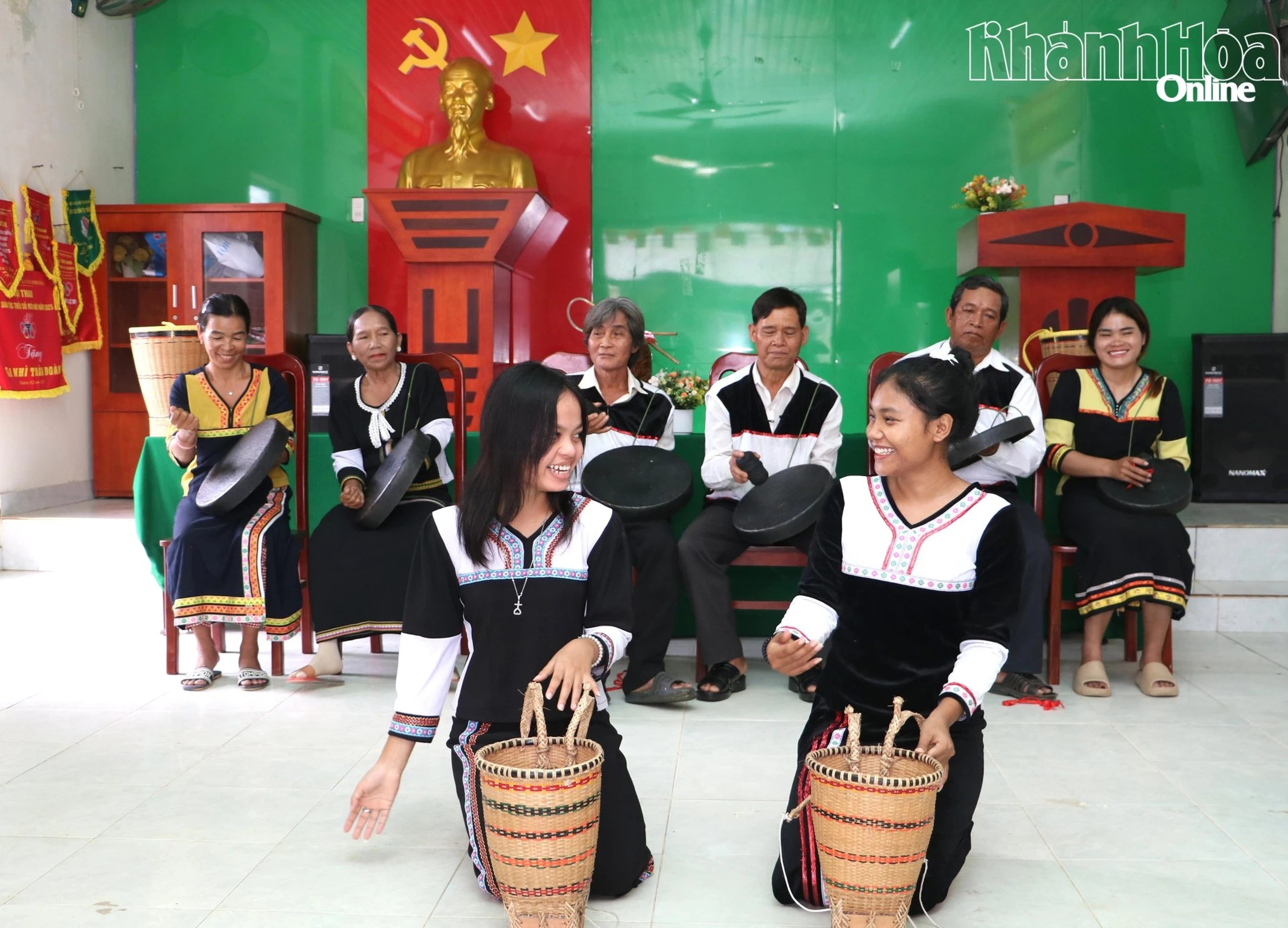


Amidst the rhythm of modern life, the sounds of traditional musical instruments of the Raglai and Ede peoples are echoing once again in Tay Ninh Hoa commune. The sacred soul-stirring sounds of the villages have been and are being passed down to the younger generation through folk culture clubs.
Preserving time-honored culture
One weekday, following Ms. Cao Thi Nu - Head of the Song Bung Hamlet Raglai Ethnic Folk Culture Club, we visited the hamlet community center, where the club meets. From the entrance of the alley, the ma la gongs resonated with rising and falling tones, sometimes leisurely, sometimes lively, mingling with the forest wind and evoking the village ambiance of days gone by.
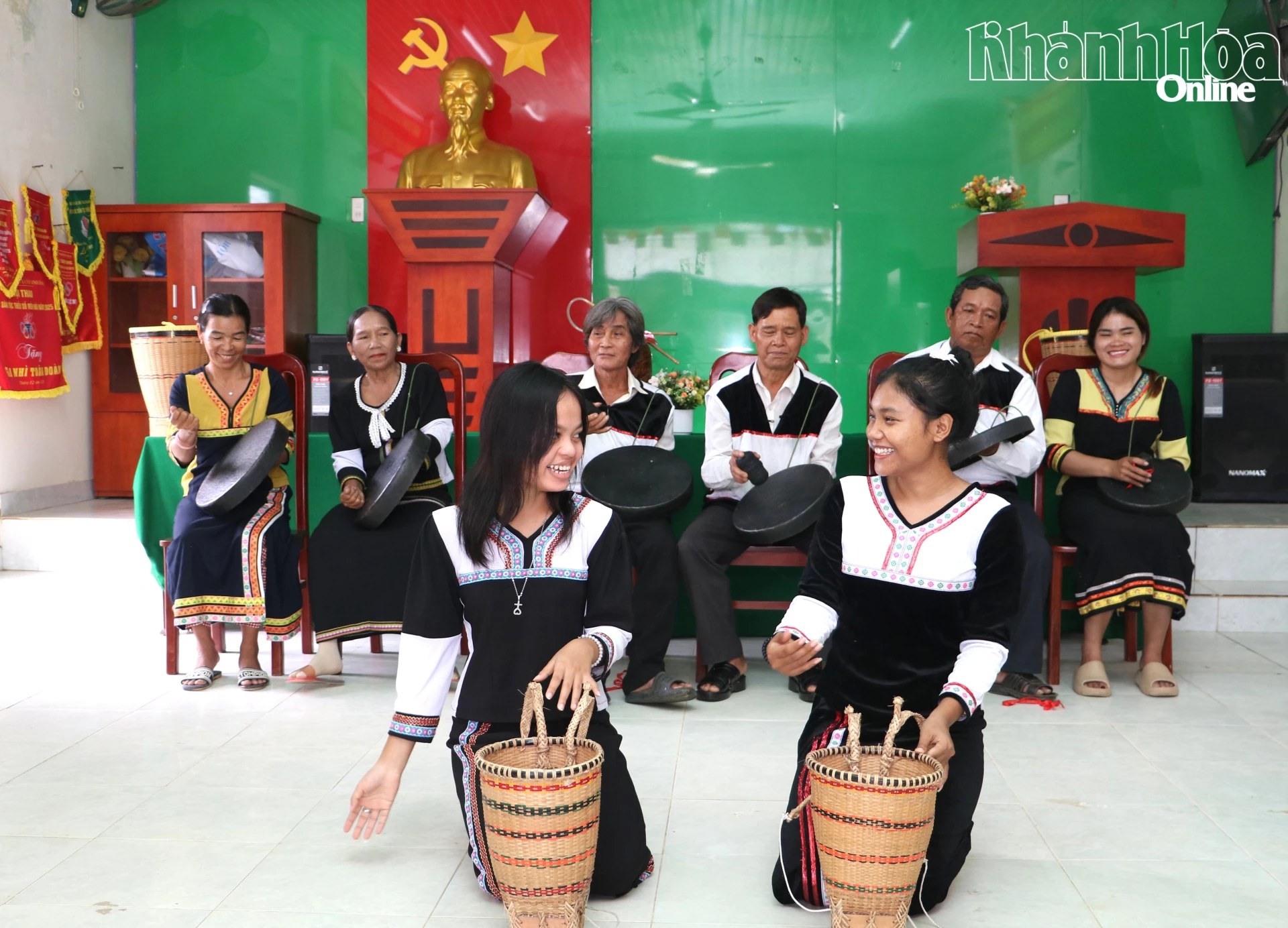 |
| A practice session of the Song Bung Hamlet Raglai Ethnic Folk Culture Club. |
On the hamlet community center grounds, club members were enthusiastically practicing. Two dancers and five ma la players moved their hands swiftly to the rhythm. Each ma la gong produced a distinct timbre, blending together into rustic yet captivating sounds. The dance troupe's graceful steps matched the music, at times rhythmic, at times brisk, making the practice atmosphere all the more vibrant. One after another, the members reviewed ma la pieces used in the water wharf worship ceremony, peace-praying ceremonies, and then moved on to songs associated with the resistance war against the US. Each piece carried its own nuance—some cheerful, others subdued, evoking difficult, arduous years. The resonant ma la sounds succeeded one another, calling to mind images of ancient villages with clustered stilt houses, where villagers gathered around the fire during festivals to dance, sing, and drink can wine to celebrate the new rice season.
Sitting beside a set of ma la gongs, Ms. Cao Thi Vinh (66 years old, Song Bung hamlet), a club member, gently ran her hands over each instrument. She shared that she began learning to play ma la at the age of 18 or 19. Back then, every evening, she would watch the village elders perform and learn from them. Most of the youth in the hamlet knew how to play gongs, as those sounds were present in many community activities. “In the past, whenever the village had a festival, I often went to watch the elders and village patriarchs play the ma la. Seeing them walk steadily with graceful hands, creating the sounds of the mountains, forests, waterfalls, and wild animals, I silently learned,” Ms. Vinh recalled.
Mr. Cao Dinh, a club member, said he has known how to play the ma la since he was 15. In the past, when villagers lived mostly in stilt houses, ma la was closely tied to the daily life of young people. Back then, there were no loudspeakers and not many forms of entertainment like today. There were only stilt houses and oil lamps, where youth gathered to play ma la during new rice celebrations, New Year festivities, and weddings, bonding together through the traditional sounds of their ethnic group.
Mr. NGUYEN THANH BINH - Deputy Secretary of the Party Committee, Chairman of the People's Committee of Tay Ninh Hoa Commune: In the coming time, the commune will continue to create favorable conditions for the four clubs to maintain their activities through cultural exchanges and performance programs to spread traditional cultural values throughout the community. The locality also aims to link cultural preservation with community-based tourism development, gradually creating experiential activities to introduce musical instruments, stage ma la and chingkok performances, and revive traditional festivals.
Leaving the Song Bung village community house, we visited the stilt house of Mr. Y Hy in Ninh Tay village—the gathering place of the Ede Folk Culture Club. Here, five members were engrossed in practicing traditional musical instruments. The experienced elders attentively kept the rhythm of the gongs and chingkok; the young members played along, adjusting each beat under the guidance of the seasoned players. The sounds of the instruments echoed throughout the stilt house, at times robust and brisk, at times resonant and lingering, blending into the unique rhythms of the Ede people. Every sound that rang out carried the memories of an era when villagers gathered together on joyful occasions, sharing the joy of labor, harvest seasons, and significant community events.
Two clubs, two distinct cultural nuances, but sharing the common goal of preserving the sounds of traditional music. During those gatherings, folk musical instruments are not only revisited by the elders but also gradually handed down to the next generation.
Passing down to the younger generation
Tay Ninh Hoa commune currently has about 17,540 residents, with the Ede and Raglai ethnic minorities accounting for 18.5%. For the Raglai people, the ma la is closely tied to traditional rituals and festivals, carrying spiritual significance and reflecting the connection between descendants and their ancestors. For the Ede people, the ma la, chingkok, and ching kram are musical instruments closely linked to community cultural life. However, in the face of modern life's changes, preserving and transmitting these cultural values faces numerous difficulties.
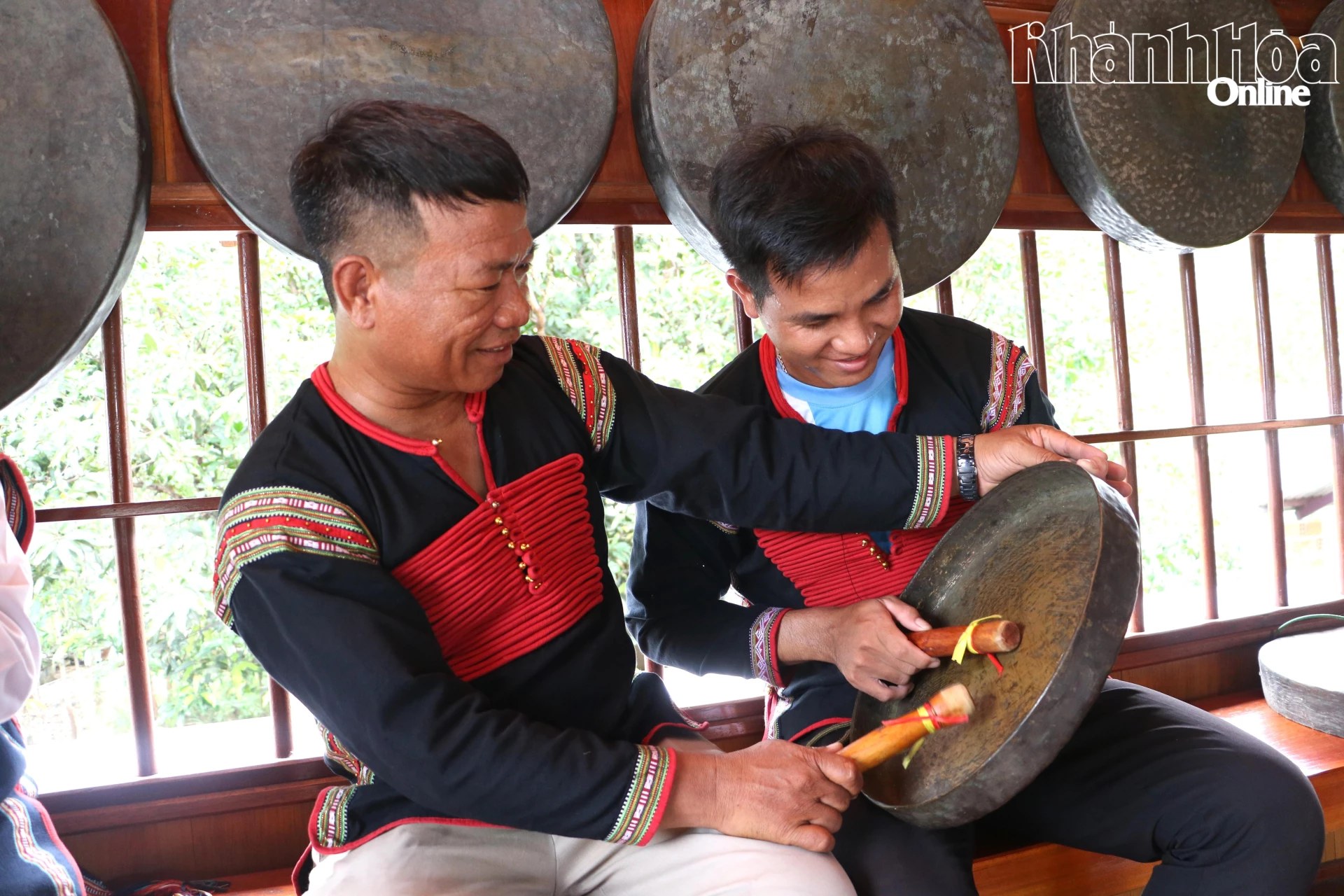 |
| Y Khen (far right) learns to play Ede gongs. |
 |
| Locals participate in the water wharf worshipping ritual of the Ede people in Song Bung village. |
Given that reality, in August 2026, Tay Ninh Hoa commune consolidated four Folk Culture Clubs of the Ede and Raglai ethnic groups across the villages of Song Bung (two clubs), Suoi Sim, and Ninh Tay. Each club consists of 20 members, bringing together artisans, individuals well-versed in cultural heritage, and community members to sustain folk art activities and teach traditional musical instruments to the younger generation.
Y Khen (20 years old), a member of the Ninh Tay Village Ede Ethnic Folk Culture Club, has known traditional musical instruments since childhood but only truly began learning to play about a year ago. According to Y Khen, amidst the fast pace of modern life with numerous forms of entertainment on the internet, young people rarely have the opportunity to delve deeply into their ethnic culture. Therefore, the club has become a place for youth to access and learn about cultural values that they previously only heard about through stories from their grandparents and parents. Under the guidance of artisan Y Hy, Y Khen gradually adjusted how to play the ma la. From dull, off-beat sounds, Y Khen gradually learned how to keep the rhythm and coordinate with the sounds of the chingkok to create harmonious melodies. “The first time I played the ma la and heard its sound ring out, it felt very familiar to me. I felt a love for my homeland and my people, and felt more connected to my roots. From not knowing much about traditional musical instruments, now I can play some instruments and perform basic rhythms,” Y Khen shared.
At the Song Bung Village Raglai Ethnic Folk Culture Club, continuity also begins with familiar things within the family. Ms. Cao Minh (28 years old) has known the sound of gongs since childhood through hearing her father perform at village festivals. However, it was not until her father encouraged her to join the club that she began learning to play this instrument. “Playing the ma la is relatively difficult. I mainly observe my father and older members, then practice along. I hope to have artisans provide systematic guidance so I can learn to play properly,” expressed Ms. Cao Minh. She also brings her fourth-grade son to practice sessions so he can become familiar with the sound of the ma la. According to her, exposing children to traditional musical instruments from an early age is a way to instill a love for their ethnic culture, helping them better understand the values left behind by their ancestors.
The Song Bung Village Raglai Ethnic Folk Culture Club meets every Saturday evening. The youngest member is a sixth grader who mainly participates in the dance troupe; the ma la playing force is still mostly made up of older people. According to Mrs. Cao Thi Nu, teaching currently relies primarily on the experience and memory of the older generation, without a systematic instructional method. Some members have to work far from home, so practice sessions have not been maintained regularly.
As evening falls, the sounds of the ma la resonate once again at the Song Bung village cultural house. Meanwhile, in Mr. Y Hy's stilt house in Ninh Tay village, lovers of traditional musical instruments gather to practice together. Although those sounds have not yet returned as frequently as in the past, each practice session reawakens the memories of the village, bringing joy back to those long attached to tradition while giving the younger generation another chance to touch the heritage of their ancestors.
Village elder Y PHE (Ninh Tay village): The elderly will eventually grow old. Without successors, the values left behind by our ancestors will be difficult to maintain. Therefore, besides creating an environment for young people to participate, local authorities need to pay attention to supporting clubs with more opportunities to perform during festivals and community activities.
LY VAN

