




With a history of over 230 years, Dien Khanh Ancient Citadel is a relic of special value in Khanh Hoa province. However, for the preservation and promotion of the relic's value to be truly effective, comprehensive solutions are needed. Among them, priority should be given to researching and restoring a number of structures inside the citadel, while also preserving the surrounding relic system and the community's living space.
Comprehensive preservation
Dien Khanh Ancient Citadel was built in 1793 and is a typical example of Vauban-style military architecture in Vietnam. Despite its immense value, the preservation and promotion of the value of Dien Khanh Ancient Citadel still face many limitations. It is estimated that each year, the site welcomes only about 10,000 - 30,000 visitors, 90% of whom are domestic tourists, with an average visit duration of only 30 - 60 minutes.
At the workshop "Preserving and promoting the value of Dien Khanh Ancient Citadel - A driving force for cultural, tourism, and socio-economic development of Khanh Hoa province" held by the Department of Culture, Sports and Tourism in early October, Dr. Nguyen Xuan Nang - former Director of the Vietnam Military History Museum pointed out that: Historically, the restoration of Dien Khanh Ancient Citadel has mainly focused on the "outer shell," consisting of the gates, walls, and moat. In the coming time, it is necessary to restore some major structures inside the citadel, because with only the "outer shell," it is difficult to attract tourists.
 |
| The North Gate of Dien Khanh Ancient Citadel. |
Sharing that concern, Dr. Luong Chanh Tong - lecturer at the University of Social Sciences and Humanities (Vietnam National University, Ho Chi Minh City) stated that through historical records and French drawings from the second half of the 19th century, one can envision that Dien Khanh Citadel once housed a temporary royal palace, courtrooms, the residence of the military governor and a system of mandarins, clerks, and offices; warehouses, barracks, prisons, mess halls, medical quarters... The excavation in July 2026 unearthed traces of the foundations of the citadel's central architecture. In the coming time, comprehensive archaeological research needs to be invested in, alongside a close and coordinated combination between preserving and promoting the relic's value.
Not stopping at structures inside the citadel, Master Pham Manh Cuong, Head of the Department of Standards and Technology Research for Monument Conservation at the Institute of Monument Conservation (under the Ministry of Culture, Sports and Tourism), argued that the conservation and promotion of the value of Dien Khanh Ancient Citadel needs to be placed within the overall context of a heritage system, including tangible elements, space, landscape, archaeology, community, memory, and adjacent monuments. Among these, the ancient citadel plays the core role, while 13 adjacent relics such as the Dien Khanh Temple of Literature, Am Chua, Trinh Phong Shrine, and Tran Quy Cap Temple... serve as a satellite network. Digital technology acts as a tool to support management and interpretation. From now until 2030, it is necessary to consolidate conservation foundations, complete databases, and address priority items; during the 2031–2035 period, expand to form the Dien Khanh heritage network; by 2045, Dien Khanh Ancient Citadel will become an exemplary citadel heritage space that develops sustainably.
Harmonizing conservation and development
Currently, inside Dien Khanh Ancient Citadel, there are headquarters of several state agencies and nearly 300 households with approximately 1,000 residents living there. Therefore, when proposing orientations for the conservation and promotion of the monument's value, experts emphasize that Dien Khanh Ancient Citadel is not a “closed” relic, but a “living” heritage. According to Assoc. Prof. Dr. Dang Van Bai, Vice Chairman of the National Cultural Heritage Council, when approached from the perspective of modern heritage studies, a monument is no longer a static physical entity that needs to be “framed,” but rather an ever-evolving heritage ecosystem. This requires linking tangible conservation and intangible memory preservation with safeguarding the legitimate interests of local residents. Integrating the heritage economy with cultural industries will help transform the monument from a “passive conservation cost” into a “dynamic economic asset,” both generating revenue for reinvestment in restoration and ensuring sustainable livelihoods for local residents.
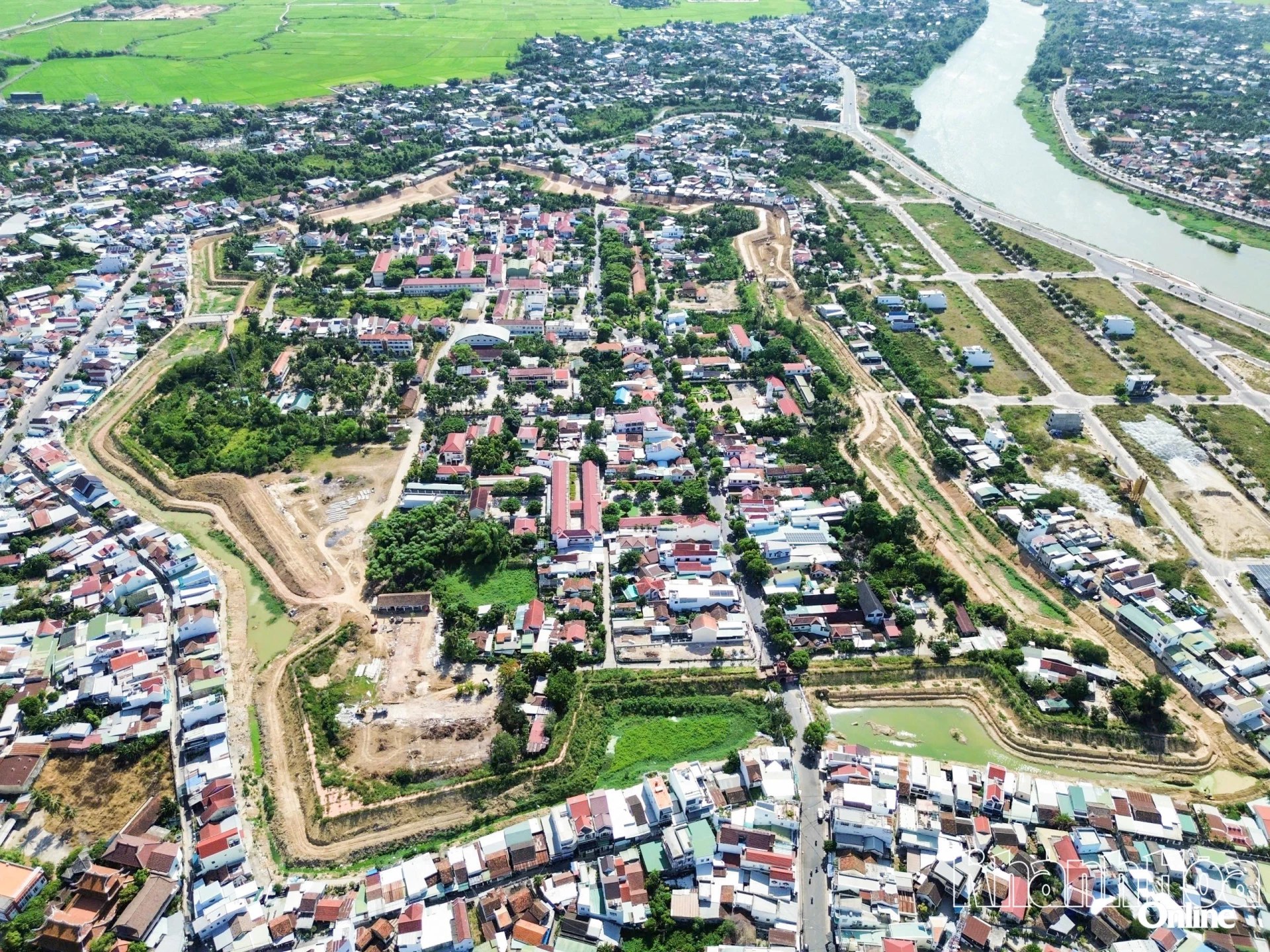 |
| Dien Khanh Ancient Citadel area viewed from above. Photo: G.D |
Sharing that view, Master Nguyen Thi Ha, a researcher at the Institute of Monument Conservation, proposed that the conservation of Dien Khanh Ancient Citadel needs to shift from a mindset of “protecting a boundary line” to “managing a heritage landscape area.” Accordingly, Dien Khanh Ancient Citadel should not only be preserved as a historical monument but also as a living cultural space recognized by the community, accessed by the younger generation, experienced by tourists, and managed through methods appropriate for a modern urban area.
According to Mr. Le Van Hoa, Deputy Director of the Department of Culture, Sports and Tourism, the Provincial People's Committee is hiring a consulting firm to develop a project on conserving and promoting the value of the Dien Khanh Ancient Citadel monument for the 2025–2030 period, with a vision toward 2045. The project will determine implementation phases and structures that require restoration.
Dien Khanh Ancient Citadel is a heritage site of multi-layered value. From a unique military structure in the late 18th century, it became an administrative and political center throughout the Nguyen Dynasty (1802 - 1945). In the late 19th century, Admiral Trinh Phong - leader of the Can Vuong movement in Khanh Hoa - chose this place as his headquarters to fight against the French colonialists. During the 1945 - 1946 period, the revolutionary government also set up its anti-French resistance headquarters here. The ancient citadel is also a vibrant cultural living space for the community... In 1988, Dien Khanh Ancient Citadel was recognized as a national historical and cultural relic. Currently, the province has tasked the Department of Culture, Sports and Tourism with preparing a dossier to request the Prime Minister to recognize Dien Khanh Ancient Citadel as a special national relic.
XUAN THANH

