


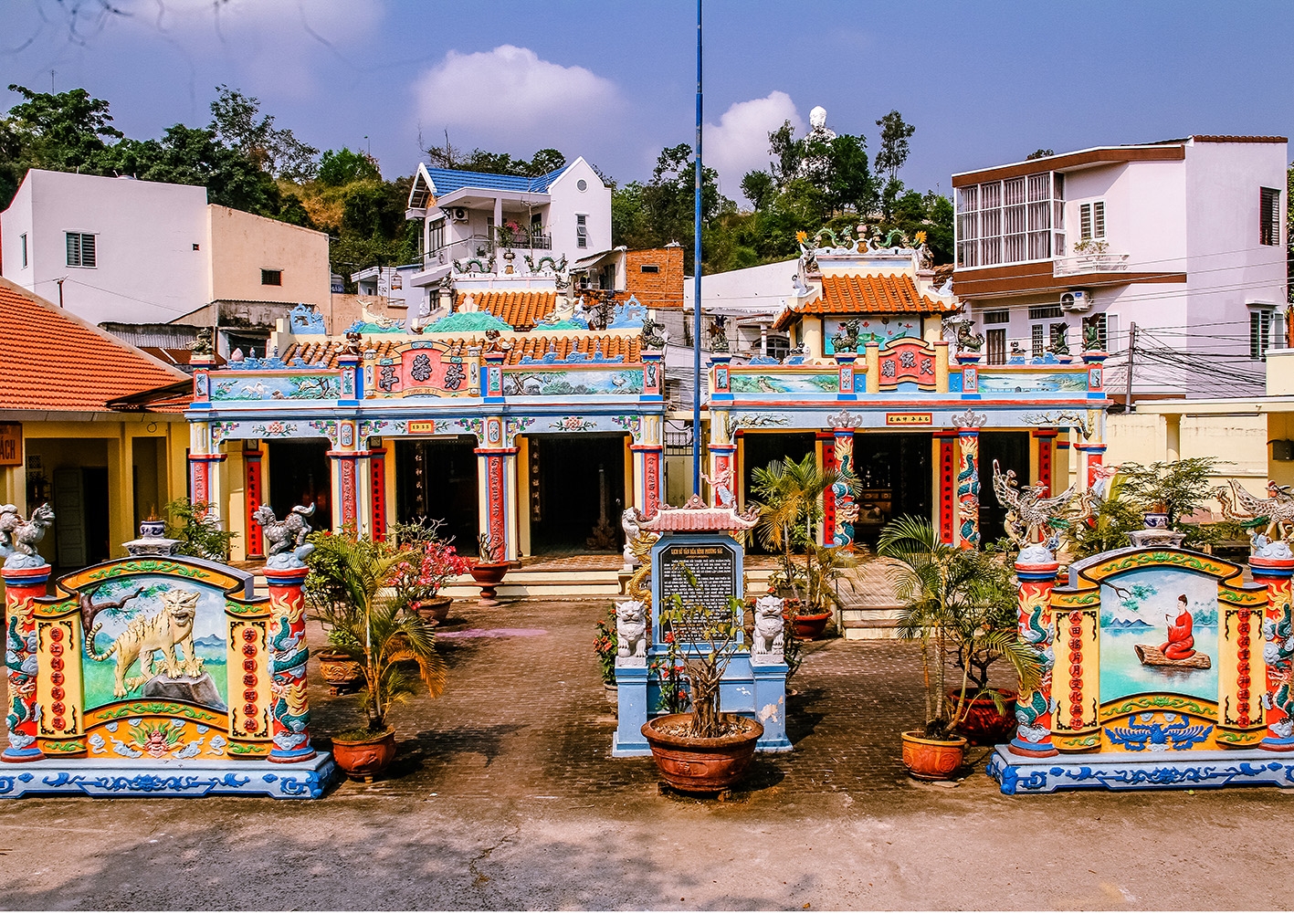
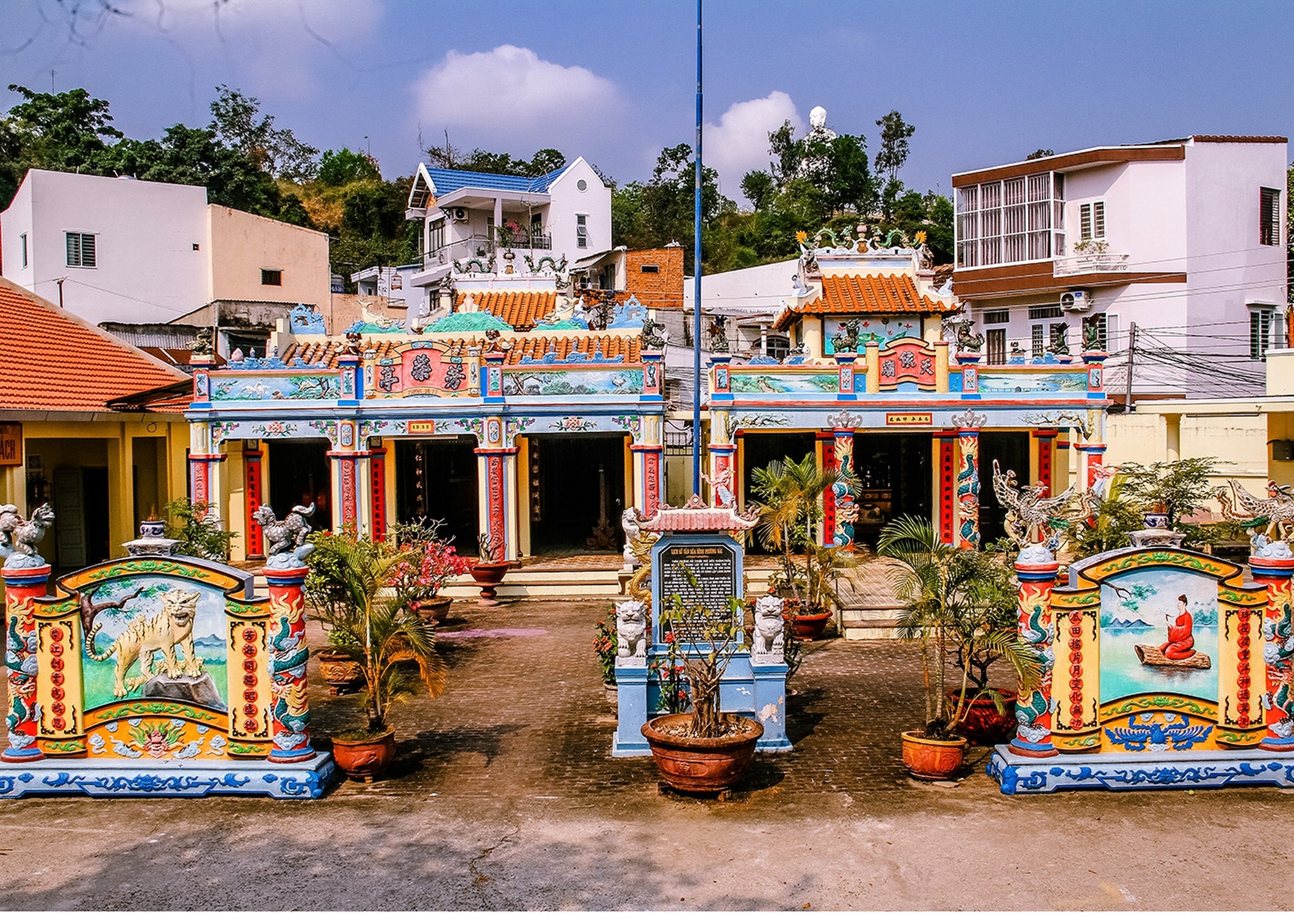
Phuong Sai Communal House is located at 83 Phuong Sai Street, in Phuong Son Ward, Nha Trang City, Khanh Hoa Province.
From the center of Nha Trang city, follow Tran Quy Cap street, turn right at the intersection onto Phuong Sai street; the communal house is located at 83 Phuong Sai street. The monument can be reached by road transport from various directions, such as via Thong Nhat street, Yersin street, etc.
Phuong Sai Communal House was named by combining the names of Phuong Mountain (Phuong Son: fragrant mountain, also known as Trai Thuy mountain/hill) and Sai River (also known as Cui River). Today, the Communal House belongs to Phuong Son Ward, but in the past, Phuong Sai and Phuong Son wards were known as Cui village/ward[1]. According to the Nguyen Dynasty land registers from the beginning of the 19th century, this area was Cui village/ward, Phuoc Hai commune, Xuong Ha canton, Vinh Xuong district, Dien Khanh prefecture, Binh Hoa town (1808), and in 1832, under the reign of King Minh Mang, Binh Hoa town was renamed Khanh Hoa province. Later, it was renamed Phuong Sai village, and in 1924, Phuong Sai village was one of the five ancient villages in Nha Trang established as the town of Nha Trang by the Governor-General of Indochina. In 1976, Nha Trang city separated the village into two wards: Phuong Son (on the mountain side) and Phuong Sai (on the river side), using Phuong Sai street as the boundary.
 Phuong Sai Communal House
The exact founding date of Phuong Sai Communal House is unknown, but according to village elders, the original structure was built with a thatched roof and round wooden pillars, facing Northeast, with the Sai River (Cui River) as the “front water” and Trai Thuy mountain as the “back mountain,” following the traditional geomancy principles of the ancients. Around the second half of the 19th century, despite the local economy being relatively stable, no local scholars had achieved success in imperial examinations, so the village elders decided to reorient the communal house from the Northeast to the Southwest. In 1955, the communal house was rotated back to its original Northeast orientation.
Today, the Communal House is built within a 2,248.5m2 campus. Looking at the monument from the outside, it includes the following structures: the Ceremonial Gate and enclosure wall, the Martyrs' Memorial stele house, the main hall (Dai Dinh), the Thien Y A Na shrine, the house for predecessors (Tien Hien), a warehouse, and a kitchen.
The communal house is roofed with yin-yang tiles and features a tiered roof structure (co lau), with embossed dragon and phoenix patterns that give the monument an ancient appearance amidst the urban setting. Phuong Sai Communal House is beautifully decorated; the tiered roof, roof ridges, and roof edges feature embossed panels depicting the Four Sacred Animals (Tu Linh), the Four Seasons (Tu Quy), bats, and chrysanthemums, alongside rich and vivid paintings of flora and fauna, as well as lively depictions of qilin and nghê mythical creatures that easily draw the attention of those passing by. Inside the communal house and shrine, the arrangement is solemn and majestic, with parallel sentences (cau doi), horizontal lacquered boards (hoanh phi), ceremonial weapons (lo bo), gongs, drums, and parasols, adding to the silent yet captivating atmosphere amidst the noisy, bustling city.
 Decorative patterns on the tiered roof of Phuong Sai Communal House
Phuong Sai village communal house worships Ha Ba (River God), Tho Cong (Earth God), Cao Cac, Bach Ma, the Predecessors (Tien Hien), the Successors (Hau Hien), and national heroes and martyrs. Among them, the Predecessor (Tien Hien) is Mr. Mai Thien Tai, who made many contributions in terms of effort and wealth to the village. Additionally, the monument includes the Thien Y Shrine, which worships Thien Y A Na Dien Ngoc Phi, the Long Cung Holy Mother, the Luc Cung Holy Mother, and the two Princes and Princesses.
Today, Phuong Sai communal house still preserves 12 royal decrees (sac phong) granted by kings from the Tu Duc to the Khai Dinh reigns.
Over time, the communal house has been renovated and restored many times:
In the 19th year of the Tu Duc reign (1866), Mr. Mai Thien Tai mobilized the villagers to contribute to building a new communal house about 65m northeast of the old one.
Around the second half of the 19th century, the communal house orientation was changed from Northeast to Southwest.
In 1880, the communal house was refurbished and repaired.
In the autumn of the Tan Ti year (1891), the Thien Y shrine was built next to the communal house.
In the autumn of the Giap Ngo year (1894), the communal house and shrine were restored thanks to the efforts of Mr. Mai Thien Thanh.
In the Giap Dan year (1914), the shrine was repaired and the statues of the Holy Mothers were erected.
In the Ky Ty year (1929), the communal house and shrine were refurbished and repaired.
In 1955, half of the communal house land was cut away to build a primary school; the communal house was moved to the western half and rebuilt facing Northeast, which is the current communal house and shrine.
When the communal house and shrine were completed, the house for predecessors and the guesthouse remained in their old locations, which was inconvenient for worship; therefore, in 1968, the house for predecessors was built on the right side of the communal house, along with the kitchen and the caretaker's living quarters.
In 1969, the ceremonial gate and the surrounding wall were built.
In 1997, the Martyrs' Memorial stele house for Phuong Son and Phuong Sai wards was built.
In 1983, three classrooms for a kindergarten were built on a 09m x 7.7m plot of land on the right side. In 2003, the People's Committee of Phuong Son ward borrowed this land from the communal house to rebuild the kindergarten; the communal house gate was rebuilt due to the widening of Phuong Sai street.
Annually, Phuong Sai communal house organizes two major ceremonies in the spring and autumn, commonly known as “Xuan Thu nhi ki” (the two spring and autumn periods). The spring festival, also called the Spring Prayer for Peace to pray for “national peace and people's happiness,” takes place on the 22nd and 23rd of the 3rd lunar month (coinciding with the Po Nagar Festival honoring the Holy Mother Thien Y A Na, where the Phuong Sai shrine also conducts ceremonies for the Holy Mother). The autumn festival, also known as the Autumn Sacrifice, is a thanksgiving ceremony for the heavens, earth, and deities held in the first ten days of the 9th lunar month, featuring a procession of the royal decree from An Lac shrine at 19 Phan Dinh Giot street, Phuong Sai ward, to Phuong Sai communal house, after which it is returned to be stored at An Lac shrine.
Recognizing the typical historical and cultural values of the monument, on August 22, 2007, the People's Committee of Khanh Hoa province issued Decision No. 1522/QD-UBND designating Phuong Sai communal house as a Provincial Historical-Cultural Monument.
[1] In the past, place names were derived from the main local occupation; in this area, residents had the occupation of chopping firewood to sell, so it was called Cui Ward (Firewood Ward).
Source: https://disanvanhoa.khanhhoa.vn/