



With its mountain and forest landscapes, lakes, streams, traditional cultural values of the Raglai ethnic people, and agricultural production advantages, My Son commune is forging a path to develop tourism from its available resources. Connecting nature, culture, and agriculture into distinctive products is expected to create additional livelihoods for local residents and promote the local economic restructuring.
Many unique features to explore
Although not yet a familiar destination, My Son possesses unique charms worth discovering. In addition to rich natural landscapes, My Son commune also holds stories of culture, history, and community life. In villages inhabited by the Raglai people, the sounds of ma la gongs, chapi zithers, folk songs, and traditional customs are still handed down through generations. These values are not only tied to spiritual life but also open up avenues for experiencing indigenous culture, from learning about musical instruments and handicrafts to savoring mountain cuisine. Ms. Chamalea Thi Khem, Secretary of the Ra Tren Village Party Cell, expects that developing community-based tourism coupled with preserving the Raglai identity will generate more jobs and improve the livelihoods of local people. This is also a desire to preserve cultural values while providing livelihoods right in their homeland.
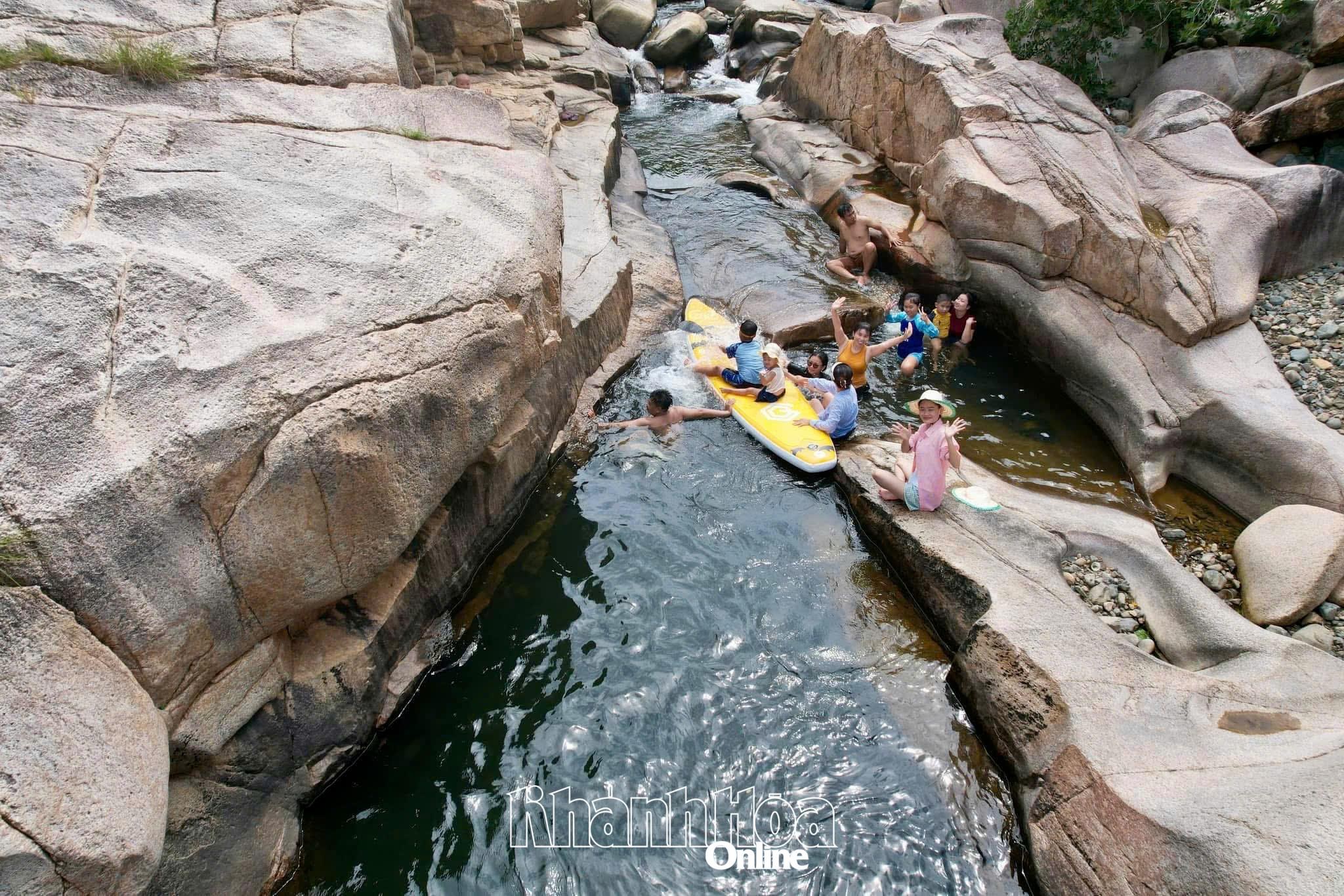 |
| My Son commune boasts many unique landscapes, attracting visitors who love exploration and experiential travel. |
From hillsides and farm fields, the journey of discovering My Son also opens up in production areas that are transforming farming practices. At PT Farm, cantaloupes are grown in greenhouses using drip irrigation systems. In Phu Thuan village, Nang va Gio Farm cultivates grapes, apples, cantaloupes, and aloe vera using water-saving methods, turning by-products into organic fertilizer. These models not only demonstrate adaptability to arid conditions but also suggest opportunities for sightseeing, harvest experiences, and consuming farm produce right at the orchards. Associated with these production areas is Nha Trinh Dam, an ancient Cham irrigation structure bearing the hallmarks of tapping and channeling water for cultivation across many generations. Together with O Cam Dam, Chomo Lake, and the mountain landscape, this area offers potential experience routes that combine historical discovery, nature exploration, and agricultural life.
Another stop rich in cultural value is Phu Thanh communal house, a provincial-level architectural and artistic relic located near National Highway 27. Beneath ancient tree canopies, the communal house preserves memories of generations of settlers who reclaimed land and established the village. Mr. Nguyen Quang Chau, a member of the communal house management board, said that on the 9th and 10th days of the third lunar month each year, locals organize a deity procession and offerings to the founding ancestors, along with folk cultural and sporting activities. This is also an occasion for descendants to return, commemorate their ancestors, and strengthen community bonds. The stories shared under the communal house roof add historical depth to the journey of discovering the land of My Son.
Connecting resources, opening livelihood pathways
From natural landscapes and Raglai cultural life to production areas and historical relics, My Son possesses abundant resources to develop distinctive tourism products. What is missing is the connection between destinations, services, and experiential activities. On October 21, the People's Council of My Son Commune passed a Resolution on tourism development associated with promoting ethnic cultural identity up to 2030, with a vision to 2035. Accordingly, the locality determined to take culture as the foundation and the community as the primary subject; developing eco-tourism and Raglai cultural experiences linked to agriculture. In the immediate future, the commune strives to build a model community-based tourism site, gradually establishing the "one village, one distinctive tourism product" model.
 |
| The purple hue of crape myrtles adorns the landscape of lakes and hills, creating a unique beauty for the semi-mountainous area of My Son. |
To realize this orientation, the commune needs to select areas with suitable conditions in terms of transportation, landscape, culture, and community consensus for pilot implementation. From culinary experiences and cultural exchanges to touring production areas, stops can be linked into half-day or full-day itineraries. Only when products attract visitors, generate revenue, and operate stably will further expansion proceed, avoiding scattered investment. Mr. Huynh Phuong Nam, Chairman of the People's Committee of My Son Commune, said that the locality is gradually concretizing thematic resolutions on high-tech agricultural development, tourism, and human resource quality improvement through appropriate programs and plans. This serves as the foundation to more effectively harness available potential and advantages, creating momentum for socio-economic development in the next phase.
The crucial factor is that local people must truly benefit. Household groups, collaborative groups, or cooperatives can undertake catering services, guiding, cultural introduction, and the consumption of local products. Once revenue is generated, residents will have more incentive to preserve heritage and protect the landscape. Along with training in hospitality skills, promotion, and connecting with tour operators, the operation of eco-sites must ensure safety and environmental protection; traditional rituals must be respected and not arbitrarily commercialized.
From the sounds of ma la gongs amid the mountains and forests, the stories told beneath the communal house roof to orchards transforming their production methods, My Son Commune has many tales to share with visitors. When these values are connected into appealing products that generate revenue for the community, tourism will not only bring visitors to this land, but also open up new livelihoods, creating momentum for a new stage of development.
According to the orientation, by 2027, My Son Commune strives to establish 1 model community-based tourism site and restore at least 1 representative traditional festival. By 2030, it aims to develop at least 3 distinctive tourist sites; welcome 7,000 - 10,000 visitors per year, reach an annual revenue of 5 - 7 billion VND, and have approximately 5% of households involved in tourism activities. By 2035, it seeks to form at least 9 signature products, striving to make tourism, trade, and services account for over 32% of the commune's total production value. The estimated funding requirement for the 2026 - 2030 period is around 39.85 billion VND.
THANH XUAN

