


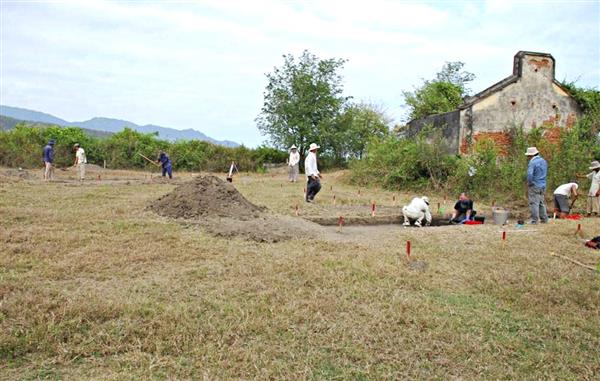
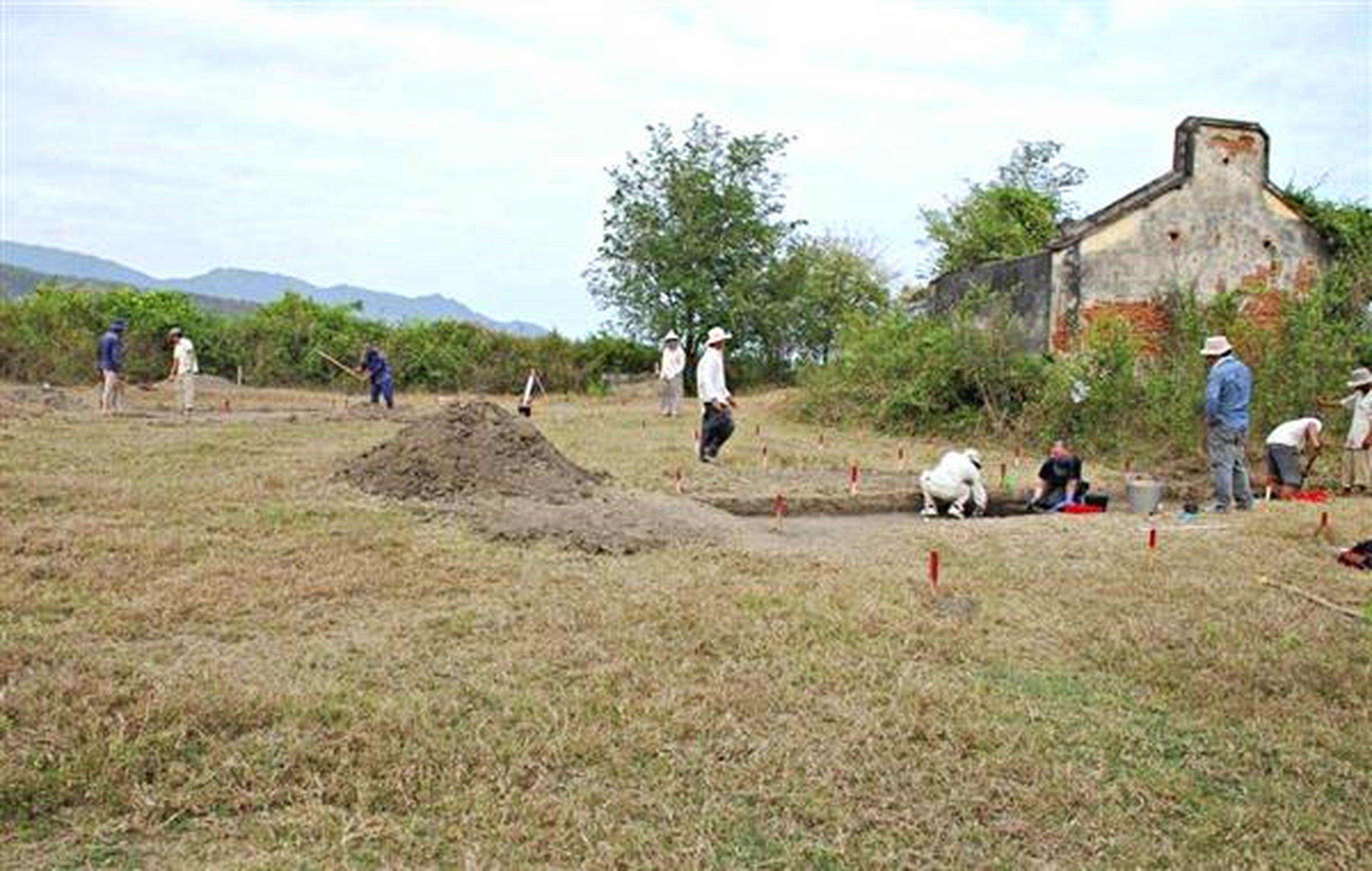
The Hoa Diem archaeological site is located in Hoa Son Village, Nam Cam Ranh Commune, Khanh Hoa Province, about 5 km south of the center of Cam Ranh Ward.

The site is located at geographical coordinates 11°53’14.77” North latitude and 109°06’35.14” East longitude, distributed on a coastal sand dune about 4m above sea level. The area of the site is mainly concentrated around the old Hoa Diem communal house (now relocated) and on local farmland. Because an old communal house still exists in the area, the site is also known as Hoa Diem Dinh (Hoa Diem Communal House) to distinguish it from other sites discovered later.
Hoa Diem is a site located on a high sand dune, where life depended on fresh water from the Ta Lua River and the ponds surrounding Cam Ranh Bay. Because it is near the sea, food was mainly sourced from marine life such as clams, snails, oysters, and fish... representing a "shell-midden culture" accumulated in a cultural layer dense with marine mollusk shells; furthermore, remains of animal bones and teeth from both the sea and mountains were the primary food sources for the residents here.
The site was discovered in February 1998 by a research team from the Institute of Archaeology during a survey of sites belonging to the Champa culture in three South Central Coast provinces (Khanh Hoa, Ninh Thuan, Binh Thuan). During the fieldwork, the team arrived at Hoa Diem Village (now Hoa Son Village) and discovered some ceramic fragments, the first traces of the archaeological site. In the following years (1999, 2002, 2007, 2010, 2011), the Provincial Museum frequently collaborated with the National Museum, the Institute of Archaeology, the Institute of Social Sciences in the Southern Region, the Museum of Anthropology under the University of Social Sciences and Humanities, and Waseda University (Japan) to conduct surveys, excavations, and research on the site.
Based on the excavation and combined with the results of previous survey investigations, scientists determined that the stratigraphy and artifacts indicate that Hoa Diem was a residential site and also a burial ground consisting of various types of graves, with spherical jar burials being the most typical. The residential area is spread over a fairly wide area, as evidenced by the stratigraphy of the excavation pits, with some areas still retaining mollusk shells while others do not.
A characteristic feature of the Hoa Diem site is that the burial ground is located right within the residential area. The burials are situated directly within the cultural layer. The burials found here only feature the spherical type, with no cylindrical types yet discovered; the burial form can be divided into clusters, including single jar burial clusters or two jars placed upside down in an upright position. Some jar lids are similar to pedestal bowls, and most jars contain skeletal remains with one or multiple individuals per jar. There are many different types of burials, especially with grave goods arranged similarly to those in Sa Huynh culture jar burials, including ceramics, iron objects, agate jewelry, gemstones, glass beads, and yellow metal.
 Artifacts found at the Hoa Diem archaeological site
Most jar burials were placed in an upright position, with no signs of being buried in clusters or evidence of double burials, although there is a phenomenon of graves cutting into one another. This indicates that the Hoa Diem site has multiple phases, even though the progression between these phases is very short.
The types of jars used for burial were quite diverse – the most common being spherical jars with constricted mouths, narrow diameters, and no lids, which were chipped at the edges to create a wider opening, likely to facilitate the placement of human remains inside the jar. In addition, there were other types of jars – perhaps the first time archaeologists have excavated a site with jar burial traditions – which were spindle-shaped jars decorated with complex geometric patterns, sophisticated in their lines and high level of artistry on the surface, which was painted and polished in non-decorated areas. These jars had lids with knobs and were decorated with reddish-brown patterns. All these elements give the jars a harmonious, unique structure found only in archaeological sites in Vietnam that practice jar burial.
Based on the evolution of the artifacts, the cultural layer appears to be a single stratum. However, since the burials are located within the same cultural layer as the settlement, there is a basis to confirm that the burials in the site are of a later date. On the surface of the cultural layer, there are scattered ceramic fragments from later periods, although they do not form a distinct cultural layer, they suggest that the entire site existed over a long period.
Regarding the environmental space, Hoa Diem was an area with many favorable factors for inhabitants, with a terrain in front of the sea and behind the mountains, and fresh water sources from rivers and streams flowing down from the plateau, forming coastal plains in the Cam Ranh Bay area, which was favorable for exchange with other cultures via water and land routes.
Regarding artifacts, the excavations yielded tens of thousands of specimens made of various materials such as stone, pottery, bone, mollusk shell tools, jar burials, jewelry, etc., indicating that Hoa Diem was quite prosperous during this period. Various types of jars, pots, pedestal bowls, and bowls with different shapes—both decorated and undecorated—include forms that absorbed and preserved features from the previous period, as well as those with characteristics unique to Hoa Diem. The decorative motifs include scraping (shaving) single, double, or triple ellipses on the shoulders, alongside impressions made by multi-toothed tools with rectangular, square, and triangular heads, and seashell-edge imprints in various compositions, proving the rich creativity of the ancient Hoa Diem residents.
The excavation results show that Hoa Diem was a residential and burial site dating from early to late periods, but the distribution of residential traces is not widespread and is instead concentrated in specific areas within the site. [1]. The results of subsequent excavations once again confirmed the date of the site to be around 2,000 years ago, with the discovery of two Wu Zhu (Han) coins in burial M6, showing that the Hoa Diem cemetery dates back at least to the period between the 1st century BC and the 2nd century AD. This date corresponds to the late Sa Huynh culture.
Excavation data shows that Hoa Diem is an important link and bridge in researching the development of archaeological culture in Khanh Hoa in particular and Central Vietnam in general. The characteristics of the Hoa Diem site, through its various types of relics, settlement areas, burials, and artifacts, show the development process of the ancient inhabitants of Khanh Hoa in the Pre-Protohistoric period, especially during the phase of strong interaction, blending, and exchange of cultures among many ethnic groups. The Hoa Diem site allows us to partly understand the transition from Sa Huynh culture to Champa culture in a specific locality and region.
Research, comparison, and analysis show that the relics and artifacts at Hoa Diem are not only unique but also reflect broad cultural exchange. First and foremost, for Vietnam, there is a similarity between the group 2 jar burials here and those in the Southeast region, especially with the Giong Ca Vo and Giong Phet sites. In addition, Hoa Diem ceramics also show similarities to some locations in Southeast Asia. Beyond the distinct characteristics and styles that highlight a typical Hoa Diem period, the Hoa Diem site also has broader relationships, serving as a historical thread connecting to other sites in the province, the South Central region, the Southern region, the Central Highlands, and the Southeast Asian region. However, at present, it can only be said that these similarities are merely signs indicating that there may have been simple exchanges between Hoa Diem and other regions, but it is not yet possible to determine the direction of such exchanges (which place was the influencer and which was the influenced).
The Hoa Diem archaeological site dates from the 5th - 4th century BC to the 1st - 2nd century AD and is of particular value in terms of science and aesthetics, containing characteristic features of the residential areas of the Pre-Protohistoric inhabitants, as well as the burial customs of the people living here. The site also clearly demonstrates the "Con Bau" (Dune-Pond) cultural space, which is very typical of the South Central region. The artifacts excavated at the site, such as mollusk shells, jar burials, burial pottery, iron grave goods, glass beads, stone beads, bronze bells, bronze bracelets, hearths, ceramic fragments, animal bones, seashells, and labor tools, have partly revealed information about the lives of the ancient Hoa Diem residents, as well as their burial rituals.
In 2014, the site was ranked as a National Monument by the Ministry of Culture, Sports and Tourism under Decision No. 4108/QD-BVHTTDL dated December 12, 2014. This is the first and currently only archaeological site in Khanh Hoa to be ranked as a national-level monument. Therefore, in the coming years, the site needs the attention of the public, authorities, and professionals in preservation, maintenance, and promotion of its value to serve local tourism economic development. This will contribute to turning this place into an attractive destination for sightseeing, research, and learning about Pre-Protohistoric culture in Khanh Hoa.
[1] Bui Chi Hoang, 2008, see also Peter Bellwood 2007 and Robert Blust 2005 regarding the dating of iron objects.
Source: https://disanvanhoa.khanhhoa.vn/