



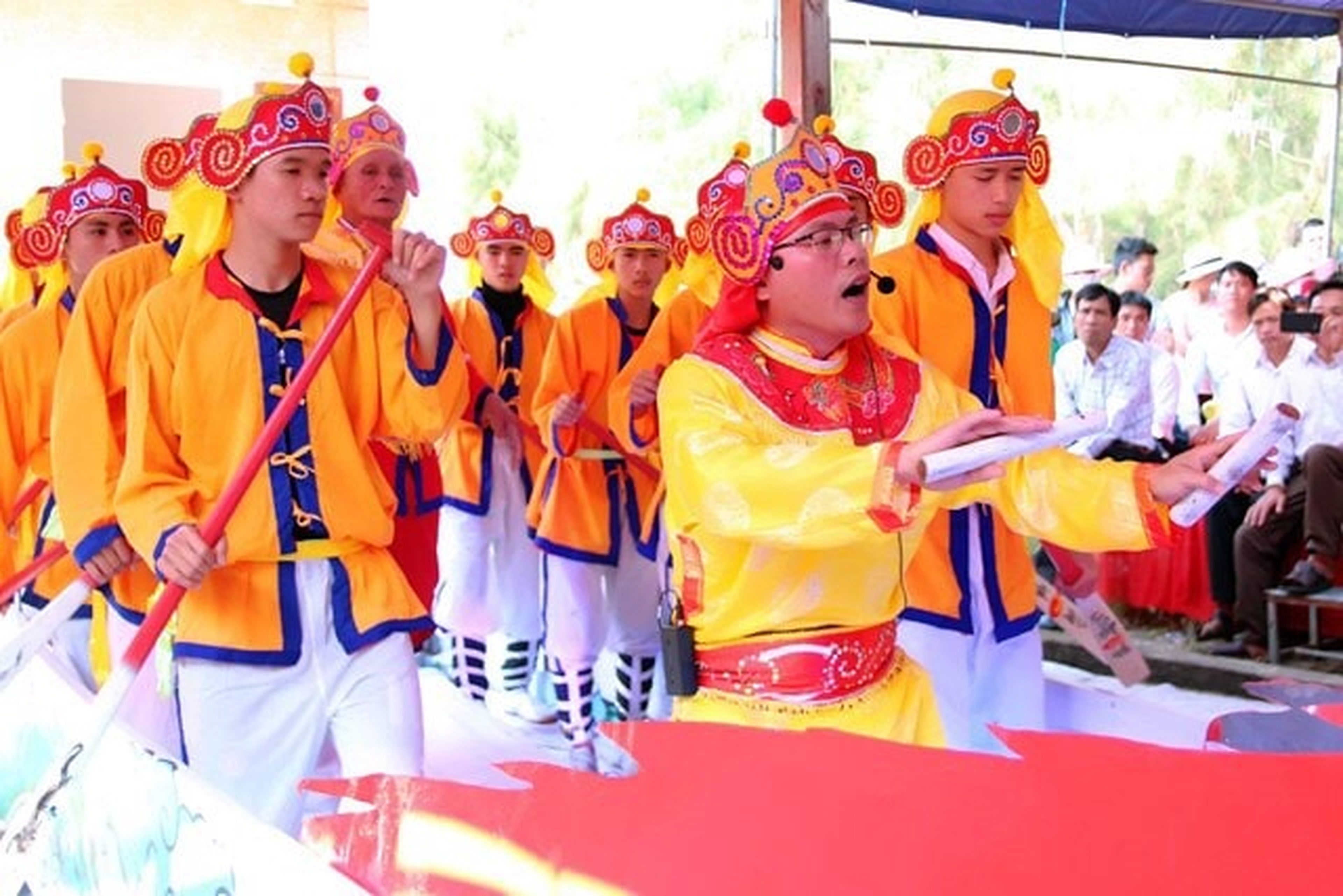
In the course of a coastal Cau Ngu festival, there is a special moment that easily causes a noisy crowd to fall completely silent: the moment the Ho Ba Trao troupe begins its rhythmic circle. The movements mimicking the posture of rowing a boat through waves, the vigorous chants, the drum beats setting the pace, and the uniform forward and backward movement of the formation create an atmosphere that is both solemn and strangely intimate. For those who have had the chance to watch, they understand that this is not merely a folk performance to entertain the festival. Ho Ba Trao is the soul, a cultural code crystallized over thousands of years from the spiritual life of those who have tethered their fate to the sea.
Ho Ba Trao is commonly found in the Cau Ngu festivals of coastal residents in the South Central region, with Khanh Hoa being one of the cradles that preserves it most vividly. From the ceremonies at Truong Tay communal house-mausoleum to the fishing communities along the Nha Trang coast, Ho Ba Trao is always considered a mandatory ritual performance, taking place alongside main rites such as welcoming Ong (Whale) or paying tribute to Ong Nam Hai. If you only look with the eyes of a passing tourist, you might see a beautiful dance with colorful costumes and wooden painted oars as props. But if you take the time to pause and look deeper through each layer of movement, you will realize this is how the fishing village community tells the story of their life: from the moment the boat is launched, the whole team working in unison to overcome storms and face dangerous deep-sea waves, to the sheer joy when bringing the boat safely back to harbor with a hull full of fish and shrimp.
A hundred pairs of hands rowing to one rhythm
In terms of meaning, the word "Ba Trao" can be loosely understood as "a hundred oars," evoking the image of a collective of fishermen working together on a single boat. Throughout the performance, the Ba Trao troupe—usually consisting of the leaders (Tong Khoang, Tong Lai) and the rowers—does not just sing or dance; they are vividly recreating the spirit of solidarity and mutual support among seafaring people. Imagine that, in the vast ocean, if a boat wants to cross a turbulent wave, no single oar is allowed to be out of sync. The safety of the entire vessel depends on the unity of each individual. A fishing village that wishes to survive and develop sustainably through storms also needs such an unshakable bond.
This is why, when writing about or researching Ho Ba Trao, we need to view it as a profound spiritual cultural practice, completely distinct from programs performed on commercial tourist stages. It features music from traditional instruments, the body language of dance, and lyrics echoing folk songs like Bai Choi or rustic sea chants, but its most durable root remains deeply embedded in the worship of Ong (the Whale) and the labor life of the fishing villages. When the entire formation simultaneously puts their hands to the oars, bows in time with the drum, and gazes in one direction, viewers standing on the edge of the courtyard can clearly feel a powerful, invisible energy of connection.
A guide for tourists observing Ho Ba Trao
If you are lucky enough to take a trip to Khanh Hoa during the Cau Ngu festival season and get to witness a Ho Ba Trao performance, do not just stand there on your phone waiting for the high-energy, vibrant segments to take photos. Try learning to observe the smallest details from the moment the troupe prepares to step into the ceremonial space:
Observe behind the scenes: The way the fishermen, who usually wear shorts and shirts smelling of the sea, now don neat ceremonial attire, meticulously adjusting their belts and checking their wooden oars.
Listen to the melody: The way members of the troupe follow the signals of their commander, taking their first steps into the sacred space of the communal courtyard. Those silent moments of preparation sometimes contain more moving stories than the formal performance itself.
Follow the body language: When the chanting begins, focus on the rhythm of the rowers' hands and feet. Each reaching and pulling movement is not for the sake of looking good, but a realistic simulation of the force exerted on an oar when a boat encounters a counter-current. The chant in a thick local dialect might be difficult for distant travelers to understand, but its rising and falling cadence, sometimes urgent and sometimes leisurely, will lead your emotions through each simulated sea voyage on land.
When you want to capture these images with a camera or phone, you should choose a standing position on the side or behind the villagers' viewing area. Do not move across the troupe's performance space or push between the rows of rowers for close-up shots. For short video clips, take just enough for documentation. Do not let your phone screen hide the opportunity to listen with your ears and feel with your soul a living heritage unfolding right before you.