


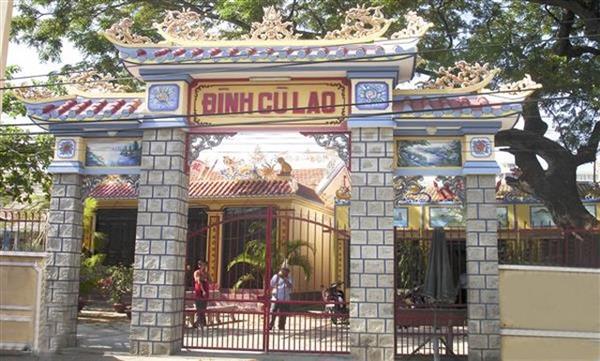
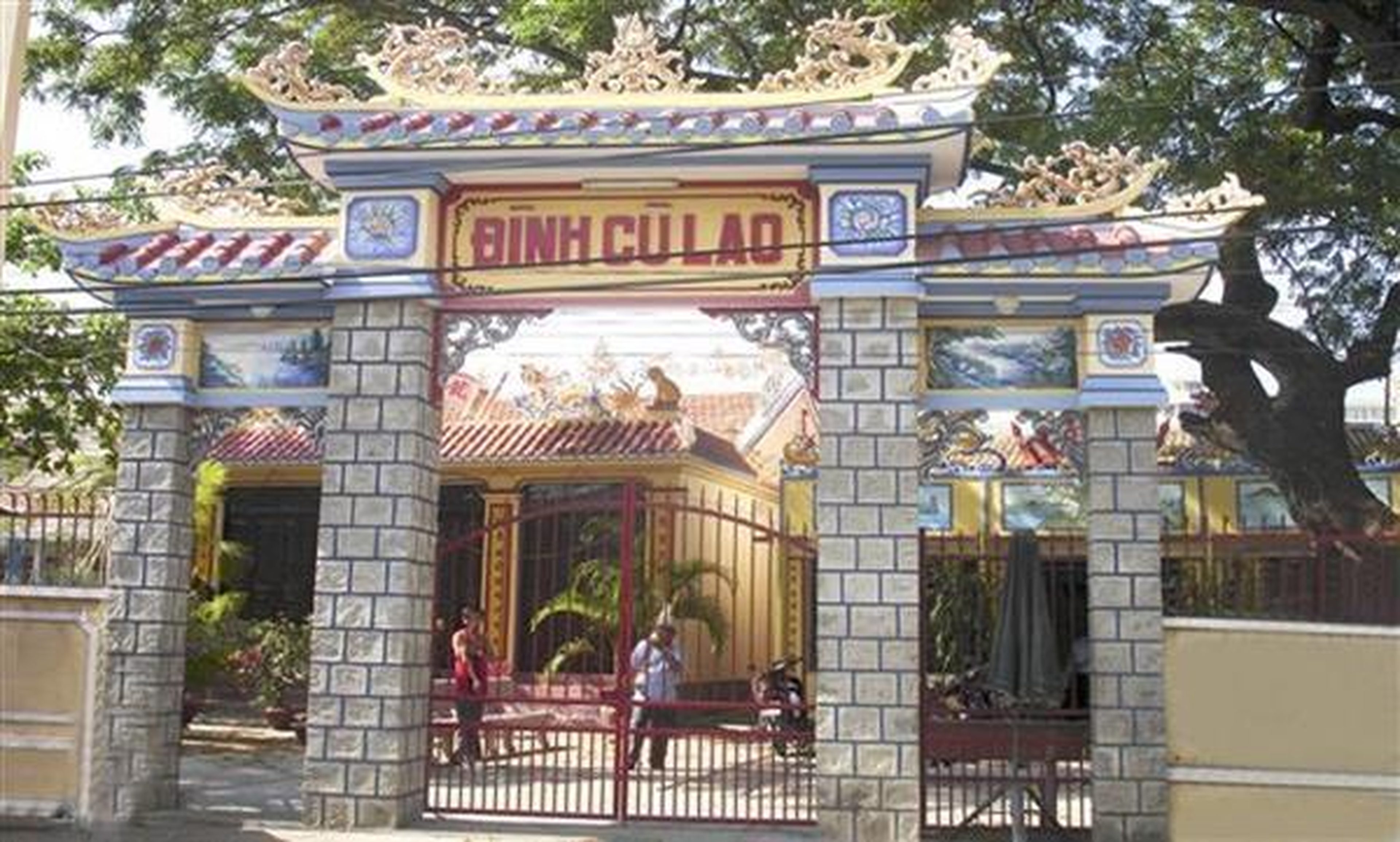
Cu Lao Communal House and Mausoleum is located on Thap Ba Street, in Hai Phuoc residential group, Vinh Tho Ward, Nha Trang City, Khanh Hoa Province.
According to accounts from village elders, the village was previously named Cu Huan, situated along both banks of the Cai River – Nha Trang. As the village expanded and its population grew, Cu Huan was divided into two villages: Xuong Huan on the other side of the river and Cu Huan on this side. Later, Cu Huan village was renamed Cu Lao Xom Bong village. Before 1975, Cu Lao was one of three villages in Vinh Phuoc Commune, Vinh Xuong District, Khanh Hoa Province; in 1976, it became part of Vinh Tho Ward, Nha Trang City, Khanh Hoa Province.
Cu Lao Communal House and Mausoleum worships the Village Guardian Deity, Ong Nam Hai (Lord of the South Sea), the village founders (Tien hien), the village benefactors (Hau hien), fallen heroes, and the Goddess of the Five Elements.
Cu Lao Communal House was built over 200 years ago in the Ba Rung area (now in Vinh Phuoc Ward, Nha Trang City). The communal house was constructed by Mr. Luong Van Tinh (a descendant of the Scholar Luong The Vinh) and local residents. Later, the structure burned down. In 1822, the communal house was rebuilt at its current location.
Facing south, Cu Lao Communal House and Mausoleum is built on a 1,222.8 m2 plot. The structure was restored and renovated in 2002, with its architecture preserving the traditional features of Khanh Hoa communal houses: the main hall features a multi-tiered roof, a wooden frame structure, rafters, and some decorative beam ends and columns intricately carved with the four sacred animals (Dragon, Qilin, Turtle, Phoenix).
Looking into the site from the outside, the main architectural components include: the Ceremonial Gate (Nghi Mon), the Screen (An Phong), the Main Communal Hall (Dai Dinh), the Shrine of the Village Founders (Mieu Tien hien), Oai Linh Pagoda, the Nam Hai Mausoleum, and the Shrine of the Five Elements (Mieu Ngu hanh).

Ceremonial Gate – Cu Lao Communal House
Today, Cu Lao Communal House and Mausoleum preserves horizontal lacquered boards (hoanh phi), parallel sentences (cau doi), incense burners, and three royal edicts issued by the Duy Tan and Khai Dinh emperors of the Nguyen Dynasty, including:
- The 5th year of Duy Tan (1911) bestowing the title of Village Guardian Deity.
- The 2nd year of Khai Dinh (1917) bestowing the title of Great General of the South-East Sea.
- The 9th year of Khai Dinh (1924) bestowing the title of Village Guardian Deity.
According to tradition, every two years the people of Cu Lao hold a festival, alternating between the communal house and the mausoleum. The festival lasts for four days, from the 15th to the 18th of either the 6th or 8th lunar month. If the festival is held at the Nam Hai Mausoleum, it takes place in the 6th lunar month; if it is held at the communal house, it takes place in the 8th lunar month.
Some of the rituals performed during the festival include: The procession of the royal edicts, the reception of Ong Nam Hai, offerings to the Deities, offerings to the village founders and fallen heroes, the Opening Ceremony (Khai dien) - Sequential Rites - Honoring the King (Ton vuong), and the conclusion of the royal edicts.
Additionally, the communal house and mausoleum hold annual memorial ceremonies on the following days:
- 1st day of the 1st lunar month: New Year's commencement ceremony.
- 15th day of the 1st lunar month: Chanting for national peace and public prosperity.
- 3rd lunar month: Thanh minh (Tomb Sweeping) offerings.
- 9th day of the 10th lunar month: Memorial service for the village founders.
- 24th day of the 12th lunar month: Giap am offering.
To date, the Communal House and Mausoleum has been restored at least six times:
- First time: 1924. The communal house was built with limestone, walls constructed of clay mixed with sand and bời lời tree resin. The roof was covered with yin-yang tiles.
- Second time: Year unknown. Walls were built of brick, floor coated with cement. Columns and rafters were made of wood.
- Third time: 1998, construction of the ceremonial gate and perimeter wall. Due to the expansion of Thap Ba Street, a portion of the communal house and mausoleum land was cut, requiring the ceremonial gate and front wall to be set back.
- Fourth time: May 2002 (the fourth month of the Year of the Horse) for the restoration and renovation of the communal house.
- Fifth time: 2006, restoration and renovation of the Shrine of the Village Founders and Oai Linh Pagoda.
- Sixth time: 2011, restoration and renovation of the Ong Nam Hai Mausoleum.

Ong Nam Hai Mausoleum
On October 10, 2008, the People's Committee of Khanh Hoa Province designated Cu Lao Communal House and Mausoleum as a Provincial Historical and Cultural Relic under Decision 2510/QD-UBND.
Source: https://disanvanhoa.khanhhoa.vn/