



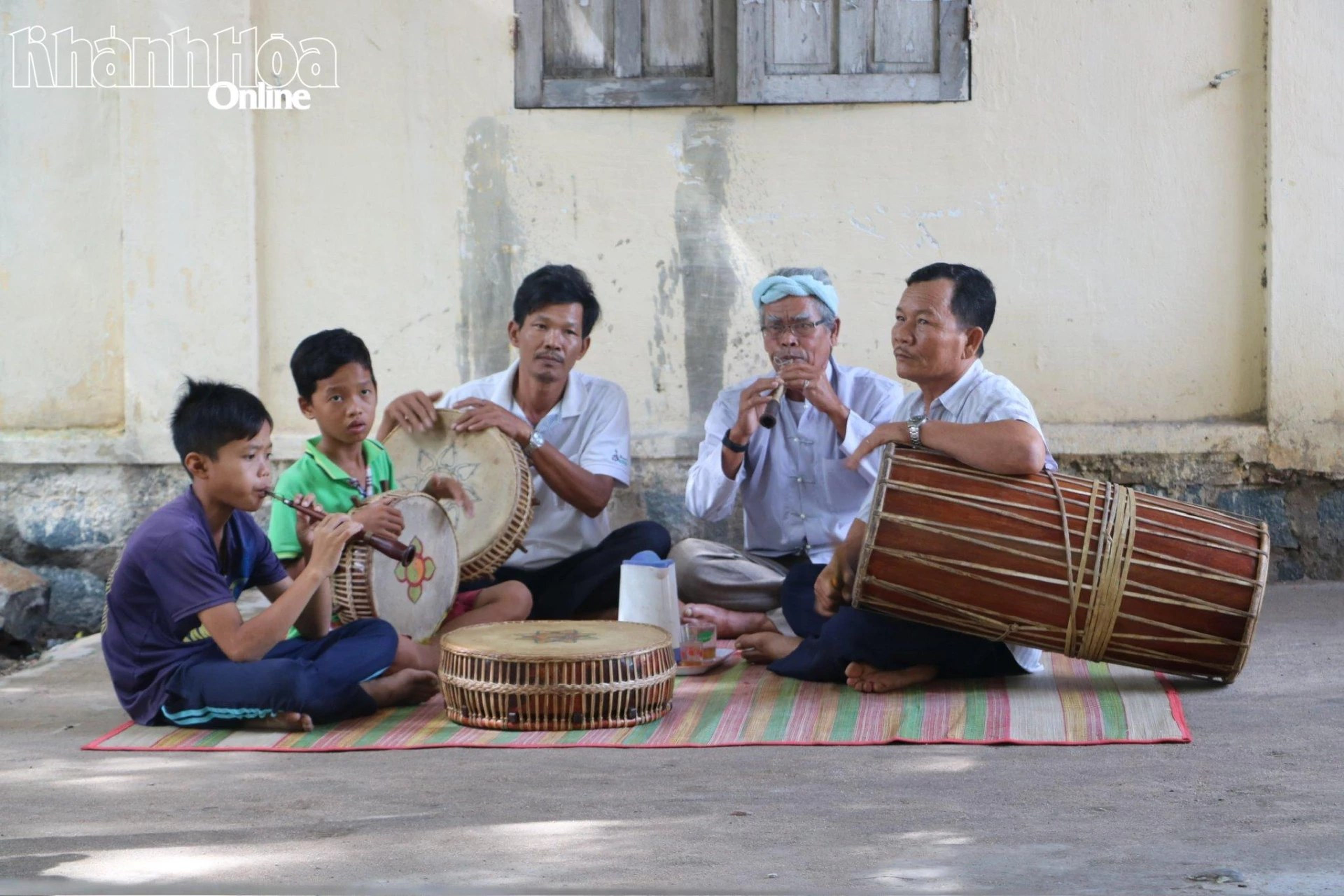
Cham musical instruments are not numerous, but each holds its own place and meaning in community life. The more one learns, the more one realizes that the beauty of Cham music lies not in an abundance of instruments, but in how the ancients created sounds, combined rhythms, and embedded within them their concepts of life and faith. Few yet refined, each instrument has its own voice, contributing to the unique character of Cham folk music.
Ginang drum - the sound of harmony
In the Cham ceremonial ensemble, the ginang drum is an instrument with a powerful, vibrant sound. But what is special first lies in how it is played: ginang drums always come in pairs, with their two bodies leaning against each other in an X-shape and one end resting on the ground. The Cham liken the drum pair to the sturdy legs of the human body, alongside the head and torso. That analogy shows that the ginang drum is not only viewed as a musical instrument, but is also linked to concepts of balance and cohesion in cultural life.
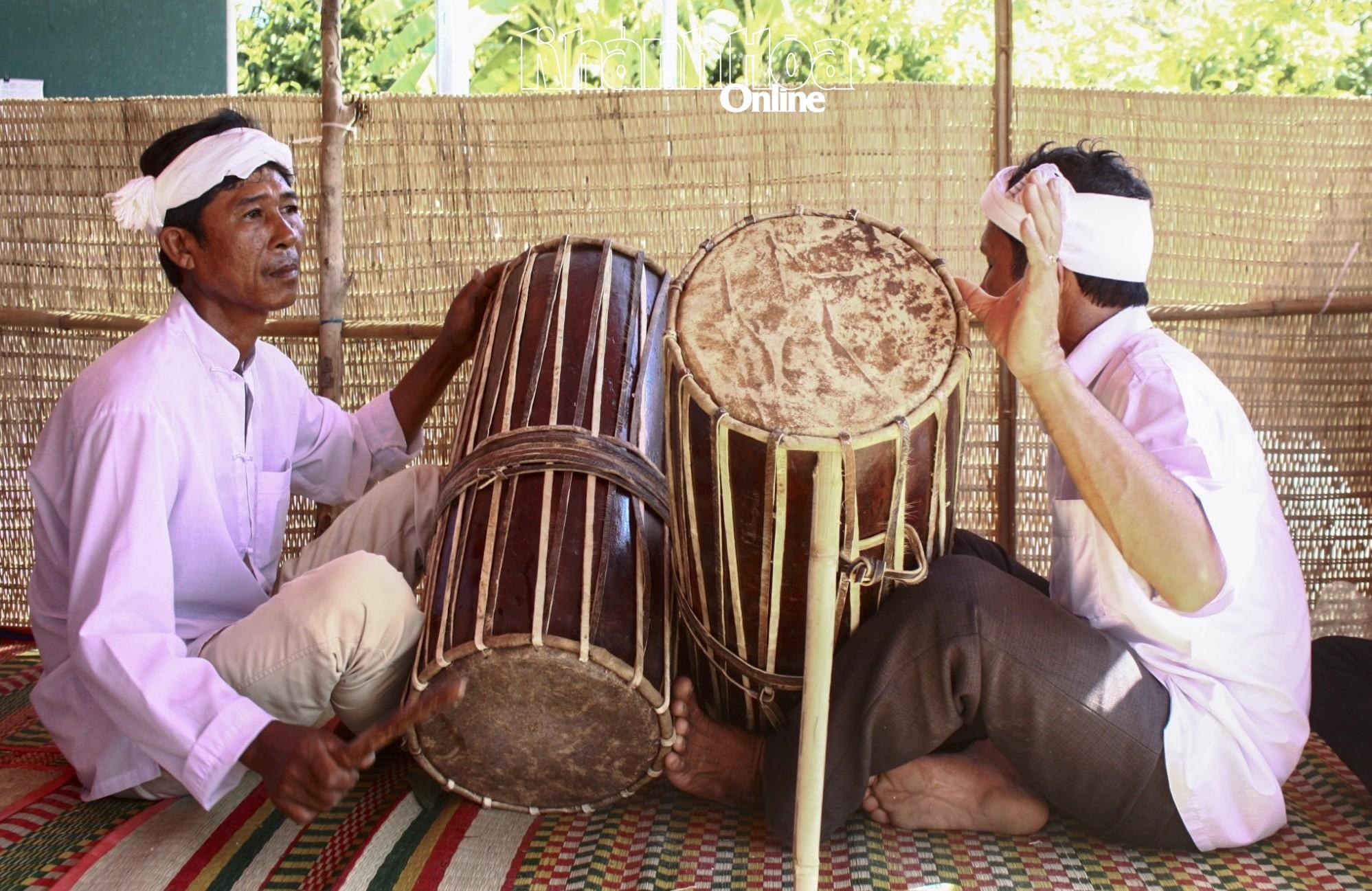 |
| A Cham artisan performs on the ginang drum. |
According to records on the craft of making Cham musical instruments, Maduen dignitaries in several villages such as Huu Duc, Hau Sanh, and Tan Bon once directly made ginang drums. The drum body was hollowed out from fine hardwoods such as hog plum, ca chi, or green ironwood. The two drums in the same set had to be taken from a single tree trunk before being shaped, stretched with skin, and laced with cords. This seemingly small detail demonstrates the craftsman's meticulousness: the two drums are not two separate instruments joined together, but a pair crafted to harmonize with each other.
The drum has two heads with different sizes and playing methods. The larger head, called the pam head, is covered with buffalo hide, placed tilted so that the drum rim touches the ground, and played with a mallet. The smaller head, called the chang head, is usually covered with goat skin or red hide, faces upward, and is slapped with the palm of the hand. According to the yin-yang concept in traditional interpretation, the pam head symbolizes yin, while the chang head symbolizes yang. Though differing in how they produce sound, the two drum heads work in harmony to create the distinctive rhythm of the ginang.
The ginang drum has six basic sounds: tớ, tìn, and tịt on the chang head; glèng, gleng, and kịt on the pầm head. In addition, players can produce "cắc" sounds by striking the rim or shell of the drum. At first listen, these may seem like brief syllables, but to produce clear, solid, and rhythmic drumbeats, the drummer must master the technique, knowing how to regulate hand force and how to use the drumsticks. During a performance, the distinction between the sounds not only creates rhythm but also showcases the artisan's experience and skill.
Notably, the ginang drum appears in both religious rituals and community festivities. However, the boundary between these two spaces is clearly defined. Repertoires used in ceremonial music are not casually performed for mere entertainment. Even in competitions, players must adhere to specific repertoires and conventions. This demonstrates that, for the Cham people, folk music is both a performing art and part of cultural rules preserved across generations.
The paranung drum - keeping the rhythm for rituals
While the ginang drum impresses with its paired form and powerful sound, the paranung has a simpler appearance. The drum resembles a small basin, with only one side covered with muntjac or goat hide. The drum body is carved from a piece of wood, and the skin head is stretched with rattan cords. Around the base, there are holes for wedges, enabling the artisan to adjust the tension of the drumhead when necessary.
The paranung produces a soft, low sound, but plays an essential role in ceremonial ensembles. The player of the drum is the Maduen dignitary, who is also the officiant of the Rija ritual. This status makes the paranung not simply an instrument that produces sound, but one tied to the role of overseeing and guiding the progression of the ritual. Some sounds do not need to be loud to hold a central place, for what matters is their function and significance throughout the ritual space.
The drum is held against the abdomen, with the skin-covered surface facing outward, and tapped using the fingers of both hands. The paranung has three basic sounds: tìn, tin (or tâm), and tắc. The differences among the sounds depend on the striking position as well as how the fingers are muted or released after touching the drumhead. On the very same drumhead, merely by altering the playing technique, the player can produce distinct sounds: staccato, resonant, or muffled.
From an instrument of uncomplicated construction, the Cham people produce distinct tonal nuances through technique and experience. That is also a precious trait of folk music: its value does not necessarily lie in the complexity of the instrument, but in the performer's mastery over sound and their understanding of handed-down repertoires.
The saranai horn - a distinctive nuance of Cham music
In the trio of instruments closely bound together in festivals featuring Mâduen dignitaries, alongside the ginăng drum and the paranưng drum is the saranai horn. While the drums set the beat and sustain the rhythm, the horn helps shape the melodic lines, adding nuance and depth to the music.
The saranai player is known as Ong Yuk. This instrument has a definite pitch, allowing its pieces to be transcribed using modern musical notation. Transcribing these melodies serves a practical purpose: researchers, music learners, and anyone interested in Cham music have an additional foundation to access, practice, and cross-reference with traditional performance methods.
However, written music is only one part of preserving the heritage. To fully understand the sound of the saranai, the melody must still be placed in relation to the ginăng drum, the paranưng drum, and the progression of each ritual. This is because Cham music does not exist in isolation from community life. Each instrument plays its own role, each performer assumes a specific part, but together they create a unified whole.
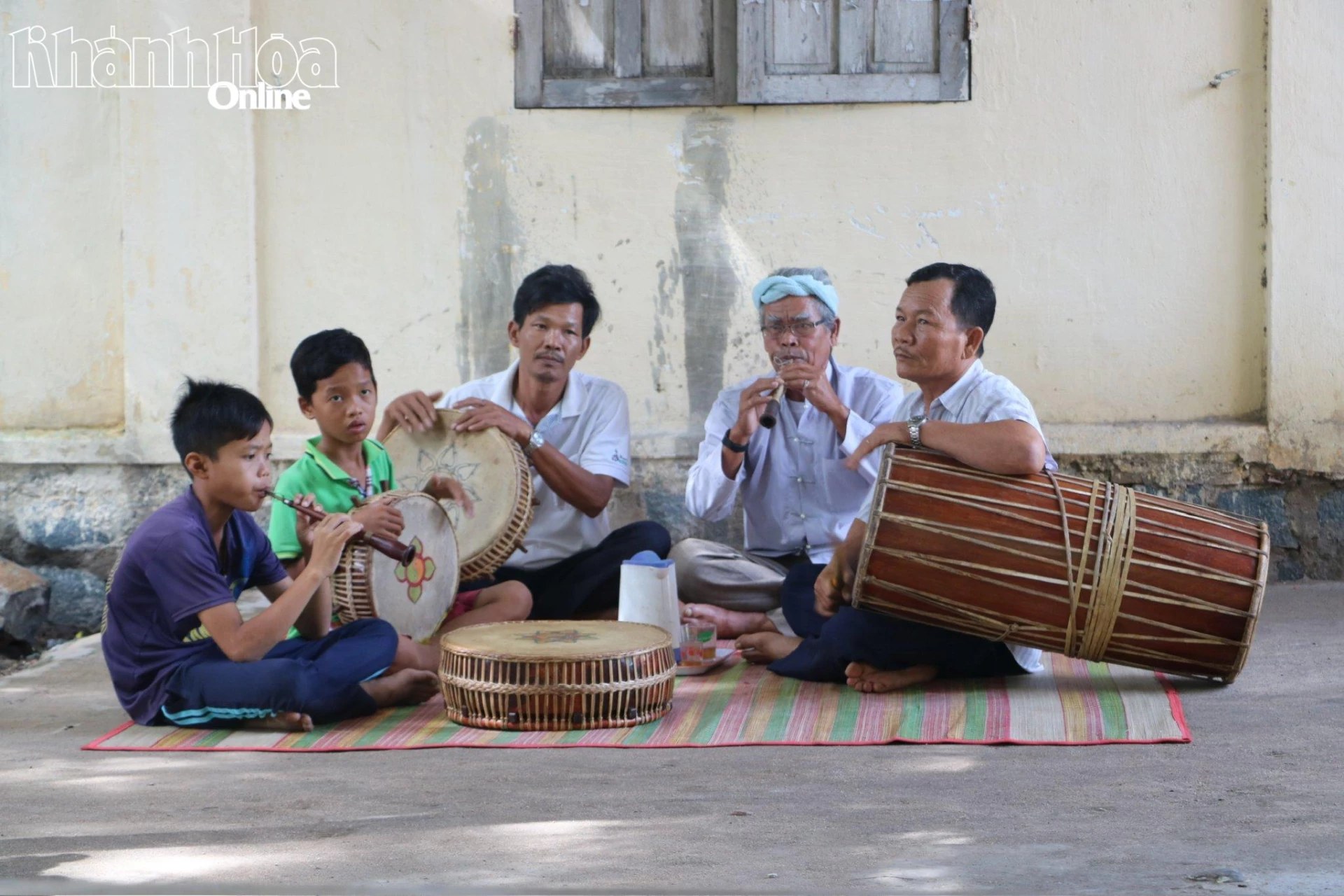 |
| An ensemble of traditional Cham musical instruments. |
Exploring these musical instruments reveals that the richness of Cham music lies not in the number of instruments, but in the depth of folk knowledge accumulated in each crafting method, performance technique, and musical piece. Artisans not only craft instruments or perform music, but also help preserve a cultural knowledge system handed down through generations. Transcribing, introducing, and practicing traditional pieces therefore not only helps readers better understand Cham music, but also contributes to preserving values that can only be fully appreciated when placed within the very cultural space that birthed and nurtured them.
S.C

