

1. Description of the intangible cultural heritage
1.1 Origin and existence process: The Cau Ngu Festival originates from the custom of worshipping Ong Nam Hai - a long-standing tradition of coastal residents from Quang Binh southwards, most densely in the South Central region. Ong Nam Hai is actually the Whale - a species with a large body but a gentle nature, often rescuing fishermen in distress at sea, called "Duc Ong," "Ca Ong," or "Ong Nam Hai" by fishermen in the southern provinces. When a Whale dies and drifts ashore in the territory of any fishing village, that village must organize a solemn funeral and establish a shrine to worship it with great reverence. The ritual to worship Ong Nam Hai is now often called the Cau Ngu Festival.
1.2. Legends about the Whale worship custom
When the custom of worshipping Ca Ong (Whale) began and where it originated cannot be confirmed exactly to this day. To explain the whale worship, there are many legends, some of which are still passed down to this day:
- According to Cham mythology: After a period of practicing magic, being eager to return to his homeland, Cha-Aih-Va disobeyed his teacher and turned into a whale, going out to the big river, and was subsequently punished. Cha-Aih-Va changed his name and called himself Po Riyah (God of the Sea Waves), sometimes transforming into a swan, becoming a benefactor to those who were shipwrecked.
- Buddhist legend tells that: Long ago, when the Bodhisattva Guan Yin (Nam Hai Quan Am) was touring the South Sea, she was very pained to see that every storm season, many boatmen and fishermen were shipwrecked and drifted at sea. To save those souls, she took the kasaya she was wearing, tore it into thousands of small pieces, and threw them into the open sea, transforming them into large-bodied whales, and bestowing upon them the "Way-shortening magic"to swim very quickly to reach and save people in distress. Since then, the whale has always been an effective assistant in rescuing people in distress at sea. Therefore, coastal people in the southern provinces of our country consider the whale to be a deity of the open sea.
- The legend also tells that while fleeing to Siam to avoid the pursuit of the Tay Son Dynasty, when reaching the Gulf of Thailand, Nguyen Phuc Anh's boat encountered a storm. When it was about to capsize, it was supported by the Whale and brought to Tho Chau Island. In 1802, after ascending the throne, Nguyen Anh (Emperor Gia Long) issued a decree bestowing the title of "Nam Hai Dai Tuong Quan" (Great General of the South Sea) upon the Whale to show his gratitude. The kings of the Nguyen Dynasty continuously bestowed noble titles upon this Whale, and the highest title bestowed upon Him is: Nam Hai Cu Toc Ngoc Lan Thuong Dang Than.
- Particularly in Quang Hoi village (Van Thang commune, Van Ninh district, Khanh Hoa province), there is a legend related to Guan Yu (Quan Cong) and Ong Nam Hai. The legend tells that a phoenix laid two eggs; one fell into the East Sea and turned into Ong Nam Hai (the whale), and the other fell on land, was incubated by a monk in a large bronze bell, and after 100 days, Quan Thanh hatched...
Feudal authorities previously stipulated that: If any village caught a dead whale, the village chief had to report to the prefecture or district for officials to examine, provide burial money, incense, lamps, and red cloth to wrap seven times, provide the funeral shroud, and grant land to build a shrine and incense fields for worship. After 3 years, they would rebury the remains, place the bones in a sarcophagus or jar, and move them into a pre-built shrine, village communal house, or temple to worship according to local customs. Each village had people to look after the incense and a village management board.
From this custom, in Khanh Hoa, whoever sees the whale carcass first has the duty to pull it to the shore to organize the funeral. At that time, they become the eldest son of the Whale and must observe 3 years of mourning, not just 100 days like in other provinces in the region. After the mourning period, every year on the day of "luy" (meaning the day the whale died), the fishermen solemnly organize the Ong Nam Hai Worship Ceremony – also known as the Cau Ngu Festival – with full rituals. Coastal people believe that the more thoughtful the ceremony and the more complete the rituals, the more grace He will bestow upon the fishermen for a bountiful catch, and for a prosperous and full life.
To this day, the coastal residents of Khanh Hoa still consider this day an important festival, and they organize it with great solemnity and reverence to pray for national peace, public security, and prosperity, making it a festival in both the literal and figurative sense.
In addition to independent shrine structures, in Khanh Hoa, there are some whale worship sites located within village communal houses, such as: Truong Tay, Tri Nguyen, Truong Dong (Nha Trang City), Ba Ha 1, Dong Ha (Ninh Hoa district). Ong Cu Lao Shrine (Vinh Tho ward, Nha Trang City) is located in a complex of folk belief sites including: Pagoda, Communal House, Ancestral House, and Ong Nam Hai Shrine. However, the internal worship structure is the same as that of independent shrines. Today, the practice of "combining communal houses and shrines " and "co-worship and co-ritual " is supported by many fishermen and has a growing trend.
2. Process of the Cau Ngu Festival in Khanh Hoa
If festivals in the plains of Khanh Hoa tend towards solemnity and reverence, the Cau Ngu Festival tends towards jubilation, excitement, and a vitality like tidal waves. Unlike other traditional festivals where the festival space is usually confined to the shrine area, the space of the Cau Ngu Festival is expanded to the whole village and out into the open sea, with the Ong Shrine serving as the focal point.
In that open space, many rituals take place over three days and nights, including unique rituals such as: The Nghinh Ong Procession (Tide Welcoming Ceremony), the Ho Ba Trao performance – those rituals that are full of festive nature have created the characteristics for the Cau Ngu Festival in the South Central region in general and Khanh Hoa in particular.
2.1. The Royal Decree Procession
In Khanh Hoa, royal decrees bestowing titles on Ong Nam Hai are usually not kept at the Shrine but are stored in the Ancestral House or entrusted to a prestigious village elder for safekeeping, called 'Thu sac' (Keeper of the Decree). When there is a festival, the decree is carried to the Shrine to perform the worship. Therefore, the Decree Procession is considered the opening ritual of the Cau Ngu Festival in Khanh Hoa.
The Decree Procession begins on the morning of the first day of the Festival. At the designated time, the Ritual Board, village elders, those serving the festival, and villagers in solemn formal attire gather fully at the Ancestral House to prepare for the ceremony. The ceremony consists of three parts:
- Thinh sac (Requesting the Decree): Performed solemnly in front of the main hall of the Ancestral House. The Ritual Board, on behalf of the villagers, offers incense to request the Guardian Deity and the Ancestors to allow the Ong Nam Hai decree to be taken to the Shrine for worship. In some places, the Thinh Sac Ceremony is also the Ancestor Worship Ceremony.
- Procession of the Decree: Performed in the form of a solemn procession. A well-organized procession leaves a deep impression on everyone, attracting a large number of villagers to participate and creating an atmosphere that is both sacred and intimate – solemn yet very lively and joyful.
- Khai sac (Unveiling the Decree): When the procession returns to the Shrine, the Ritual Board brings the Royal Palanquin into the Main Hall. After placing the Palanquin in the Shrine, the Chief Officiant will take the decree and place it on the altar to perform the Khai Sac Ceremony and open the Cau Ngu Festival.
Today, due to the trend of simplifying traditional rituals in festivals, some fishing villages have merged the Village Communal House and the Ong Shrine into one for both worship and rituals. Consequently, many places no longer maintain the traditional Decree Procession but only keep the Khai Sac Ceremony – a mandatory ritual before the festival.
2.2. The Nghinh Ong Ceremony
While the Decree Procession is a ritual used for many festivals where the organizing location or the main Deity worshipped has a royal decree, the Nghinh Ong Ceremony is a ritual unique to the Cau Ngu Festival.
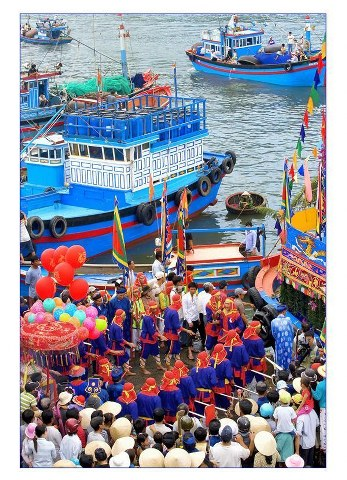
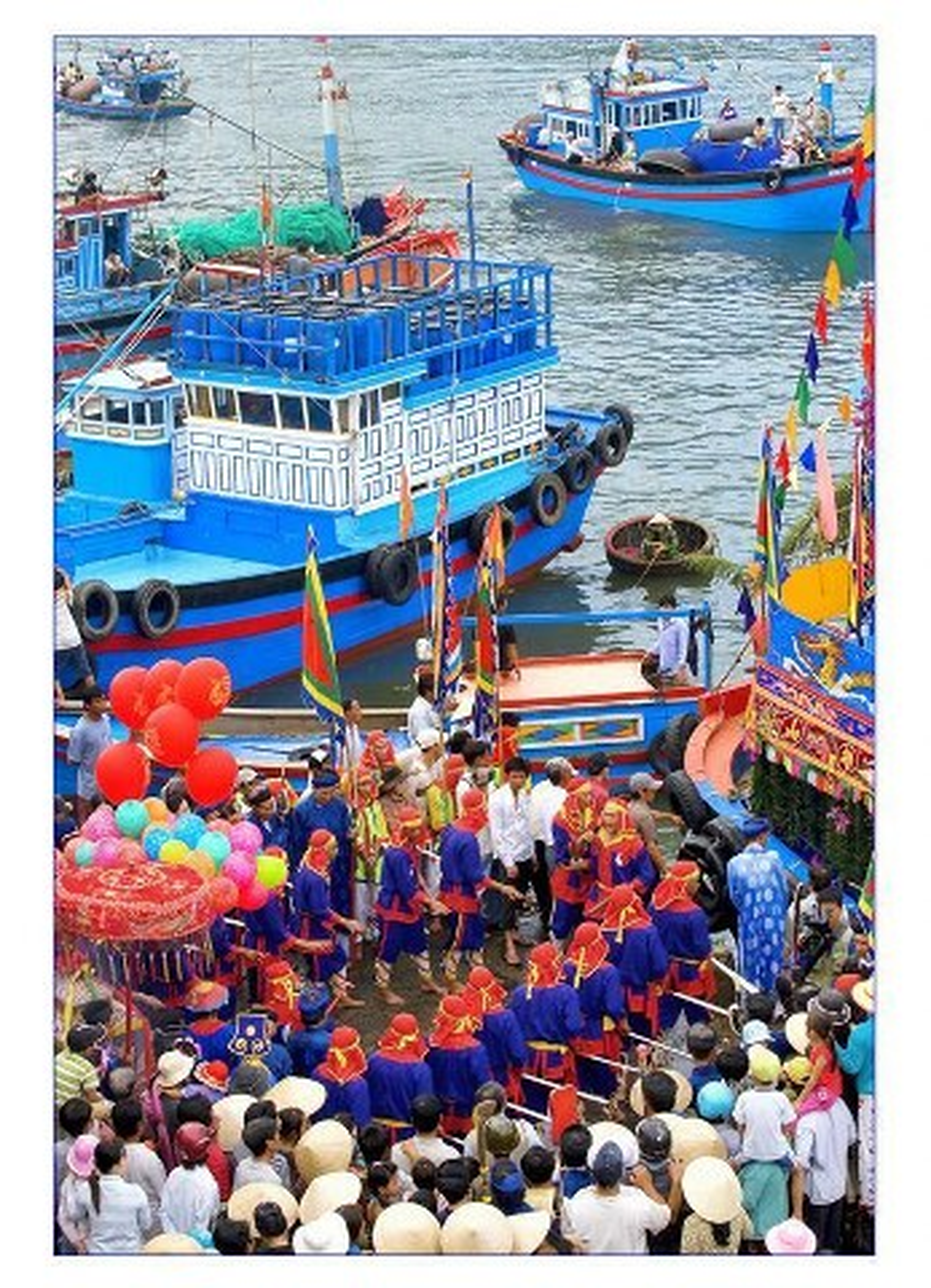
The Nghinh Ong Ceremony in Khanh Hoa is usually held at high tide, so it is also called 'Tide Welcoming Ceremony'. The ceremony is performed with the purpose of inviting the soul of Ong Nam Hai from the open sea to the Shrine before the Main Ceremony. Therefore, this ritual is also called 'Phung nghinh hoi dinh' (Respectfully inviting [him] back to the communal house). Because the Cau Ngu Festival in each village does not coincide in time and must depend on the tide, the time for each village's ceremony is different. However, most Nghinh Ong ceremonies in Khanh Hoa are organized early in the morning – the time when the sun rises as well as the tide. The Nghinh Ong ceremony usually lasts about two hours. The fleet of boats participating in the Nghinh Ong Ceremony in Khanh Hoa must be genuine fishing boats and are arranged as follows:
- Ceremony Boat: To create more space for the ceremony, many places combine two smaller boats into the main boat to form the ceremony boat. The main boat is lavishly decorated with flags and parasols, with a main flagpole in the middle carrying a large flag. The Royal Palanquin is placed at the bow of the boat, in front of which is an incense table for offerings. The Ritual Board and the music band sit on the main boat. The two side boats are also decorated with flags and flowers and are reserved for drums, gongs, and ceremony servers.
- Ba Trao Boat: Consisting of 2 boats going on both sides of the Ceremony Boat, also decorated with flags and flowers but simpler than the Ceremony Boat. One boat carries a group of Ba Trao and the Master Helmsman, the other boat carries a group of Ba Trao along with the Bow Master and the Hold Master (Commercial Master). The Ba Trao team must stand and row in service throughout the ceremony at sea.
- Leading Boat: A small boat carrying the Lion dance team; this boat must be connected to the Ceremony Boat by a rope and has the task of leading the procession. Many places that do not organize a leading boat will have the Lion dance team on the Ceremony Boat.
In addition to the aforementioned boats, there are many boats of fishermen or tourists who follow the ceremony, creating a joyful atmosphere and colors for the Nghinh Ong Ceremony.
When going out to sea, the Leading Boat carrying the Lion dance team leads the ceremonial fleet; the Ceremony Boat goes in the middle, and the two Ba Trao boats go on either side and lag behind half the length of the Ceremony Boat. The Ba Trao and Lion dance teams dance gently to the rhythm of the boat's movement but do not sing or use music. Once reaching the sea mouth, they stop and perform the rituals. Afterward, the fleet returns in the bright morning sun. The Ceremony Boat still goes in the middle, the two Ba Trao boats sail side-by-side and swap positions to simulate how the Whale swims when drifting ashore to find a place to "pass away." The sound of gongs and drums sets the rhythm for the Ba Trao team to sing 'Phung nghinh hoi dinh' throughout the way back to invite the spirit of Ong to enter the Shrine for worship. Upon docking, the bow of the boat must face the Shrine; the ritual team brings the Royal Palanquin down, and together with the villagers, they escort the soul of Ong into the hall. At this point, the Siu team dances before the altar to welcome Ong, then the Ba Trao team performs once more, and this time it is performed right in front of the altar to welcome Ong back to his grandchildren.
2.3. Ho Ba Trao
Ho Ba Trao is a folk performance in the South Central region with a strong, integrated, holistic nature. It is a synthetic performance form featuring elements of folk theater such as dance, song, and spoken word... Although it is a performance, it is considered a mandatory ritual unique to the Cau Ngu Festival in the South Central region and Khanh Hoa.
 Ho Ba Trao in the Cau Ngu Festival
According to ancient custom, every village with an Ong Shrine establishes a Ho Ba Trao team to serve their village festival. Before the festival day, the village selects 15 to 19 healthy young men to practice the Ho Ba Trao performance. During that training period, they must eat vegetarian, sleep on the ground, avoid killing, and not have relations with women to keep their body and mind pure to serve Duc Ong (Lord Whale). Later, this ancient rule was relaxed, and due to the need to improve the quality of festival services, semi-professional and professional Ho Ba Trao teams were formed. Since then, coastal villages have gradually lost their own Ho Ba Trao teams or only retain the rowers, while key roles like the Master Helmsman, Bow Master, and Commercial Master have to rely on professionals to perform.
Because the starting point of the Ho Ba Trao performance is to worship Ong Nam Hai, even though the performance has been partially professionalized over time and added many aspects, it still retains the flavor and character of the early period and is used only in the Cau Ngu Festival or related worship days of coastal residents in the South Central region and Khanh Hoa, contributing to the identity of a land.
Through a survey of the Ho Ba Trao scripts existing in Khanh Hoa, it can be seen that although the scripts differ in literary language, singing melodies, and length, the content all focuses on praising the merits of Ong Nam Hai and the desire for a peaceful life, and praying for a bountiful catch. And even though the scripts and performance styles differ, they all share a common structure and layout. This unity in structure, layout, and content has created a comprehensive script and formed the performance with the common name: Ho Ba Trao. Below is the structure of the Ho Ba Trao performance in Khanh Hoa.
 Characters in the Ho Ba Trao performance
Portrayal of characters in the Ho Ba Trao performance:
- Master Helmsman: The boat captain character, costumed as an old fisherman and in charge of the steering position. The Master Helmsman wears a black or blue traditional long dress with white trousers, holding a paddle about 2.4m long, and is the leader who directs the entire rowing team.
- Bow Master: Costumed as a strong middle-aged man, standing at the bow position, holding a pair of wooden castanets to keep time for the whole troupe to sing and perform. Like the Master Helmsman, the Bow Master character often sings the lead and must be a person proficient in singing and performing because, in addition to his own role, the Bow Master is also the timekeeper for the entire performance.
- Commercial Master: A humorous character, standing in the middle of the hold, so he is also called the Hold Master. The Hold Master in the performance is responsible for taking care of the boat, bailing water, cooking... The Hold Master wears a short black tunic, holds a fish-shaped stick, and has mouse whiskers drawn on his face, so he is also called the Mouse Master.
- Rowers (Trao phu): There are 10 to 16 people, each holding a short 1.2m paddle. All rowers wear blue (or black) tunics, white trousers, with sleeves and trouser legs wrapped in leggings; they wear cone-shaped hats like old-time soldiers. All are arranged in two rows creating the model of a ship gliding out to sea, simultaneously symbolizing the servants of Ong Nam Hai.
Structure of the Ho Ba Trao script:
Surveying the texts shows that Ho Ba Trao in Khanh Hoa has the following structure:
- Act I - Jiao Tou (Introduction): Performed by the Master Helmsman. This act introduces the reason for the Ho Ba Trao performance. Depending on the purpose of the ceremony, the content of the introduction act may vary. The introduction act is usually connected after the dance of arranging characters to wish for blessings and bowing to Ong Nam Hai.
- Act II – Sailing out to sea This is the main and most important act of the Ho Ba Trao performance. It is the most important not only because it is the longest (nearly half the performance) but also because in this act, the performance techniques are most utilized, and through it, the entire thematic and content of the performance is revealed.
In this act, many theatrical techniques are used; singing methods taken from "hat boi" (classical opera) are interwoven with characteristic folk melodies, in which the song 'Ho Ba Trao' transitioning to the Nam singing style is used many times. Researcher Mich Quang wrote: "...Since ancient times, the Nam singing style has only been used for the moment of preparing to leave and while on the way. Nam singing is never used for dialogue, mainly for monologue, and it is a monologue while on the way, definitely not a long-night monologue..." And he emphasized the function of Nam singing as "expressing the character's feelings while on the way". This combination is intended to describe the process of the boat overcoming waves out to sea and the fishermen's feelings toward the sea and sky and their aspirations.
- Act III – The Commercial Master watches the storm: This act describes the scene of the boat resting on the sea. When everyone is asleep, only the Commercial Master is left watching the boat and bailing water. This is an act reserved for the Commercial Master's solo performance and is the act with many humorous details, allowing the performer maximum improvisation, so it requires a skilled performer. The act ends when the Commercial Master detects a storm suddenly approaching and wakes everyone up to cope with it.
The Commercial Master storm-watching act is a piece of daily life right within the sacred atmosphere of the ceremony, making the harmony between the divine and humans more intimate, thus the humanistic value is higher.
- Act IV – Returning to shore: Describes the scene of the fishing group fighting the storm to bring the boat back to shore safely. This act uses many unique folk songs of the Ho Ba Trao performance such as: Ho Mai Dam, Ho Mai Ngoi, Ho Nhai, Ho Ba Trao... creating a lively and powerful performance act like the spirit of overcoming danger of the coastal people.
In many scripts in Khanh Hoa, this act is often written in "luc bat" (6-8 syllable) verse and is up to two hundred lines long; the content focuses on telling of the merits of Ong Nam Hai and like a plea for him to help the fishermen overcome the storm. This segment is also the segment the Ba Trao team must sing when turning the boat back during the Nghinh Ong Ceremony. Therefore, it is also called the Boat Returning Act.
Regarding the content of Ho Ba Trao in Khanh Hoa:
It can be said that whether it is performed during the Cau Ngu Festival, the Bone Relic Elevation Ceremony, or the New Shrine Inauguration Ceremony, the essential and overarching content of Ho Ba Trao still focuses on reflecting the following aspects:
- Ho Ba Trao – A hymn of praise for the merits of Ong Nam Hai: Surveying the scripts currently kept at the Truong Tay Shrine (Vinh Nguyen ward), Truong Dong Shrine (Vinh Truong ward) of Nha Trang City, and Luong Hai Shrine (Van Gia town, Van Ninh district), it will be clear that the main content is praising the merits of Ong Nam Hai and the adoration, respect, and sorrow of fishermen when He "passes away." In particular, the 'Phung nghinh hoi dinh' act sung by the Ba Trao team during the Nghinh Ong Ceremony clearly reflects that it is a hymn of praise for the merits of Ong Nam Hai.
- Ho Ba Trao – The epic of the coastal people: Believing in the protection of Ong Nam Hai does not mean that coastal people leave their lives to fate. On the contrary, that faith has become a driving force to give them more confidence and will when facing storms. This has been strongly depicted in the Ho Ba Trao performance in Khanh Hoa. It can be said that Ho Ba Trao is not only a hymn about Ong Nam Hai but also a heroic and magnanimous epic of the coastal people.
With the image of the boat gliding out to sea along with strong rowing movements and powerful labor work songs praising the sea, sky, and country, sung with a magnanimous spirit, this is fully expressed.
- Ho Ba Trao – The faith and aspirations of the coastal people: As a performance dedicated to Ong Nam Hai, the content must exude praise for his merits and prayers for his protection when going out to sea and coming back, while simultaneously expressing their aspirations, asserting their dreams, and consolidating their faith: ''Now the fishing village gathers/ with one heart to start the whale worship ceremony/ Praying for plenty and warmth for everyone/ peaceful life and prosperity for every home...''
In summary, Ho Ba Trao is a long-standing folk performance continuously preserved and fostered by generations of fishermen and artisans in the South Central region and Khanh Hoa, and to this day, it has reached a degree of perfection in content and structure. The greatest characteristic of the Ho Ba Trao script is its open structure, and thanks to that, it is always becoming increasingly enriched. Such a structure allows folk artists of the South Central region and Khanh Hoa to be creative without going off track. Therefore, every Ho Ba Trao script is different, but when read, sung, and especially when performed in the Cau Ngu Festival, nothing can be mistaken.
Therefore, it can be said that if the Cau Ngu Festival is a unique intangible cultural heritage of the coastal residents of Khanh Hoa, then the Ho Ba Trao performance is a unique folk art work in the Cau Ngu Festival, deserving to be considered an independent intangible cultural heritage within the common heritage.
2.4. Tinh Sanh Ceremony
The Tinh Sanh Ceremony is a ritual before entering the Main Ceremony. In Khanh Hoa, when worshipping natural deities or celestial deities, the offerings must include "tam sanh" (three types of sacrificial animals), among which there must be a whole live pig. The Tinh Sanh Ceremony is actually a ritual to ask the Deity for permission to kill the sacrificial animal. The pig chosen for sacrifice must be "toan sinh, toan sac" (meaning a pig of one color and kept whole).
While the Nghinh Ong Ceremony is taking place at sea, those assigned at home will conduct the Tinh Sanh Ceremony.
2.5. Main Ceremony
In any festival, the Main Ceremony is always the most sacred moment and the most important ritual. In the Cau Ngu Festival in Khanh Hoa, the Main Ceremony takes place after the Ba Trao team has completed their ritual before the altar of Ong Nam Hai and the ritual board has also prepared everything necessary for this important ceremony. Usually, the Ong Nam Hai Main Ceremony takes place around 10 AM and lasts until 11 AM - i.e., the beginning of the Horse Hour (Ngo hour). People believe that the more solemn and grand the ceremony, the more protection will be received from Ong Nam Hai. Therefore, no mistakes must be made during the Main Ceremony. At the end of the Main Ceremony, the Ba Trao team dances and bows to Ong Nam Hai to conclude.
2.6. Secondary Ceremony and Ton Vuong
- The Secondary Ceremony is the ritual following the Main Ceremony, conducted in the form of singing to worship the deity. The Secondary Ceremony is a ritual that is not always present in the Cau Ngu Festival. Typically, every 3 years, on the day of the Cau Ngu Festival, fishing villages invite a "hat boi" troupe to perform, primarily to worship Ong and secondly to entertain the villagers after a long year of hard work. And only in years when the village invites a hat boi troupe to perform for Ong do they organize the Secondary Ceremony and Ton Vuong.
The stage for organizing hat boi in the Cau Ngu Festival is set up at the performance pavilion (or shrine courtyard) and faces the altar of Ong to perform. The audience stands and sits watching from all three sides. With such a stage setup, the main audience for the Secondary Ceremony performance is the deities, while the people are just secondary viewers. Because of this way of performing facing the altar, the people of Khanh Hoa also call hat boi in the Cau Ngu Festival ''hat an'' (altar singing).
Singing at the Secondary Ceremony is singing to worship the deity, singing to offer to Ong, so it is respected by the villagers and has its own regulations, not like a regular performance. Regarding the plays, the Secondary Ceremony in Khanh Hoa must perform "Tuong Ong," meaning plays about the character Guan Yu (Quan Van Truong) in the Romance of the Three Kingdoms, and it is usually the play "Quan Cong releases Cao Cao at Huarong Trail," because this is the only play among the "Tuong Ong" plays that does not have scenes of killing on stage, and at the same time, the act of releasing Cao Cao to repay a debt of gratitude is seen by the people as a noble gesture of integrity, and that behavior fits well with the mentality and behavior of coastal people.
According to ancient custom, the person playing the role of the Red Duke (Guan Yu) must be an actor who is both retiring and moral. In many places, when the Red Duke appears, everyone must stand up to show respect. In the consciousness of the coastal people of Khanh Hoa, Ong Nam Hai and Lord Guan Yu have been unified. This is also one of the unique nuances of the Cau Ngu Festival in Khanh Hoa.
- Ton Vuong is the ritual that ends the ceremony, also performed by the hat boi troupe. According to tradition, after the Secondary Ceremony singing part, the Organizing Committee will pause for a moment to allow villagers and visitors to enter the shrine to offer incense; then they will announce for those in mourning, those with disabilities, and pregnant women to temporarily leave the place where the ceremony is being held, then close the Shrine gate to conduct Ton Vuong. The hat boi troupe in Khanh Hoa has a saying: ''First is the Secondary Ceremony, second is the Ton Vuong'' to remind each other to be careful because Ton Vuong is also an important ritual in the Cau Ngu Festival, so it cannot be taken lightly.
If we say the Secondary Ceremony is the bridge connecting the Ritual and Festival parts of the Cau Ngu Festival, then Ton Vuong is the hymn, the blessing for the beautiful life that people always hope for, and it is the epilogue of the Secondary Ceremony that helps the participants feel uplifted to enter the festival part of the Cau Ngu Festival in the most excited way.
Usually, during the Cau Ngu Festival in Khanh Hoa, hat boi is organized continuously throughout the day and night, and in some places, it lasts for thirty hours at a time, creating a festive atmosphere throughout the night and day.
2.7. Tong Na Ceremony: The Tong Na ceremony is a ritual to offer to the wandering souls of the sea. The ritual location is set up in a corner of the Shrine courtyard, facing East. Like other offerings to wandering souls, people do not set up a solemn altar but only set up a small table. In front of the altar is a model boat made of bamboo strips, simulating a large fishing boat.
After the ceremony, the chosen sacrificial items are each placed a little on the bamboo boat to be released at sea. The Tong Na group consists of two people holding ceremonial flags, four people carrying the boat, with two people holding "sieu" (censer) on both sides, followed by two people holding incense while walking and planting it along the way from the Ong Shrine to the beach. Upon reaching the beach, people transfer the bamboo boat onto a boat to take it out to sea and launch it, as if seeing off the souls to the deep sea and sending a bit of the coastal people's heart to those souls who could not come to the Cau Ngu Festival. Afterward, everyone returns to the Shrine to perform the completion ceremony.
 3. Cultural heritage value of the Cau Ngu Festival in Khanh Hoa
The Cau Ngu Festival is a folk festival with many specific features, embodying cultural values and having a powerful impact on the spiritual life as well as the beliefs of coastal residents in the southern provinces and Khanh Hoa. Therefore, preserving and promoting the Cau Ngu Festival in Khanh Hoa is preserving the cultural values that the coastal people of Khanh Hoa have painstakingly built and preserved through many generations.
- The Cau Ngu Festival – the coastal village festival: As a newly established land, villages in Khanh Hoa do not have all the characteristics of an ancient Vietnamese village; however, the banyan tree, wharf, and village communal house yard... are still images dear to the hearts of Khanh Hoa people. Unlike agricultural villages, fishing villages in Khanh Hoa are often located along water channels, river mouths, or sand dunes, tidal flats, and are often isolated from other villages. In the village, houses are close to each other and all face the sea. These characteristics have created a high sense of community cohesion among coastal village residents in Khanh Hoa.
Almost all fishing villages in Khanh Hoa have built a Communal House to worship the Guardian Deity and Ancestors; some villages even have an Ong Nam Hai Shrine, and where there is a shrine, there must be a Cau Ngu Festival. The Cau Ngu Festival is not only associated with the long-standing customs of fishermen but is also a day for everyone to have the opportunity to play, entertain, and visit each other. Normally, fishing village life is often confined within the community, with little opportunity to socialize with neighboring villages; therefore, the Cau Ngu Festival has created conditions to compensate for their actual emotional deficiencies. The Cau Ngu Festival is the festival of the coastal village of Khanh Hoa, a day for everyone to gather:
“… In the second month, the ritual to worship Duc Ong
Whoever is far away, remember and come back…”
The Cau Ngu Festival is the homeland's invitation to those away from home; it is an underground current connecting the past with the future so that coastal people never leave the sea for thousands of generations.
- The Cau Ngu Festival – the faith and will of the coastal people: Our nation's fishing industry has long existed. Parallel to opening the land to the South was the migration, settlement, and expansion of fishing grounds. Geography in our country also shows that the further south one goes, the richer the fishing grounds are, so the fishing industry in the southern provinces has also developed more than in the northern provinces.
Going with the sea is going with waves and winds; in the past, people did not have tools or means to predict the weather, so the danger at sea was unpredictable. Perhaps that is why people in the past believed in fate more than in themselves, and the element of divine support became the faith and salvation of fishermen when going out to sea to stick with the sea. In reality, the story of whales saving many people in distress at sea, and at the same time the appearance of whales is also a sign for fishermen that there are many schools of fish rising in that sea area, helping fishermen have a bountiful catch. Therefore, fishermen in the southern provinces revere the whale as "Duc Ngu," as a God, and are always grateful and worshipful. The Cau Ngu Festival is therefore always associated with the production labor of fishermen; it contains deep faith and forms a will to rise above difficulties to achieve the happiness they always long for.
Believing in the protection of Ong Nam Hai, fishermen pray, but that does not mean they rely on and entrust everything to fate; they still maintain the will of those who have faced big waves and storms: “A thousand days rely on great blessing/ one day must try hard/ even if against the current, still charge forward/ encounter storms, still glide through” (Excerpt from Ho Ba Trao). Moreover, in the entire process of the Cau Ngu Festival in Khanh Hoa, the ritual element is respected, but it still exudes the joyful and vibrant atmosphere of the coastal village festival – what true fishermen want to aim for. In other words, in the Cau Ngu Festival in Khanh Hoa, the "sacred element" has expanded and blended with “the daily life”to create faith for the coastal village community, and from that faith, it turns into the will to overcome hardship, firmly steering the boat when going into the lagoon or out to sea.
- The Cau Ngu Festival – a place to preserve the traditional and folk art treasures of the South Central region: In his speech at the international conference “Traditional festivals in current life” Professor Ngo Duc Thinh said: “Festivals are a form of integrated and synthetic performance between ritual and festival, between different art forms, between the sacredness of the deity and the secular nature of people… It is in that empathetic and democratic environment of the festival that many cultural values have been preserved, and creations have been passed down from one generation to another, ensuring the cultural unity of the community.”
The above assessment compared to the Cau Ngu Festival in Khanh Hoa is indeed accurate. The Cau Ngu Festival in Khanh Hoa has synthesized traditional art forms and folk performances such as: Hat boi, Ho Ba Trao, Siu dance, and folk games, forming a vivid and colorful picture of the coastal village festival. More than 2/3 of the festival time is dedicated to art activities. Moreover, the plays and performances presented in this festival are all precious treasures that the people of the South Central region have created, passed down, and preserved for generations.
In summary, the Cau Ngu Festival in Khanh Hoa is the coastal village festival in Khanh Hoa; it educates patriotism, points towards the roots, and creates the community cohesion of coastal residents for generations. The Cau Ngu Festival in Khanh Hoa expresses the faith and will to overcome hardship to build a beautiful life. The Cau Ngu Festival is also a labor song of the coastal community of Khanh Hoa, recreated in the form of rituals, folk performances, and traditional art forms, and from there, it becomes the cradle and source of milk nourishing the folk culture and traditions of the South Central land, contributing to creating the foundation for building the cultural identity of Khanh Hoa land.
4. Current status of the Cau Ngu Festival cultural heritage in Khanh Hoa
 Currently, in Khanh Hoa, there are 50 places worshipping Ong Nam Hai in the localities: Van Ninh district, Ninh Hoa town, Nha Trang city, Cam Ranh city, and Cam Lam district.
Regarding the rituals and process of the Cau Ngu Festival in Khanh Hoa, it is a legacy and integration of the Cau Ngu Festival of the South Central provinces, mainly Binh Dinh and Phu Yen. During the years from 1975 to 1990, for various reasons, traditional festivals in Khanh Hoa received little attention; however, the worship rituals of the Cau Ngu Festival were still preserved by the villagers. Thanks to that, when conditions allowed, the rituals in the Cau Ngu Festival in Khanh Hoa were still preserved and passed down intact. In recent years, with the attention of local authorities and functional sectors, the Cau Ngu Festival in Khanh Hoa has been organized more thoughtfully and has promoted its social effectiveness in contemporary life. The Cau Ngu Festival has gradually become known to the people in the province and tourists as a respectable cultural heritage that needs to be preserved and promoted further; the Cau Ngu Festival is integrating into contemporary life and contributing to creating a unique identity for the land of Khanh Hoa.
Source: Department of Culture and Sports of Khanh Hoa province