


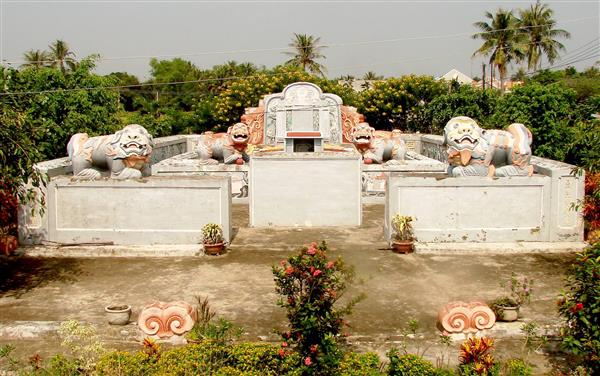
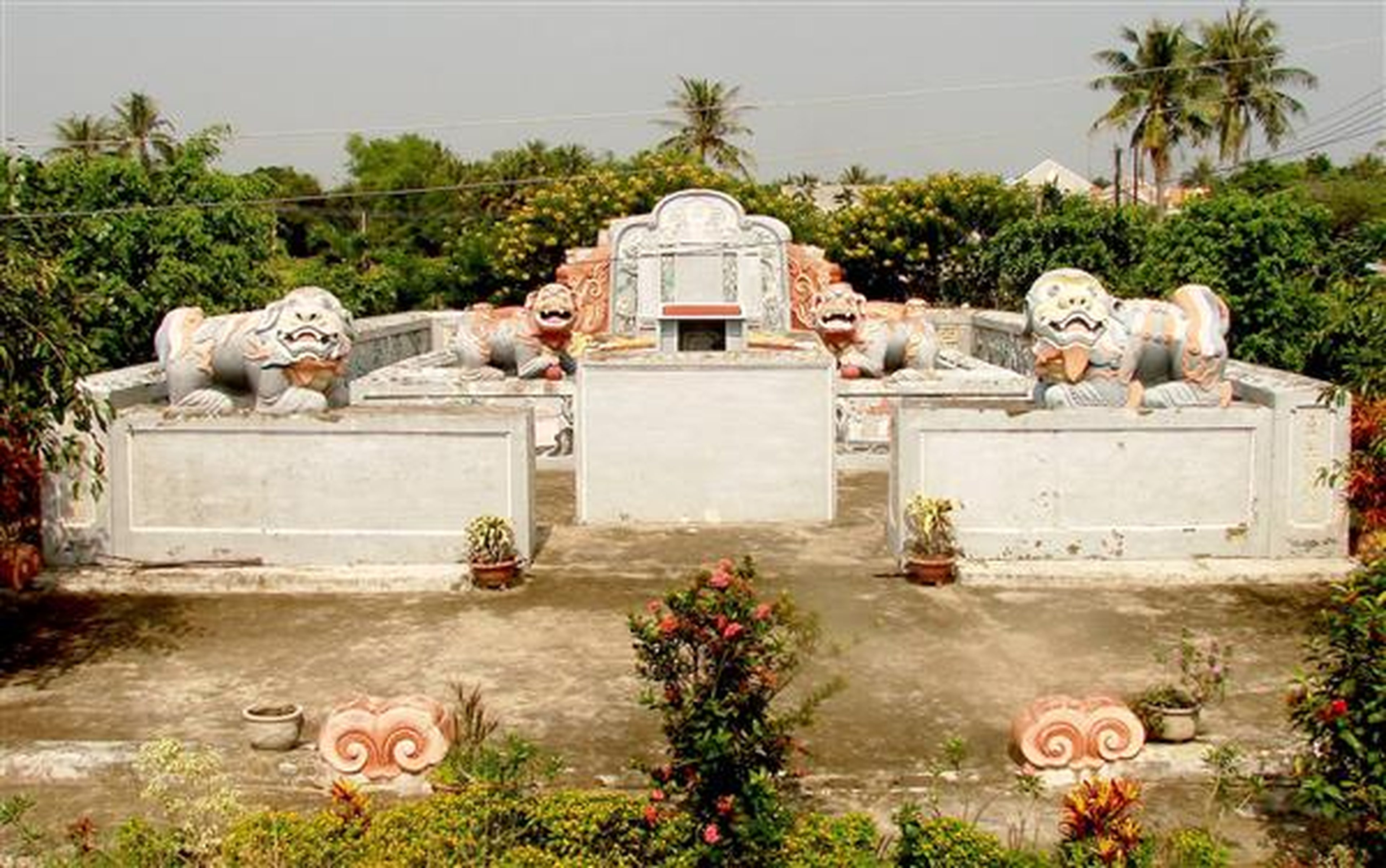
Ba Vu Mausoleum (also known as Nhu Mau Mausoleum) is located in Ninh Hoa ward, Khanh Hoa province.
Ba Vu Mausoleum is the burial site of the woman who helped Lord Nguyen Phuc Anh (later Emperor Gia Long) through difficult times during the conflicts with the Tay Son dynasty. The structure was commissioned by the Emperor in the style of a royal mausoleum to express his gratitude, hence the local designation of the site as a 'mausoleum'.
Tracing back history, from 1775 onwards, Khanh Hoa was a land frequently caught in disputes between the Tay Son army and the Nguyen Lord's army. The book Dai Nam Thuc Luc[1] of the Nguyen Dynasty's National History Institute records: Nguyen Anh led troops to attack and occupy Binh Khang prefecture (modern-day Khanh Hoa) five times, and in all those instances, Nguyen Anh was defeated and scattered by the Tay Son army, forced to flee in every direction, a notable example being the naval battle in the Hon Thi area (1784).
During the conflicts with the Tay Son dynasty, Nguyen Anh suffered many defeats and was forced to retreat with his remaining troops. On one occasion, while fleeing to My Hiep village, his provisions ran out and he fell ill; his soldiers were both starving and exhausted—the situation was extremely dire. In the dark of night, Nguyen Anh and his entourage knocked on a villager's door to ask for a bowl of rice to stave off hunger. The host (traditionally said to be Mrs. Truong Thi Tiem) was moved by compassion and invited Nguyen Anh and his entourage to rest in her home. Afterwards, she had her servants slaughter a pig, prepare a meal for everyone, and provided extra provisions for their journey. Specifically for Nguyen Anh, in addition to providing attentive medical care, she had someone milk a cow for him to drink so he could recover his health quickly. Thanks to her devoted care and kind treatment, Nguyen Anh soon recovered from his illness, and his generals and soldiers gradually regained their health to continue leading the army south.
After Nguyen Anh unified the country, ascended the throne as Emperor, and took the title Gia Long (1802-1819), he remembered the kindness of the woman who had saved him years earlier. The Emperor sent emissaries to My Hiep village to bring the elderly woman to the imperial capital for care. However, when the emissaries arrived, she had already passed away. To show his gratitude, Emperor Gia Long posthumously honored her with the title "Nhu Mau" (Wet Nurse). At the same time, the Emperor ordered the Ministry of Works to send a number of skilled craftsmen, who were building his palaces in the capital at the time, to My Hiep to collaborate with local workers to build a mausoleum for the Wet Nurse following the regulations of royal mausoleums. The mausoleum complex took two years to build, completed from 1802 to 1804. A grand inauguration ceremony was held, presided over by the provincial chief official.
Furthermore, because she had no descendants to maintain the incense and ancestral rites, the Emperor granted land to local relatives to cultivate tax-free, in order to support her death anniversary commemorations (traditionally held on the 16th day of the 12th lunar month). Every year, on the day of her death anniversary, local officials and villagers gather to conduct a very solemn ceremony, with full music and rituals as observed at court mausoleums. Since then, the burning of incense and the rituals at Ba Vu Mausoleum have been performed with the Khanh Hoa provincial official presiding in accordance with the semi-annual spring and autumn rites. Today, the relic management board, along with local authorities and the public, still organize the death anniversary ceremony for Ba Vu on the 16th day of the 12th lunar month each year.
Description of the relic: Ba Vu Mausoleum is situated on a large plot of 1,766 m2 (the tomb itself covers an area of 291m2). In front of the mausoleum is a large open space used for planting flowers and ornamental plants. Farthest to the front is a rectangular pond (262m2 in area). According to ancient beliefs, a site with good positioning requires a pond in front to gather water (i.e., gather blessings) as an 'entryway' element (minh đường), and behind Ba Vu Mausoleum there was once an artificial hill made of soil as a 'rear support' element (hậu chẩm); however, due to various reasons, the artificial hill no longer exists.
The mausoleum faces East, slightly tilted to the North (about 15 degrees), and features a structure consisting of 3 layers of perimeter walls:
- La Thanh (The 1st perimeter wall): Encloses the outer area in a rectangle (dimensions 9.65m x 13.46m), with an entrance 3.62m wide and an average height of 2.0m. On top of the entrance pillars on both sides are two reclining qilins sculpted from lime mortar and painted vividly and delicately. The top of the wall is capped with a rounded molding. The outer surface is plastered with fine mortar, while the inner surface is decorated with historical scenes. On the two front wall corners, there were originally couplets, but the characters have now almost faded. Beneath the two qilins are two raised relief characters for "Phuc" (Blessing).
- Buu Thanh (The 2nd perimeter wall): Rectangular in shape (dimensions 9.43m x 12.3m), 1.385m high, with the entrance facing East (like the La Thanh), 2.97m wide. The top of the wall is also capped with a rounded molding. On both sides of the gate are also two qilins in a pose with one foot resting on a ball. The entire inner and outer surfaces of the Buu Thanh are decorated with panels, relief patterns, and colored plaster scenes.
- Uynh Thanh (The 3rd perimeter wall): The innermost wall enclosing the grave. The Uynh Thanh is oval-shaped, with the top of the wall undulating in a saddle style (higher at the ends, lower in the middle). The wall is shaped to resemble two qilins with their tails entwined, with their two heads lying on top of the gate. The tufts of hair (manes) are spiraled, and the qilin tail tufts are connected to the heads, overlapping the Uynh Thanh wall cap; the wall body is divided into panels with relief floral and scene patterns.
From the outside in, beyond the three aforementioned walls, there are also a spirit screen, a stele base, the grave, and an altar. The unique points that create the value of Ba Vu Mausoleum are the building materials and decorative patterns:
- Materials: The mausoleum was built with traditional mortar using Nguyen-era techniques, commonly referred to by locals as "ancient concrete" or "triple-mix" mortar. Researchers suggest that this compound was created by mixing materials including: coarse sand (grain size up to 10mm), crushed oyster lime, paper pulp, sugarcane molasses, and the resin of the 'boi loi' tree (or crushed bodhi leaves to extract mucilage). The materials are blended in specific proportions, and the durability of the structure depends on the artisan's mixing ratio. Perimeter walls or molded blocks are layered 20-30cm thick, with outer plaster or decorative details 12mm thick. The colors of the details use traditional Hue 'phap lam' (enamel) colors.
- Decorative patterns: The decorative panel motifs and inscriptions are mostly molded on the perimeter walls: La Thanh, Buu Thanh, Uynh Thanh…. The system of panels is spread across the space of each ring surrounding the mausoleum complex. The subjects depicted follow ancient legends such as: The Twenty-Four Filial Exemplars (Lao Lai Zi, Guo Ju, Lu Ji, Jiang Ge, Huang Xiang, Yang Xiang, Zeng Zi, Min Zi Qian...), The Monk Tang Sanzang and his disciples on a pilgrimage, Mountains and Waters with Pine Trees, The Eight Immortals, Pines and Deer, Willow Branches, Pair of Phoenixes in Homage, etc. These scenes reflect the elegant, pure lifestyle of the gentleman and human morality, aiming to express the principle of 'When drinking water, remember its source'.
The larger panels are decorated with stylized 'wan' (swastika) patterns or vine motifs. In particular, in the altar area, the decorative motifs are expressed in great detail. This is considered the throne for worship and is also the focal point of the mausoleum complex. In addition to the decorative patterns, there is a stone stele with Han-Nom characters praising the virtues of the Wet Nurse.
The decorative art at Ba Vu Mausoleum has achieved completeness, from the overall structure to the decorative motifs. The system of lines and masses reflects unity and a tight composition within a limited space, featuring primary and secondary masses, with areas for visual rest, creating a harmonious and symmetrical whole. Artisans skillfully used shapes and lines directed inward in every panel detail, as well as the placement of the qilins at the La Thanh, Buu Thanh, or the dual dragons at the Uynh Thanh... This creates an aesthetically effective composition, bringing a sense of warmth to the mausoleum complex.
In summary, from the building materials to the decorative art at Ba Vu Mausoleum, the site expresses deep cultural significance and humanistic values, meant to honor the woman who contributed effort and wealth to help Lord Nguyen Phuc Anh in his time of need. That Nguyen dynasty architectural style naturally inherits from previous eras; according to Nguyen Huu Thong, the formative art of the Nguyen Lord era in its early stage reflects Le dynasty art in aspects such as materials, techniques, and shaping. Mausoleum architecture also appeared with structures leaning towards solid, robust, and even coarse, thick volumes in the style of the Le dynasty[2].
Ba Vu Mausoleum is a cultural heritage site ranked by the Ministry of Culture and Information (now the Ministry of Culture, Sports and Tourism) as a National Historical and Cultural Relic in Decision No. 05/1999-QD-BVHTT dated February 12, 1999, under the category of architectural and artistic monuments. The relic not only holds significance in the moral principle of 'When drinking water, remember its source' but also carries immense value in terms of architectural art, reflecting the talent of the artisans under the Nguyen dynasty more than two centuries ago.
Some images of the architectural and artistic details of Ba Vu Mausoleum:


[1] Nguyen Dynasty National History Institute (2007), Dai Nam Thuc Luc, Education Publishing House, Hanoi.
[2] Nguyen Huu Thong (Editor-in-chief) (2014), op. cit., p.32.
Source: https://disanvanhoa.khanhhoa.vn/