



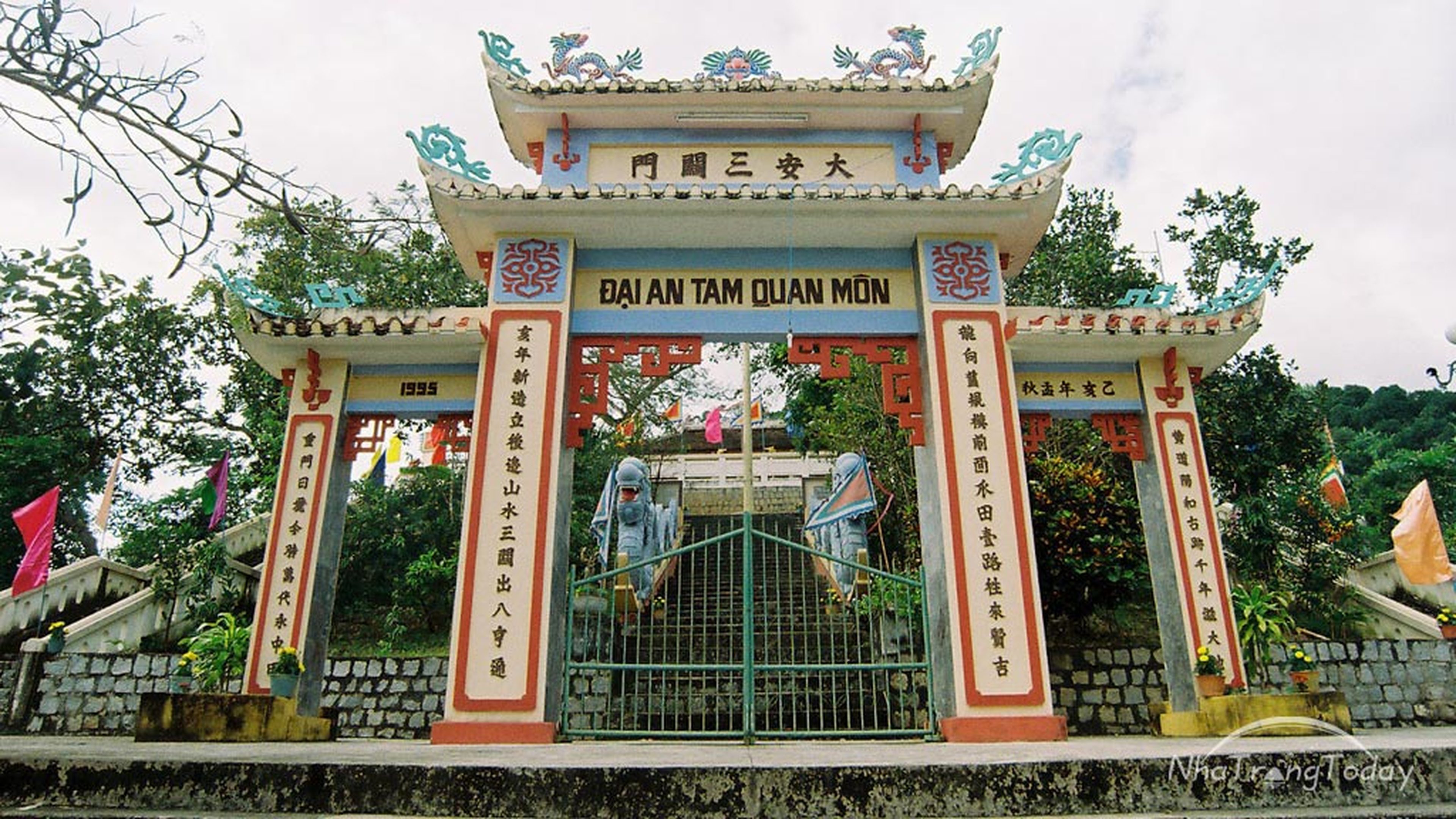
Almost every visitor who sets foot in the coastal city of Nha Trang is familiar with the image of the towering fired-brick towers of the Po Nagar Cham Towers relic site located by the mouth of the Cai River. However, not everyone knows that to fully and deeply understand the origin of the worship of the Holy Mother Thien Y A Na in this "Land of Agarwood," travelers should embark on a journey inland to the space of Am Chua Dien Khanh. If the Po Nagar Towers are a famous, bustling tourist destination right in the heart of the city, Am Chua holds a completely different rhythm: less noisy, carrying the colors of an authentic pilgrimage, and closely linked to the sacred mountain forest space of ancient Khanh Hoa.
Am Chua nestles on the hillside of Dai An Mountain (also known as Chua Mountain) in Dien Dien Commune, Dien Khanh District. According to local historical and folk culture documents, this is the sacred site associated with the legend of the incarnation and manifestation of the Holy Mother Thien Y A Na—the Mother Goddess of the land revered by both the Vietnamese and Cham people. This relic is a vivid testament to the long-standing cultural exchange and integration between the Cham and Vietnamese ethnic groups in the history of the South Central Coast. This is an ideal destination for those seeking a true moment of spiritual quietude, far removed from the bustle of tourist-filled beaches; however, you must remember that Am Chua is first and foremost a solemn place of worship, not a mere sightseeing spot for entertainment and photography.
Profound cultural intersection under the mossy roof
The figure of the Holy Mother Thien Y A Na holds a supreme position and has a profound influence on the spiritual life of the people of Khanh Hoa. The roots of this belief stem from the Goddess Po Nagar—the Mother Goddess of the land, who created the earth and rice, and taught the Cham people how to farm and weave. When the Vietnamese migrated south to settle, they embraced this goddess with deep reverence, "Vietnamized" the legends, and incorporated her into the Vietnamese system of Mother Goddess worship (Tam Phu and Tu Phu). Therefore, when you step onto the stone steps of Am Chua, you are not just visiting an ancient temple; you are standing on a vivid slice of cultural history where the Cham and Vietnamese spiritual currents merge into one.
The unique geography of Dai An Mountain creates a major difference in the spiritual experience at Am Chua compared to the Po Nagar Towers. The path leading up to the shrine is small, winding through stone steps, shaded by ancient trees, and filled with the chirping of birds, giving one the feeling of gradually shedding the dust and worries of urban life to step into a world of nature and serenity. As you pass through the weathered gate, you should consciously slow your pace. The space dedicated to the Mother Goddess at Am Chua features traditional architectural characteristics with several small shrines connected to each other; the scent of incense, present year-round, mingles with the mountain breeze, creating an atmosphere of absolute solemnity and stillness.
An ideal time for a slow-paced visit
Every year, the Am Chua Festival is held solemnly at the beginning of the 3rd lunar month. It is considered one of the largest and most grand folk festivals in Khanh Hoa province, attracting tens of thousands of pilgrims from across the Central and Central Highlands provinces who come to offer incense and attend the festivities. Throughout the festival days, the space at Am Chua becomes vibrant with traditional ritual ceremonies, female officiant rites, flower offerings, and especially the *hat van* (spiritual singing) and trance dancing performances dedicated to the Mother Goddess, which take place continuously from morning to night.
Suggested times to visit Am Chua:
-
If you want to experience living culture: Go between the 1st and 3rd day of the 3rd lunar month (Main festival season).
-
If you are looking for peaceful quiet: Go on regular weekdays, avoiding full moon days or the first day of the lunar month.
If you are a cultural researcher or want to immerse yourself in the vibrant faith of the community, visiting during the festival will provide very powerful visual and emotional experiences. However, going during the festival also means you must accept crowded conditions and the need for extremely careful behavior so as not to disrupt the ritual delegations. Conversely, if your goal is to find a moment of meditative silence, wish to leisurely observe the details of the ancient architecture, read the horizontal lacquered boards and parallel sentences, and understand more deeply the legend of Thien Y A Na, choose to visit Am Chua on a regular weekday. At that time, the small shrine appears at its most rustic, quiet, and authentic—perfect for souls who like to slow down and listen.
Setting up a cultural itinerary for the Dien Khanh region
To keep your trip to Am Chua from being monotonous, you can design a half-day itinerary entitled "Dien Khanh—slower than Nha Trang." The land of Dien Khanh is an ancient citadel area that still preserves many historical and cultural traces of inland Khanh Hoa:
-
8:00 - 9:30: Travel from Nha Trang to Dien Khanh, walk up Dai An Mountain to visit Am Chua, and view the panorama of the Dien Dien fields from above.
-
10:00 - 11:00: Visit the Dien Khanh Temple of Literature—a symbol of the tradition of study and scholarly success in this land of agarwood.
-
11:15 - 12:00: Stroll leisurely around the Dien Khanh Ancient Citadel area, observing the ancient earthen ramparts and the city gate with its characteristic Vauban architecture.
-
12:30: Enjoy a local lunch with the famous Dien Khanh steamed rice rolls (*banh uot*) along the highway.