


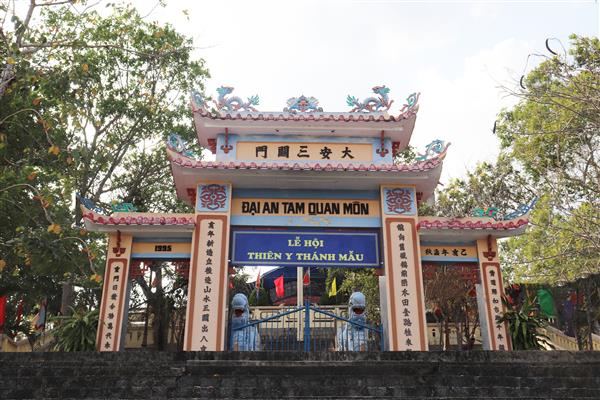
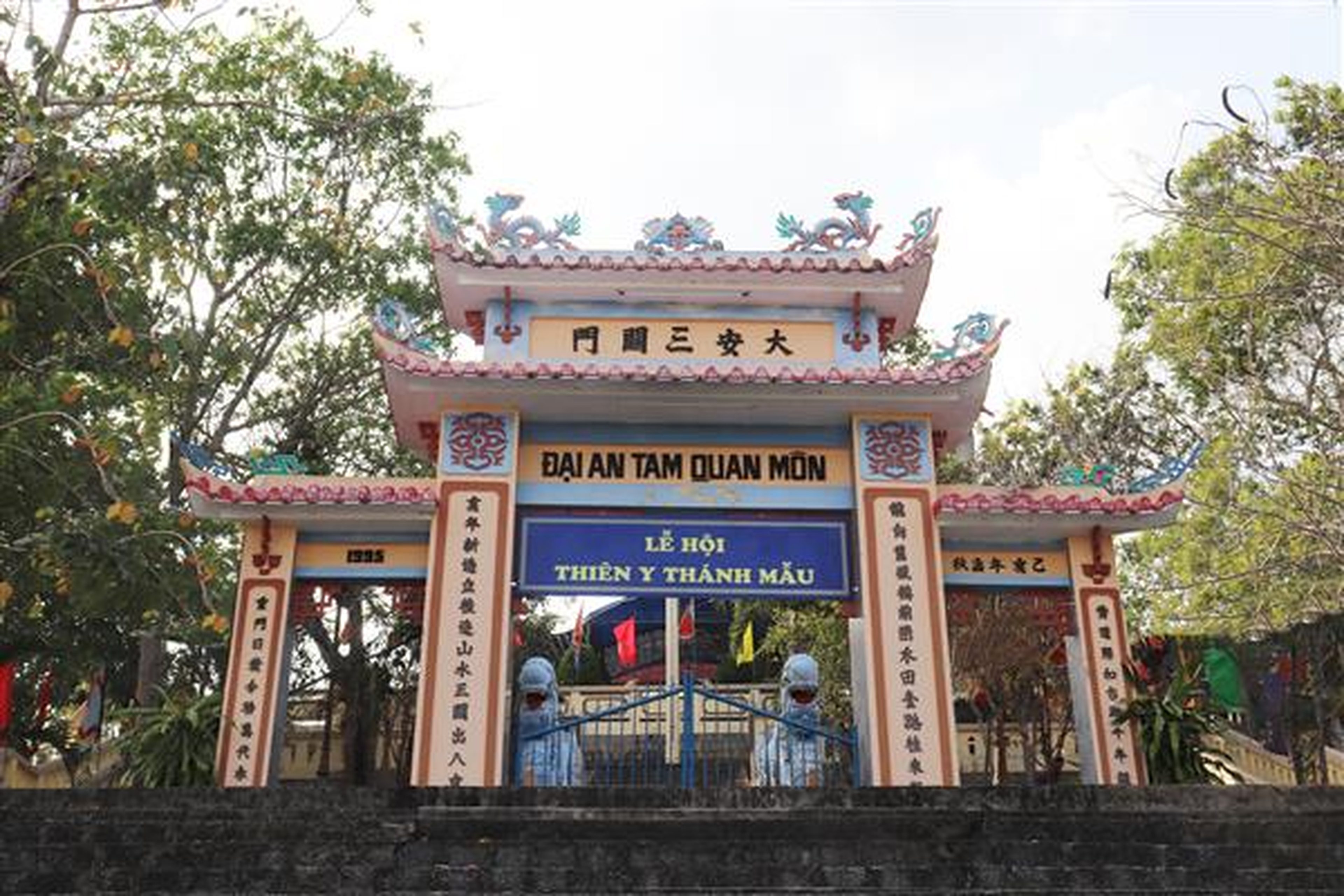
Am Chua is a religious architectural site dedicated to the worship of Thien Y A Na by the Vietnamese people, whose origins trace back to a Cham goddess named Po Inu Nugar (also known as Po Nagar), who is worshipped at the Po Nagar Cham temple. The Vietnamese refer to Her by many titles: Ba Chua Tien, Ba Chua Ngoc, Thien Y A Na Dien Ngoc Phi, Chua Ngoc Dien Phi, and Chua Ngoc Tien Nuong (Chua Tien). However, the name 'Thien Y A Na' is the most familiar and commonly used by the people, 'as the name Thien Y A Na is essentially a phonetic transcription of Po Inu Negara'.

Am Chua is located on Dai An Mountain, also known as Qua Son (Qua Lanh, Chua Mountain, Cam Mountain), though the name Dai An has been the most common throughout history. Chua Mountain is an earthen mountain reaching a height of 284 meters, with Am Chua situated halfway up the mountain at an altitude of 80 meters above sea level, within the territory of Dai Dien Trung 3 village, Dien Dien commune, Khanh Hoa province.
The Dai Nam Nhat Thong Chi (Comprehensive Treatise on Unified Great Nam) records: “Dai Dien Mountain: located 11 miles north of Phuoc Dien district, commonly called the principal mountain, with a massive scale and a circumference of over a hundred miles. It is rumored that this is the place where Thien Y A Na Dien Ba manifested her divinity; people were forbidden from entering the mountain to gather firewood, the trees were dense, and sacred light often shone down. In the 3rd year of Tu Duc, the name was changed to the current one and it was recorded in the registry of worship sites.”[2]. The entire landscape and topography of Am Chua are truly poetic and conform to feng shui principles, with the terrain configuration of 'water in front, mountain behind.' Standing at Am Chua, one feels as though they have escaped the mundane world, feeling grateful to our ancestors for skillfully choosing this place to worship the Holy Mother Thien Y, a site revered across the South Central Coast and Central Highlands on land that is both fertile and steeped in history.
To date, there are no documents specifying the exact time Am Chua was built; however, according to local elders, Am Chua began as a small thatched hut located alongside the Dai An Son Tu (Dai An Pagoda) on Hoa Mountain. After many restorations, the hut became the spacious temple for worshipping the Holy Mother Thien Y as it is today. Although the small temple named Dai An no longer exists, the fusion of the Mother Goddess worship tradition and Buddhist rituals remains intact and is a distinctive cultural feature of Am Chua.
According to ancient beliefs when building communal houses, shrines, and temples, much attention was paid to feng shui. The selection of feng shui elements for the construction of a temple complex is equivalent to choosing a location with 'favorable' terrain and surroundings. Regarding the orientation of Am Chua, the Vietnamese turned the main entrance to the True East for the site worshipping Thien Y A Na, a feature similar to the Po Nagar Cham Tower. Does this suggest that the Vietnamese greatly desired to harmonize their culture with that of the Cham, or more precisely, with a Cham goddess adopted by the Vietnamese? Both face True East to receive direct sunlight, rather than South, which in the Vietnamese concept is the direction of vital energy.
The main tower dedicated to Thien Y A Na at Po Nagar Cham Tower is located to the north, and Am Chua was also built in the northern area of Dien Dien. Ancient Dai An village had four Dai Dien hamlets in the East, West, South, and Central directions; the North was occupied by Dai An Mountain. Thus, together with the four Dai Dien hamlets, Dai An Mountain—the site for worshipping Thien Y A Na—created the configuration of the Five Elements for the land of Dien Dien commune.
The system of worship architecture at Am Chua shares many similarities with the architecture of communal houses in Khanh Hoa. The structural layout involves the collective worship and ritual offerings similar to other religious architectural works in the province, which is a characteristic of the religious life of the people of Khanh Hoa. The architectural structures at Am Chua include the Triple Gate (Tam Quan), the tomb of the Tieu couple, stone stelae, the Son Lam shrine, the Five Elements (Ngu Hanh) shrine, and the main sanctuary.

The main sanctuary underwent its third restoration in the Year of the Earth Dog (1958), the fourth in the Year of the Earth Dragon (1988), and a major restoration in the Year of the Earth Ox (2009), featuring a three-bay architectural style. If viewed only from the outside, Am Chua might not appear to be an ancient relic, but upon entering, pilgrims are immediately captivated by the interior altar system, with sophisticated and exquisitely carved processional palanquins, parallel sentences, and horizontal lacquered boards.
The first altar is the incense table dedicated to the spirits of the Tieu couple. The altar of the Holy Mother Thien Y is magnificently decorated and serves as the focal point of the interior architecture; on either side are the altars for the Six Fairy Maidens and the Twelve Fairy Maidens. To the left of the Mother Goddess altar is the altar for the Four Princes and the Twelve Commanders, also known as the altar of the Princes (Prince Tri - the Mother Goddess's son); to the right is the altar of the Six Fairy Maidens and the Twelve Fairy Maidens, also known as the altar of the Princesses (Princess Quy - the Mother Goddess's daughter). All altars in the main sanctuary are made of precious wood and feature delicate and distinctive carvings. The entire main sanctuary utilizes a roof structure with trusses, and the main columns are made of high-value precious timber. Am Chua also preserves two royal edicts bestowed by the Nguyen dynasty emperors.
According to folk belief, the third lunar month is the month of the Mother Goddess's death anniversary—'The eighth month for the Father, the third month for the Mother.' The Am Chua Festival takes place from the 1st to the 3rd day of the third lunar month every year and follows a traditional sequence: the ritual of bathing the statue (Moc Duc), the triple offering ritual, the main ritual, Mother Goddess hymns (Hat Van), female officials' ritual, the post-festival offering, and incense offering and spirit dance rituals.
In the past, 'during the spring and autumn sacrificial occasions at Am Chua, the provincial governor was responsible for organizing and presiding over the ceremonies in a very solemn manner as prescribed by the imperial court. This further confirms the position of the Thien Y A Na cult in the spiritual life of the local people, carrying ethnic cultural elements from the past as well as in the present in Khanh Hoa, which are very profound'.[3]. This further confirms the immense role of Am Chua in the system of relics and the worship of Thien Y A Na.
Coming to Am Chua, besides their faith in the Holy Mother, pilgrims can also learn about the indomitable struggle of the people of the four Dai Dien hamlets during the resistance against the French. Due to its strategic position, with easily controlled terrain in front and rugged mountains behind, in 1947, the French colonialists built a defensive system right at Am Chua, including many solid bunkers, each side 20m long with 3m high walls, backing against the mountain. Behind the walls were surface tunnels, inside which machine gun nests and embrasures were placed with convenient sightlines for observation. In the middle of the fortification was an underground bunker structured in a circle. Consequently, during this period, Am Chua was devastated by war, with only the Mother Goddess statue remaining intact, which made the local people believe even more firmly in her sanctity, a belief passed down to this day.
Due to historical conditions, the migration process of the Vietnamese following the Nguyen Lords from the central provinces of Vietnam to expand territory to the South took place over several centuries, creating the S-shaped country of Vietnam as it is today. The Vietnamese were present almost everywhere and quickly localized the culture of other ethnic groups, which in Khanh Hoa specifically meant the Cham cultural elements. Continuing the Vietnamese cultural tradition with a selective adoption of Cham cultural essence has created a unique and distinct cultural identity for the Vietnamese people of the land of Agarwood.
It is not a coincidence that the Po Nagar Tower and Am Chua became the two most important Mother Goddess worship sites in the province. Each site contains distinct tangible and intangible values, yet they are inextricably linked. This is expressed through the objects of worship, ritual practices, folk legends, offerings, and religious customs of the Vietnamese in Khanh Hoa.
According to Vietnamese legends, the day the Mother Goddess descended to earth at Am Chua is the 1st day of the 3rd lunar month, and the day she ascended back to heaven at the Po Nagar Tower is the 23rd day of the 3rd lunar month. The sites of the Mother Goddess's manifestations and her ascension are two exceptionally important sites for both the Vietnamese and the Cham. However, to fit their own cultural and religious life, the Vietnamese 'Vietnamized' many cultural elements as well as the objects of Cham worship; it is this cultural assimilation that creates the diversity of cultural nuances at the Po Nagar Tower. The Am Chua relic, meanwhile, was built by the Vietnamese to worship Mother Thien Y, so the cultural and religious elements and the objects of worship here are purely Vietnamese. But they meet in the consciousness of worshipping the Mother—Mother Thien Y A Na, the protector of the people of Khanh Hoa; the Mother worship activities of the Vietnamese and Cham at the two sites create a distinctive culture with strong and lasting vitality.
Through legends and folk stories to the worship itself, which demonstrates a continuous connection in culture and religion, Am Chua carries within it the values of both Cham and Vietnamese cultures. Although there are different imprints, it must be affirmed that the figure of Thien Y A Na is a Vietnamese creation, with roots in the figure of Po Nagar of the Cham people, and both originate from the figure embodying the mother who created all things.
Am Chua is a typical cultural heritage site, reflecting the mentality, social relations, perception of the natural world, and the creation of values in folk literature and art. To this day, Am Chua still preserves typical traditional Vietnamese-Cham cultural elements. The harmony between Vietnamese and Cham deities is most clearly expressed in the Am Chua Festival, a fusion between two spiritual cultures that have been almost unified. This speaks to the integrative capacity and the tolerant, open attitude of the ancient Vietnamese in Khanh Hoa in receiving the essence of other cultures; as the folk saying goes: 'Am Chua reveals the Human, Po Nagar reveals the Saint'.
With its tangible and intangible cultural values, in 1999, Am Chua was classified by the State as a National Historical and Cultural Relic.
Source: https://disanvanhoa.khanhhoa.vn/vi-vn/disan-vanhoa/disanvanhoa/AM%20CH%C3%9AA-26