



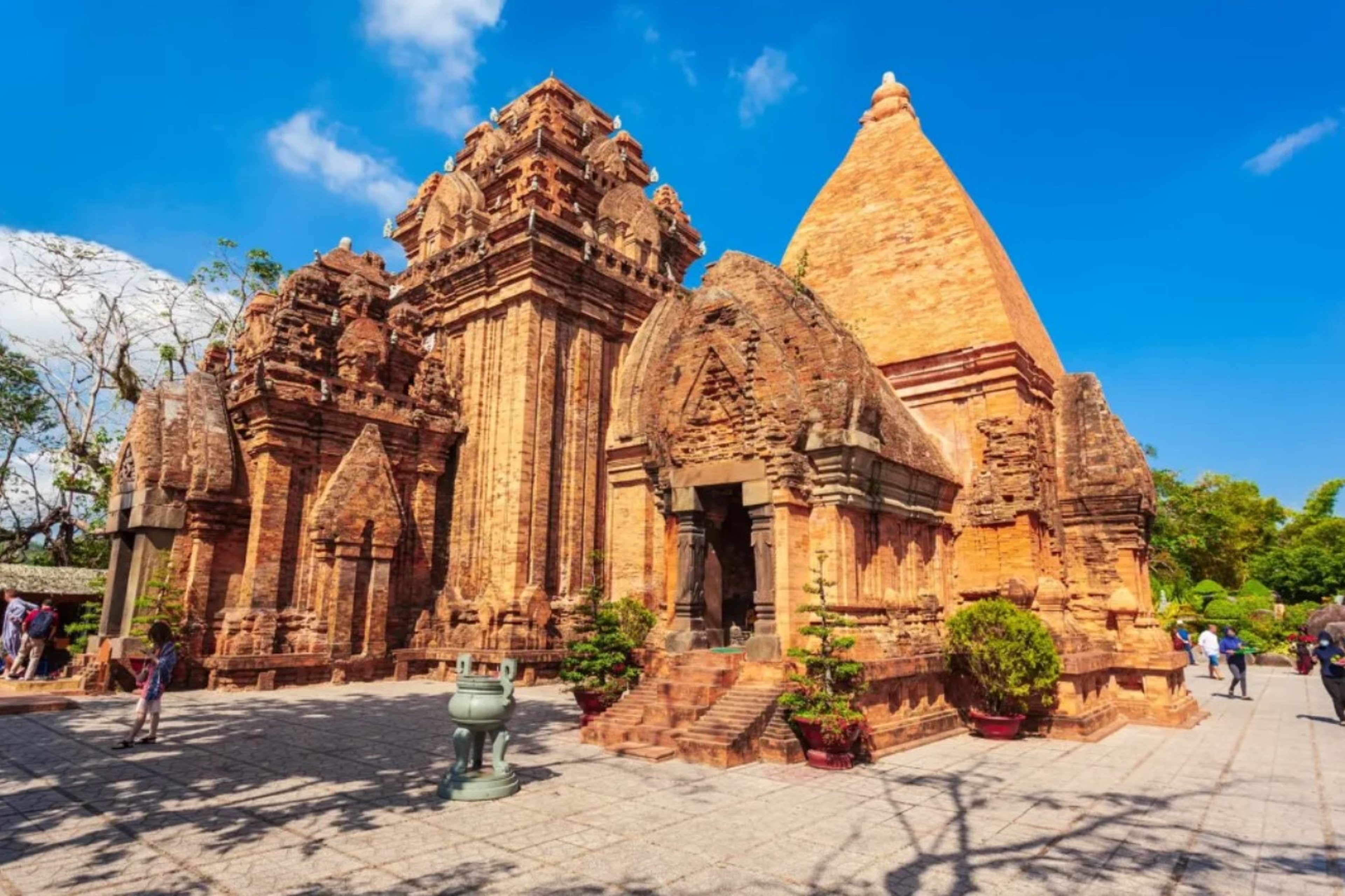
There is a very special experience for those who love to observe history through baked brick structures: start from the top of Cu Hill by the Cai River in Nha Trang, then leisurely move along the national highway towards the south. On that journey, you will pass through two ancient Cham tower clusters — Po Nagar Tower and Hoa Lai Tower. Previously, these two landmarks belonged to two different provinces, but now, in an expanded tourism map of Khanh Hoa, they have suddenly become two perfect nodes on a journey to understand the flow of Champa architectural art.
The first stop is Po Nagar Tower, a tower that is all too familiar with the identity of Nha Trang city. Built between the 8th and 13th centuries, this tower cluster is a symbol of the peak period of the ancient kingdom. Standing at the foot of the tower, the first thing that strikes you is not its grandeur, but the vibrant red of the weathered baked bricks standing out against the blue sky. The reliefs carved with images of the god Shiva and graceful Apsara dancers right on the brick surface are what make people stop and observe for a long time. The binding and brick-firing techniques of the ancient Cham people remain a mystery to modern science to this day, and it is this mystery that creates the enduring attraction of Po Nagar.
From the tower by the river mouth to the tower cluster in the countryside
If Po Nagar Tower brings a vibrant feeling because it is located right in the heart of the city, Hoa Lai Tower (in the former Ninh Thuan region) carries a completely different rhythm: solemn, solitary, and more original. The Hoa Lai tower cluster has been dated by archaeologists to the 9th century, which is equivalent to or even earlier than some parts of Po Nagar. The name of this tower cluster has even been given to a distinct architectural style in the history of Champa art — the Hoa Lai style.
When you arrive at Hoa Lai, you will not encounter noisy tour groups. The tower stands there amidst the countryside, swept by the winds of the Central region. The biggest difference lies in the decorative details of the arched doorways, the pilasters on the walls, and the moldings that were carved extremely delicately but have been partially eroded by wind and sand. If at Po Nagar, one sees a continuous succession of Cham-Viet cultural layers through the worship of Thien Y A Na, then at Hoa Lai, you will encounter history in its purest state, a heritage standing silently through time to tell of a prosperous era that has passed.
A guide for traveling and sightseeing for the slow traveler
To fully complete this heritage route, you should set aside a full day. Start at Po Nagar Tower early in the morning, around 7:30 AM, when the sunlight is just bright enough to clearly reveal the architectural angles and the air is still cool. After visiting Po Nagar, you can leisurely travel along the coastal route or National Highway 1A towards the south.
Suggested one-day itinerary following the traces of baked bricks:
-
7:30 - 9:00: Visit Po Nagar Tower (Nha Trang).
-
9:30 - 11:30: Travel towards Phan Rang.
-
13:30 - 15:00: Visit the Hoa Lai Tower cluster by the side of the national highway.
-
15:30: Continue the journey towards Po Klong Garai Tower to see the complete development of Cham architecture.
Appropriate attire for this trip is neat, modest clothing as both locations are sacred heritage sites. Bring a wide-brimmed hat and drinking water, because the weather in the South Central region is always sunny. When taking photos, prioritize capturing angles from the side to see the relief of the brick layers and the decorative details carved on the tower walls.
Reading history through the spacing of the bricks
Placing Po Nagar and Hoa Lai together on the same journey gives visitors a very interesting comparative perspective. You will realize that architectural art is not a static quantity; it shifts and transforms through the centuries. From the rustic, raw lines initially seen at Hoa Lai to the delicate, complex work at Po Nagar, every baked brick is a testament to the talented hands of the ancient craftsmen.
This journey is not for those who like to check in quickly just for quantity. It requires a slow pace, a readiness to listen, and proper respect for the cultural values that have overcome a thousand years of storms to remain with us today.